Understanding What’s Behind The Murals In Kaka‘ako
Graffiti art does more than deface walls. It challenges gentrification itself.
January 19, 2026 · 7 min read

About the Author
On any given day, you can take a walking tour of Kaka‘ako’s open-air gallery, marvel at the murals coloring the nine-block neighborhood. Known as “Our Kaka‘ako,” the area offers some of Honolulu’s most exciting experiences, from unique dining to lively social gatherings.
For the past 15 years, Our Kaka‘ako has championed core values such as kaiāulu (community), makakū (creativity), and mo‘omeheu (culture). Its most popular murals share moʻolelo (stories) passed down from Hawaiian ancestors. They show to the world that Hawaiʻi, too, has an art scene.
But for all their cultural significance, these murals mark a shift in the neighborhood’s identity. For locals who remember Old Kaka‘ako, they signal gentrification, covering up a long pattern of displacement.
Not so long ago, Kaka‘ako was an industrial hub, lined with warehouses and auto shops where the shopping center and condos now stand. There were no trending bakeries or cute boutiques. Nobody came just to hang out.

Ideas showcases stories, opinion and analysis about Hawaiʻi, from the state’s sharpest thinkers, to stretch our collective thinking about a problem or an issue. Email news@civilbeat.org to submit an idea or an essay.
That changed when landowners set out to rebrand the neighborhood. Their master plan promises to build an “emerging epicenter of progressive urban island living.” But this was not the first wave of gentrification—displacement in Kaka‘ako spans an entire century.
The 29 acres of Kaka‘ako are owned by Kamehameha Schools, a private trust established by the will of Princess Bernice Pauahi Bishop, the great-granddaughter of King Kamehameha I. Upon her passing in 1887, the princess gifted 363,000 acres of ancestral land — including Kakaʻako — to Native Hawaiians, intended for education.
True to her wishes, the land served her people for a time. Built mostly on landfill, Kaka‘ako was undesirable and largely unused in the early 1900s. Many Native Hawaiians began settling there after the Great Māhele to be closer to economic opportunities in Honolulu.

Hundreds of Hawaiians formed an encampment that became known as Squattersville, which, in the 1920s, was described as “a grand place where they had a wonderful, merry time, all the time.”
Eventually, the government seized the land for its own use and forced the residents out. What was once Squattersville is now Kaka‘ako Makai, a park sitting atop landfill that used to house a thriving community.
Kaka‘ako then turned into an industrial hub with an active harbor and shipyard. The working class made a home there too, living in plantation-style cabins with their own shops, schools, and churches.
The second wave of gentrification hit in the 1940s, when the government planned to industrialize the area further in an effort to “eliminate slums and urban blight.”
By the 1960s, Kamehameha Schools had evicted all its tenants and replaced their old dwellings with new warehouses, ushering in what became Old Kaka‘ako, before the most recent wave of gentrification brought in Our Kaka‘ako.
This history is not breaking news. Scholars and historians have long documented Kaka‘ako’s cycles of displacement, though Kamehameha Schools tells a very different story.
Recent Developments
Claiming to “honor Kaka‘ako’s history while moving forward with development,” their official narrative omits any mention of displacement, including the well-documented Squattersville. The omission feels deliberate, as if erasing the past makes the present easier to justify.
With recent developments, the erasure was felt keenly in the street art community. To outsiders, graffiti may seem childish, mere property destruction. But more than that, it carries deeper significance as a direct challenge to gentrification itself.
Historically, graffiti symbolizes anti-establishment and rebellion. Real estate investors equate it with crime and poverty, and its presence can lower property values. Naturally, it should never exist near a Whole Foods.
Rich Oania-Elam, 38, known as Tonk, is a local graffiti artist who has witnessed Hawaiʻi’s street art scene before and after gentrification.
Born and raised on Oʻahu, he has been active since 2001 and has established himself as one of the islands’ leading street artists. Having started in illegal graffiti, Tonk has since gone public, exhibiting at pop-up galleries and selling his work at night markets.
His iconic cartoon head, flaunting its mischievous grin and flared nostril, can still be seen across traffic signs and utility boxes throughout the island. He recalls a time in Kaka‘ako when the street walls served as unofficial canvases for graffiti artists.
Historically, graffiti symbolizes anti-establishment and rebellion.
For years, artists openly layered their work on the walls, painting over old pieces with new ones. Layer upon layer of graffiti accumulated until a muralist was hired to permanently claim the wall with commissioned art.
“Years of (graffiti) history, erased just like that,” Tonk laments.
Though he acknowledges the loss, Tonk remains ambivalent about gentrification, recognizing it as inevitable for the future. He admits that he once resisted how these changes reshaped the graffiti community, but now sees the murals as part of a growing movement.
“Illegal graffiti has improved because of them,” he says. “When there are nice murals, street artists need to step it up. Both coexist and feed off of each other.” For Tonk, the murals ultimately strengthen Hawaiʻi’s art scene.
Still, the symbolism behind graffiti remains sacred, particularly to BIKEFACTORY, a local business that challenges gentrification through street art.
Founded in 1974, the family-owned bike shop traces its humble beginnings to Old Kaka‘ako, where it operated alongside warehouses for nearly three decades. While respected within the community, even they were not immune to gentrification.
Owner Mitch Parcels, 44, had trepidations about operating his business in Our Kaka‘ako. The land, still owned by Kamehameha Schools, could be reclaimed at any time, and his lease included a clause requiring tenants to vacate with six months’ notice.
“It’s their land,” Parcels says. “They can do what they want.”
According to Parcels, multiple businesses in Our Kaka‘ako were asked to leave under this clause, though enforcement was inconsistent. After receiving their notice, some tenants were later told they could stay without a clear timeline.
The uncertainty itself became a pressure tactic. Unsure how long they could continue operating, businesses chose to leave on their own in search of stability. BIKEFACTORY, which had occupied its Kaka‘ako space since the mid-1990s, was among those pushed to secure a future elsewhere.
Parcels eventually purchased his own storefront during the pandemic. His new shop opened in May 2025 at the corner of South King and McCully Street, finally free from the uncertainty imposed by Kamehameha Schools.
Parcels describes himself as someone who does not fit into the system. To him, art represents the person choosing it, like tattoos on a body. He wanted the art for his shop to reflect exactly that.
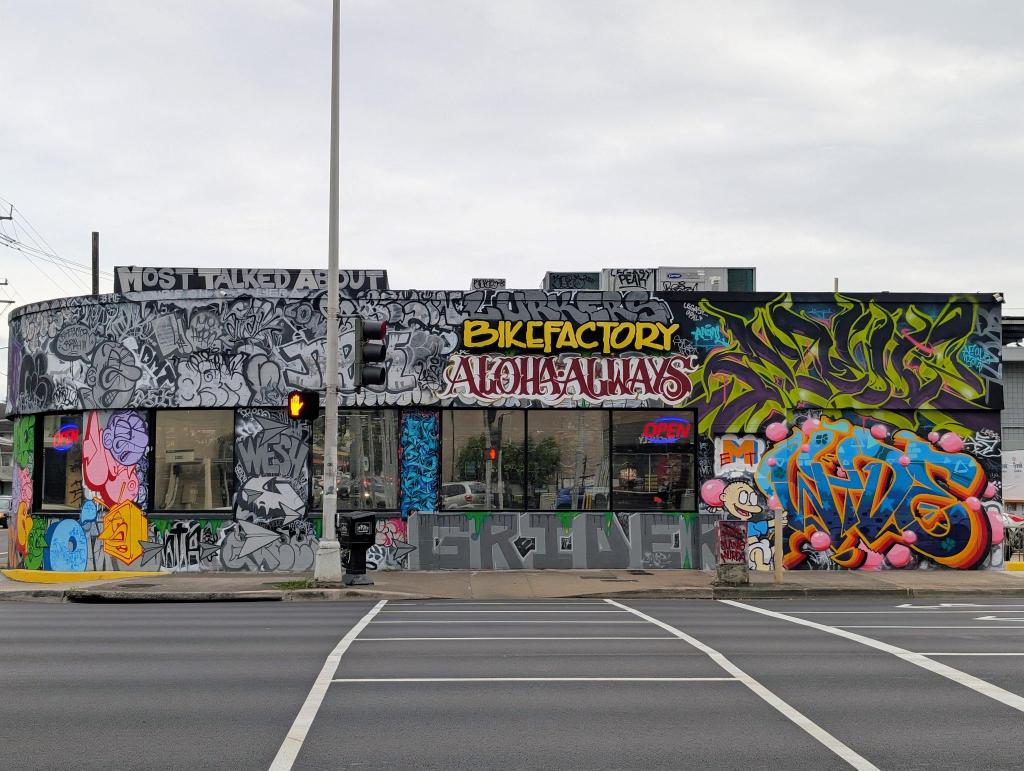
Before BIKEFACTORY, the space housed a high-end Japanese restaurant, which Parcels painted completely black, despite complaints from the neighborhood. For the exterior, he commissioned a group of illegal graffiti artists to “trick out” the building.
Within weeks, a collection of Hawai‘i’s best graffiti art emerged across the walls of the new BIKEFACTORY location, including a piece by Tonk. Some of the featured artists are known for leaving work on uncanny surfaces, even rappelling off buildings to do so. They are considered Hawai‘i’s “most wanted vandals,” embodying the rebellious spirit of graffiti art.
“In a world of control, these people are uncontrollable,” Parcels comments.
These so-called vandals paint more than just graffiti art. Every piece is an act of defiance, a reminder to question and challenge those who control the narrative; to reconcile with Kaka‘ako’s layered past; to tell their story honestly.
Gentrification should not erase the past the way it erased Kaka‘ako’s graffiti walls.
The next time you are in McCully, seek out the graffiti at BIKEFACTORY by Hawai‘i’s most wanted artists, curated by a business owner pushed out of Our Kaka‘ako. It is a quiet form of resistance, asserting its right to exist even if some want it gone. Gentrification may be inevitable, but so is the art that refuses to comply.
 Sign up for our FREE morning newsletter and face each day more informed.
Community Voices aims to encourage broad discussion on many topics of community interest. It’s kind of a cross between Letters to the Editor and op-eds. This is your space to talk about important issues or interesting people who are making a difference in our world. Column lengths should be no more than 800 words and we need a photo of the author and a bio. We welcome video commentary and other multimedia formats. Send to news@civilbeat.org. The opinions and information expressed in Community Voices are solely those of the authors and not Civil Beat.

Local reporting when you need it most
Support timely, accurate, independent journalism.
Honolulu Civil Beat is a nonprofit organization, and your donation helps us produce local reporting that serves all of Hawaii.
ContributeAbout the Author