A Reporter's Work Exposing Corruption Has Helped Shape Hawaiʻi Public Policy
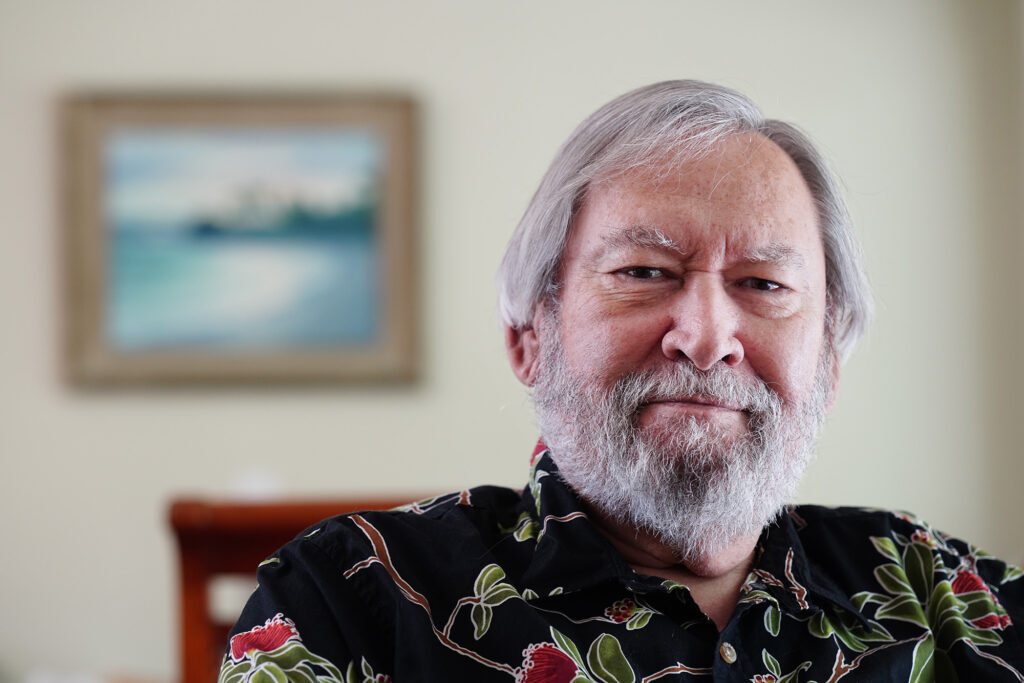
Longtime investigative reporter Ian Lind has been helping guide public policy through his good-government work and by ferreting out abuse of the public trust.
February 22, 2026 · 9 min read

About the Author

For years, Ian Lind has been one of the best investigative reporters in Hawaiʻi. An amazing life made even more amazing by the path he’s taken to get there.
Lind describes this path as “accidental” and “meandering.” He’s right.
I am going to tell his story two different ways. One traces this path by looking at how he became an investigative journalist in the first place. The other takes two developments about 50 years apart from each other that bookend Lind’s career.
The early one is Kahoʻolawe where Lind, a Native Hawaiian, was part of that first small group that occupied the island 50 years ago almost to the day.
The other story is Michael Miske, whom Lind has been writing about for more than seven years.

His path to reporting: For the first few years after he returned to his birthplace Hawai‘i as a 1969 Whitman College graduate, he was an anti-war activist and grad student.
In 1973 he went to work for the Quaker organization American Friends Service Committee. One project job was to find where nuclear weapons were stored in Hawaiʻi, which of course the military would neither confirm nor deny.
Lind began by searching government documents that stated the specs for a nuclear storage facility, then found the actual sites by hanging out of a small plane taking pictures and furtively hiking to the places in the photos.
Not your average journalism internship.
He refined those skills working in the mid-’80s as Common Cause’s point person at the Hawaiʻi Legislature.
At that time many journalists covered the State Capitol. Offices were full of experienced reporters willing to talk story with him to help teach him the ropes.
Lind took corruption story ideas from what he found doing his Common Cause work, and in 1990 he started a newsletter, The Hawai‘i Monitor.
The newsletter became so popular that Dave Shapiro, then the Honolulu Star-Bulletin managing editor, offered him a job as an investigative reporter where he worked until 2001 when the newspaper was sold and his position eliminated. He began his blog, ilind.net, in 2000, documenting the transition from the inside.
That’s where most of his investigative reporting appears now, the heart and soul of Lind’s work and an essential source for understanding Hawaiʻi.
Those early old-school influences are still apparent in his blog, but times have changed. Fewer journalists to talk to, less newspaper money for investigative stories.

On the other hand, technology began to make it possible for easy access to material that was hard to find before.
Like documents. Lind loves documents. A “treasure trove” and a “road map,” Lind calls them.
Beginning with his work with Common Cause, Lind has fought for and won broader access to public records, including campaign finance reports. He has gone to court and often writes about the lack of transparency. This is a constant struggle for him.
Kahoʻolawe And The Hawaiian Movement
“It’s amazing how much was set in motion by that first Kahoʻolawe protest,” Lind told me in a lengthy interview for this column. His website has a beautiful collection of photos and commentary about the occupation.
It’s easy to see those nine occupiers as heroes. They were. After all, two died. They are legends.
Lind adds a more complex, human story, though, by showing how by-the-seat-of-the pants this mission was.
A few days before the Kahoʻolawe occupation, Lind got a call from his friend, an activist working on Hawaiian rights issues.
“Hey, there’s this thing landing on Kahoʻolawe. Let’s go. Let’s go,” he recalls the friend saying.
“And I always have to laugh,” Lind says, because at the time Lind’s mother-in-law was staying with him and his wife in their tiny apartment. He didn’t mind the idea of taking a little domestic break.
Lind describes his Kahoʻolawe role as “an accidental participant with a camera.”
The flotilla of small boats heading toward the island were borrowed fishing boats. Near the island the Coast Guard stopped them and threatened to commandeer their boats. The activists realized that if the boats got taken, the fishers would lose their livelihood.
They didn’t know what to do. Until a Maui news reporter in a tiny boat offered to take as many as could fit into hers. So, those nearest that boat, including Lind, clamored aboard.
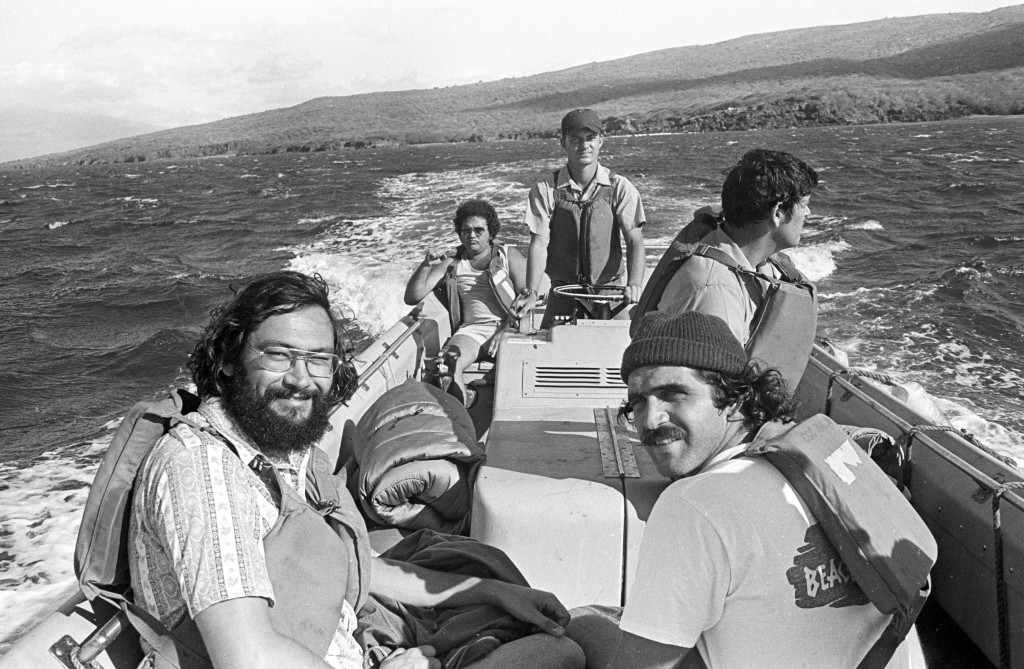
Here’s what you see in Lind’s story that became the foundation of his future work: his willingness to look not just at the big picture but also at the small from the ground-up details, modesty about his role but at the same time a full-on chronicling.
He had the faith. At the same time, he saw the need to document the facts.
When I mentioned to Lind that he didn’t seem to be writing about Native Hawaiian issues as much anymore, he paused, took a deep breath, and admitted that was true.
He’s become discouraged, he said. Too many movement supporters were so driven by what they believed was true that they no longer would consider the facts. In his words, faith rather than facts.
Lind likes to begin his writing not with his opinion but with a document so that readers have some facts before they jump in with their own views, at least to entertain the chance that they’re wrong.
Which is what Lind himself has done regarding Hawaiian issues.
For a long time after Kahoʻolawe, Lind wrote positively about Hawaiian initiatives. But he became troubled by the Hawaiian Kingdom movement and its land title claims.
He searched historical documents, talked to land title experts, and concluded that view was historically baseless.
When he wrote about this in his blog, readers accused him of selling out and not being sensitive to the strong feelings Hawaiians had about losing their land.
Miske And Murder
No one has even come close to covering the Mike Miske crime story as Lind has. He estimates that he’s spent 5,000 hours on Miske.
Lind has published dozens of blog posts and more than 80 stories in Civil Beat alone.

In his Miske work, those Kahoʻolawe roots, his investigative reporter apprenticeship, and his love of documents combine.
“Well, again, it’s one of those accidental things,” he says of his Miske involvement
One day he got a call from an east Honolulu neighborhood activist about some lights on a park tree that someone named Mike Miske had somehow gotten the City Council to put up to honor Miske’s dead son.
“People were freaking out,” he says. “I never heard of Mike Miske. And as soon as I started making calls, you know, people would pull the shades down.”
Lind went to work.
“I did the regular thing. I profiled Miske. I found the business records and looked for contracts and looked for lawsuits and followed the people. I did a records request and I got internal emails from the parks department.”
“So when he was arrested, suddenly I had this whole roadmap of his companies and the people and the family. And I could just start taking bits of that and researching further, looking at criminal records.”
“It’s the kind of story I love,” Lind told me.
“It’s so rich in detail and no one else was looking at these records. And you find these things said in court or in lawsuits that you can’t imagine.”
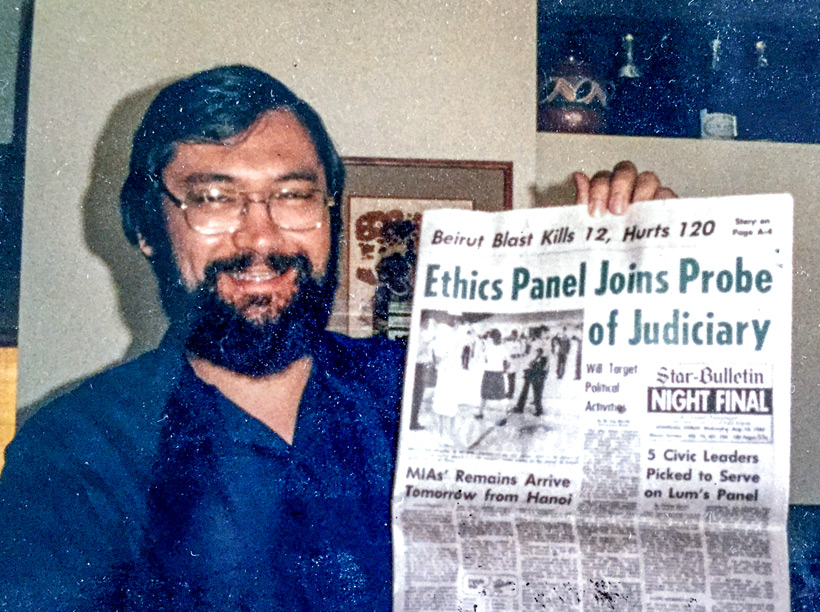
Take this job and love it.
There’s so much to admire in Lind’s work, an enormous public service performed by one guy working alone.
His searches helped put Gary Rodrigues, the head of the United Public Workers union, in prison for skimming union funds.
He uncovered an Ala Wai Golf Course scam where some Honolulu city and county workers were selling preferred tee times.
He stopped Department of Land and Natural Resources Director William Aila from muzzling journalists by requiring them to get state approval before publishing certain material.
And many more. His work reads like a who’s who of weaseling, cheating and loathsome incompetence.
But what sticks with me most is what Lind says about what he’s trying to accomplish.
“I’ve always tried to reduce expectations of those coming for quick, immediate answers,” he told me.
“I want to complicate what sound like simple answers. I would like to make them more complicated and get people to walk down those paths.”
That’s a very different path from going to Kahoʻolawe or from entering the office of some politician with documents proving the person is lying.
But in its own way, just as hard and just as noble.
Correction: This article has been updated to correct the year in which Ian Lind left the newspaper and started his blog.
Tell us about a government program or service you think is working well. We’re also interested in people, especially public employees, who deserve to be celebrated for their service or their contributions to making Hawaiʻi a better place. Send to sunshine@civilbeat.org and include Bright Spots in the subject line please!
 Sign up for our FREE morning newsletter and face each day more informed.
Read this next:

Local reporting when you need it most
Support timely, accurate, independent journalism.
Honolulu Civil Beat is a nonprofit organization, and your donation helps us produce local reporting that serves all of Hawaii.
ContributeAbout the Author