Denby Fawcett: Pidgin Author Lee Tonouchi Is Hawaiʻi's New Poet Laureate
For years, Lee Tonouchi has fostered a growing respect and love for Pidgin, a language once reviled as lazy, inferior — or worse.
February 10, 2026 · 9 min read


About the Author

Lee Tonouchi writes his plays, essays, dictionaries, poems, books, children’s stories, anthologies and even restaurant reviews exclusively in Pidgin.
Tonouchi, 53, is the new Poet Laureate of Hawaiʻi — one of the highest honors for a writer in the state. To put this self-styled “Pidgin Guerrilla” on a pedestal shows how much acceptance and respect has grown for a language once reviled as “inferior,” “broken,” “lazy,” “improper,” or even worse. A letter writer to the Honolulu Star-Bulletin in 1953 called it “a mess of grunts and groans.”
A committee formed by the Hawaiʻi State Foundation on Culture and the Arts, the Hawaiʻi State Library System and the Hawaiʻi State Council for the Humanities selected Tonouchi for the award, which carries a $35,000 stipend for each of the three years he serves.
As poet laureate, he is expected to conduct workshops and offer readings on all the islands to share his poetry and inspire new writers from all communities — even the most marginalized — to find confidence in their own voices as poets, authors and playwrights.

Ideas showcases stories, opinion and analysis about Hawaiʻi, from the state’s sharpest thinkers, to stretch our collective thinking about a problem or an issue. Email news@civilbeat.org to submit an idea or an essay.
In his working life, Tonouchi has already made this his mission: teaching classes, visiting thousands of school children and reading his poetry to hundreds of adults to spread the word that Pidgin is a valuable voice as a language widely shared here to describe the experiences of the people in these islands.
“He writes with great courage and energy, bravely embracing all genres of writing. He is the perfect person to promote the value of diverse voices when today there is a push for sameness and increasing intolerance for differentness,” said Aiko Yamashiro, executive director of the state humanities council.
Tonouchi is Hawai‘iʻs third poet laureate. The first was the slam poet Kealoha (2012-2022) who was selected by former Gov. Neil Abercrombie, and after Kealoha came Brandy Nālani McDougall (2023-2025).
If a writer of Pidgin like Tonouchi had been selected for this esteemed award during my childhood in Territorial Hawaiʻi, many educators would have had a fit.
During my days at Punahou School, teachers across the islands — instead of honoring the primary language of most of their students — spent their classroom hours trying to stamp out the kidsʻ Pidgin, eradicate it, making the children who spoke it feel inferior.
Tonouchi is bilingual. The first language he learned as a toddler was Hawai’i Creole or Hawaiian Creole English, popularly known as Pidgin with a capital “P.” It is a legitimate language with a grammar, syntax and structure like any other language including Japanese, Vietnamese, French or German.

Tonouchi’s mother, an English teacher at Kalani High School, died when he was 2 years old when a city bus broadsided a car she was driving near the Pearlridge Mall. He survived the crash, strapped in a car seat on the passenger side.
At the time his father was working long shifts at the Air Force satellite tracking station at Kaʻena Point. With the remoteness of his job and ever-changing work hours, he was unable to care for his little boy in the family’s ʻAiea home.
Tonouchi was taken to Pālolo Valley to live with his maternal grandparents, a carpenter who was about to retire and a housecleaner for families in Hawai‘i Kai. Both of them, originally from Maui, spoke Pidgin — so that’s what the toddler learned as his first language.
Tonouchi said the same dismissal of Pidgin as inferior during my day in the 1950s persisted when he was in public school the 1980s. “In sixth grade, my teacher told me I wrote just like I spoke. I was all happy. I thought that’s good. No, she said, that’s bad, very bad. I was upset,” he said. “I thought, ‘Why can’t we use words we use in the real world?’ They were trying to change how we talked.”
The phrase he selected to go with his photo in the ʻAiea High School yearbook was the famous maxim Mr. Miyagi said to Daniel in the movie “The Karate Kid”: “Man who catch fly with chopstick accomplish anything,” meaning with patience and focus a person can overcome great odds.
“When I got my yearbook, the advisor had changed the phrase to ‘A man with chopsticks accomplishes nothing.’ The total opposite of what Mr. Miyagi meant,” Tonouchi said. “I was so mad. I had dreams to be one writer but then, I no care. I never want to be one writer.”
He clammed up. Retreated into Standard English for school work.
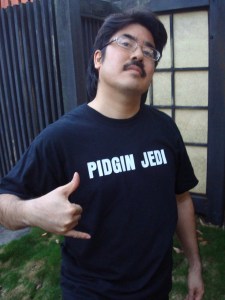
In later years, he reflected about effects of language discrimination as a kind of homicide, saying “Pidgin is the people who talk it. You get rid of Pidgin, you get rid of the people.”
Tonouchi finally understood it was possible to become a writer exclusively in Pidgin in his sophomore year at the University of Hawaiʻi Mānoa when his English literature professor introduced the class to Pidgin based writer Eric Chock’s poem “Tutu on the Curb.”
After that, there was no looking back. He pleaded with Valerie Wayne — his professor in a graduate level Shakespeare course — to let him write his final class paper in Pidgin.
“First, he had to convince me it was significant and worthy language for people who grew up in Hawaiʻi,” Wayne said. “He did and he got an A for the paper.”
And after that he was permitted to write his master’s thesis in Pidgin, which was later turned into his first book, “Da Word,” a collection of short stories published by Bamboo Ridge Press in 2001.
What he was doing began to gain traction. In 2005, The Wall Street Journal wrote a front-page article about his position at Hawaiʻi Pacific University as the first teacher in the country conducting a college-level class on Hawaiʻi’s Pidgin literature.
He started writing popular plays staged at Kumu Kahua Theatre downtown documenting island experiences in Pidgin and he kept getting his books published, year after year.
Publisher Buddy Bess said Tonouchi walked into the office of Bess Press in Kaimukī one day saying, “Hey, I got one book.” It was “Da Kine Dictionary: Da Hawaiʻi Community Pidgin Dictionary Projeck,” a popular and funny collection of ever-evolving new words in Pidgin as well as classic old Pidgin sayings, now in its third printing. Bess said it was the perfect follow up to the 1981 classic “Pidgin to da Max” which Bess Press had purchased the rights to publish.
“Lee is a soft-spoken guy but he was kind of hustling the whole time,” he said.
After that, Bess published four more of Tonouchi’s books including “Significant Moments in da Life of Oriental Faddah and Son: One Hawai’i Okinawan Journal.” It is a humorous and sometimes sad semi-autobiographical series of poems that deals with Tonouchi’s Okinawan heritage and his life growing up with his often uncommunicative father after his mother died.
“Significant Moments …” won the Asian-American Studies Book Award in 2016.
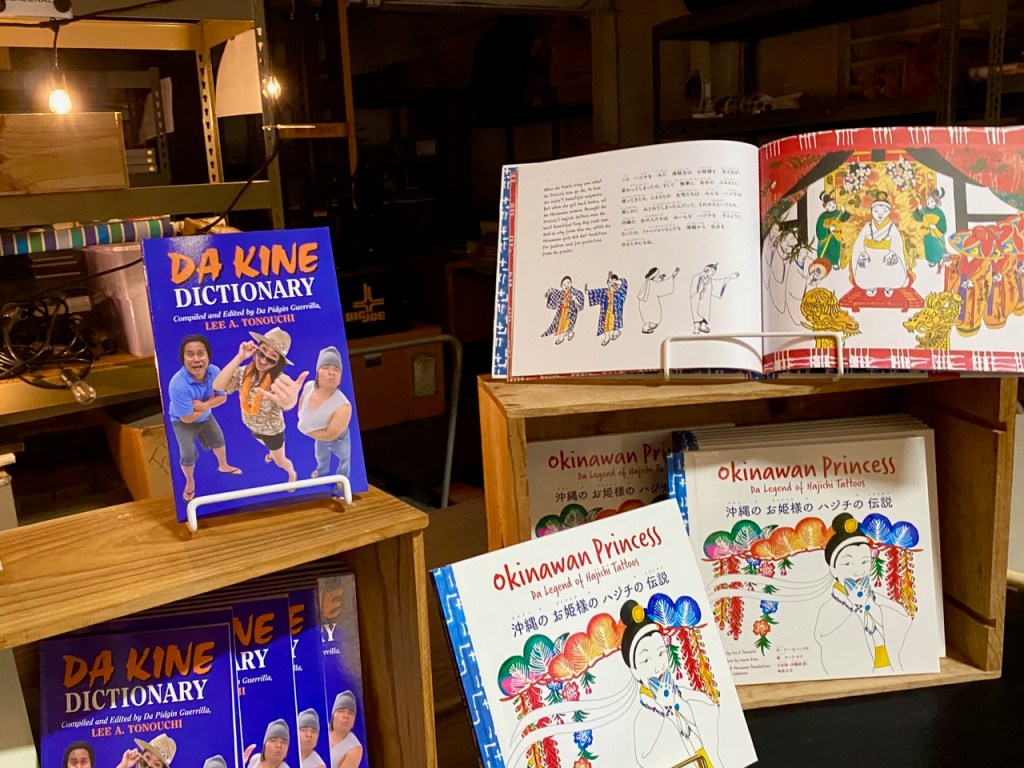
By then, Tonouchi had taken on another mission: To write seldom heard stories about Okinawans in Hawaiʻi while encouraging other local writers to do the same
In his 2023 book, “Chiburu: Anthology of Hawaiʻi Okinawan Literature,” he features the art and writing of 30 authors of Okinawan ancestry,
When Tonouchi married, he insisted on saying his wedding vows in Pidgin. When the pastor asked if he would take her as his wife instead of the expected “I do,” he responded, “Shoots. I chance em.”
This sequence from Tonouchi’s wedding was featured in the 2009 documentary “Pidgin: the Voice of Hawaiʻi” by filmmaker Marlene Booth.
Booth’s film used animation, interviews with Tonouchi and scholars such as UH linguist Kent Sakoda, co-founder of the advocacy group Da Pidgin Coup, and music and design to explain the importance of Pidgin to its speakers. The film says Pidgin started here in Hawaiʻi like the pidgins born in other countries as a basic means of communication to help early arrivals who all spoke different languages communicate with each other for business and social needs.
A pidgin language becomes a Creole when children born to the families hear pidgin in the homes as their first words just as Tonouchi did. And because human brains are hard-wired for complex language, little children instinctively transform simple pidgin into an orderly system of grammar, a stable syntax as well as expand the vocabulary to elevate what was formerly code for limited communication into a complete language — in this case, Hawaiʻi Creole. While pidgins are useful only for certain situations, Creole can be spoken to communicate in all aspects of life.
Filmmaker Booth said of Tonouchi: “He’s terrific and has always been true to himself and to his mission to fill Pidgin speakers with pride.”
Pidgin has survived all attempts to obliterate it. And, as a sign of its legitimacy, the U.S. Census in 2015 declared it an official language.
Hawaiʻi’s Board of Education also for the first time has included Hawaiʻi Creole as one of the languages in its Seal of Biliteracy, awarded upon graduation to students who demonstrate a high proficiency in both of the state’s official languages — Hawaiian and English — or in one of the state’s official languages and at least one additional language. In May, 10 Waipahu High School seniors graduated with Seals of Biliteracy for their proficiency in both English and Hawaiʻi Creole.
Whatʻs next? Well, Tonouchi says perhaps it won’t be much longer before Hawaiʻi lawmakers submit a bill proposing a third official state language: Hawaiʻi Creole, the people’s Pidgin.
 Sign up for our FREE morning newsletter and face each day more informed.
Read this next:
Local reporting when you need it most
Support timely, accurate, independent journalism.
Honolulu Civil Beat is a nonprofit organization, and your donation helps us produce local reporting that serves all of Hawaii.
ContributeAbout the Author