Less than 3 days left to help us reach 250 donors by May 15. Make a gift of any amount today!
The Sunshine Blog: A Face Mask Ban For Cops Picks Up Early Momentum
Short takes, outtakes, our takes and other stuff you should know about public information, government accountability and ethical leadership in Hawai‘i.
February 4, 2026 · 9 min read

About the Author

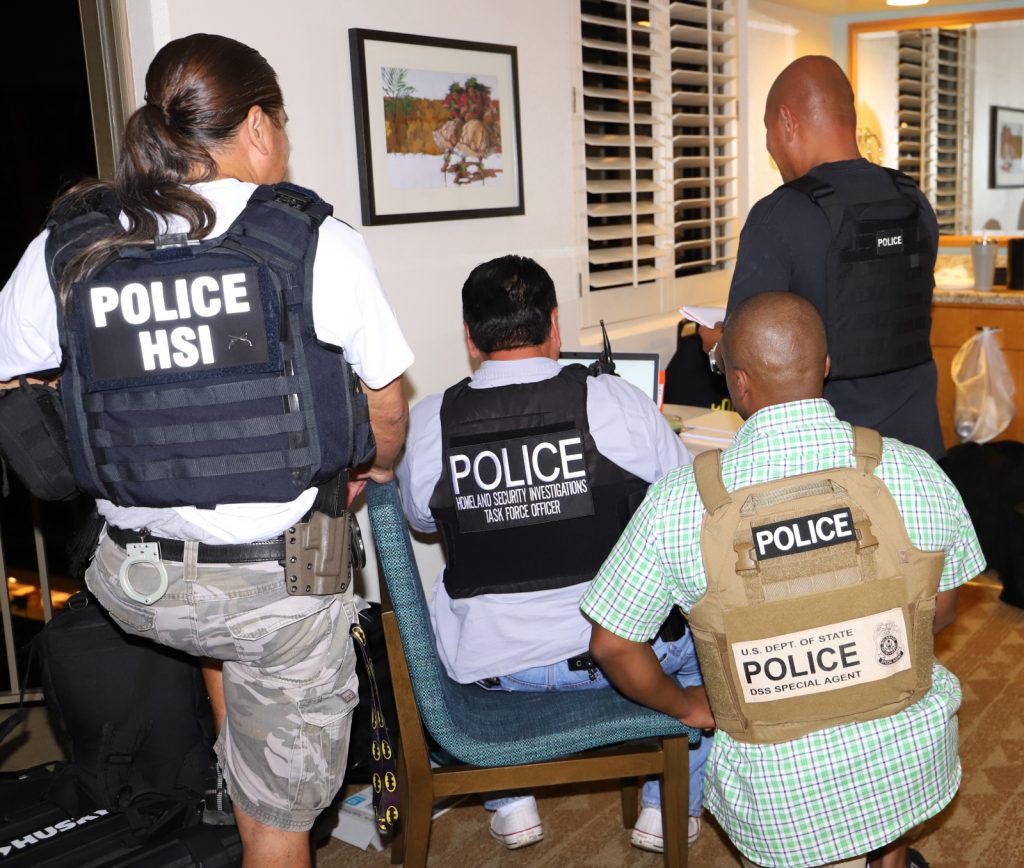
Facial recognition: On Tuesday, The Sunshine Blog sat in on the first of what likely will be many legislative hearings this session aimed at making all law enforcement officers working in Hawaiʻi show their faces while, say, rounding up people they think are in the country illegally or conducting other large-scale raids or enforcement operations.
There are at least nine bills in play that restrict cops from wearing masks or require more visible identification or mandate that policies on transparency be posted publicly. Or all of the above.
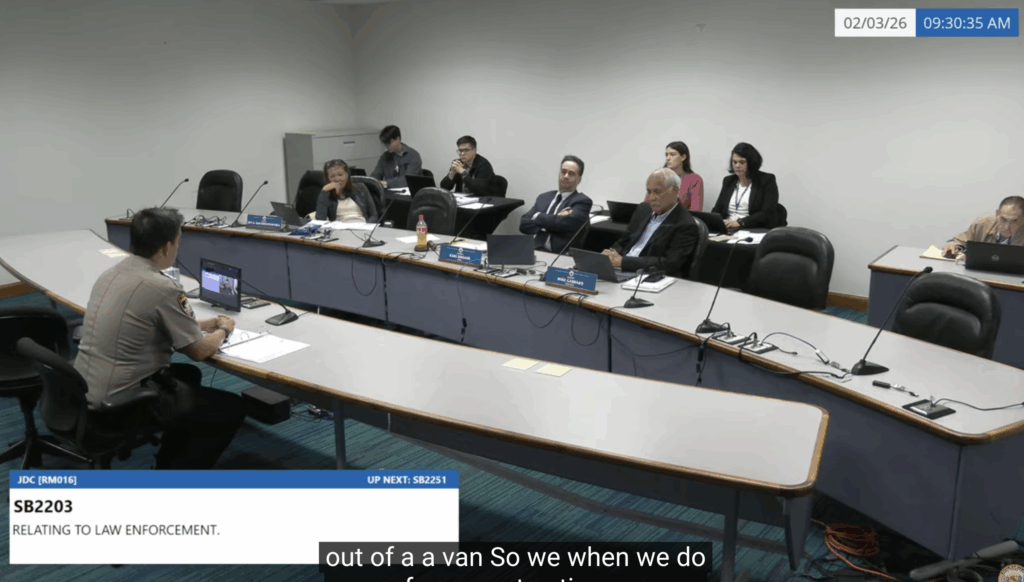
If Senate Bill 2203 is any indication, it seems like they will have an easy ride. (Although The Blog has thought that before about no-brainer reform legislation only to be disappointed when it enters the black hole known as conference committee.)
SB 2203, introduced by Sen. Stanley Chang, would make it a misdemeanor if a law enforcement officer wore a mask or a disguise while conducting their police duties. It drew more than 151 pages of testimony and only three of those testimonies opposed it.

Advocates want the bill to basically include the features of some of the other more comprehensive bills — visible identifiers and prominent publication of policies, among them — and Senate Judiciary Chair Karl Rhoads indicated that as the transparency bills roll along through the Legislature this year, they would pick up the best elements from each.
“This bill and others are going to move,” Rhoads said. “There is visceral anger against what’s happening in Minnesota.”
As you might have guessed, the opposition is coming from law enforcement. The state Department of Law Enforcement and Honolulu Police Department sent officers to the Senate Judiciary hearing to explain their concerns.
Generally, they said they sometimes need many extra officers to help on, say, a gambling operation raid or a narcotics operation and they want those officers to be able to wear face coverings because they might need to be undercover someday.
“We don’t want their picture taken. You just get on Hungry Hungry Hawaiian or Stolen Stuff and you’ll be famous in seconds,” DLE Deputy Director Jared Redulla told the committee. “We want them to try to keep as low a profile as they can.”
Rhoads expressed some skepticism about that objection, calling the notion of cops maybe someday being undercover a “huge loophole.” But he’s giving them time to come up with a proposed amendment that might address the concern. The bill is scheduled to be back on the agenda for final action on Thursday morning.
And then it’s on to the Senate Ways and Means Committee for its final stop before going to the full Senate.
Sunshine daze: It’s early yet in the session (which just started two weeks ago) but lawmakers are cranking through a number of the Sunshine Bills we identified for you in a story on Sunday.
On Monday, Rhoads’ Judiciary Committee passed out Senate Bill 2311, which seeks to ensure state agencies aren’t just paying claims when they’re found at fault and then not fixing the underlying problem. “I’m in my 11th year as a judiciary chair (between the House and Senate),” Rhoads said, “and some departments have the same kinds of problems that we as taxpayers pay out over and over again.”
The Senate committee also moved along two proposed constitutional amendments that would go before voters in November. (Spoiler alert: the Legislature rarely allows anything to go to the ballot that would let voters have a direct say on an issue.)
One would put in place a year-round Legislature. The other would change the way votes are tabulated if people ever did get to vote on a constitutional amendment so that you’d have to vote no on a measure to vote against it. Currently, blank votes and over-votes count as no.
Next stop for both of those: WAM.
Over in the House, Rep. David Tarnas’s Judiciary and Hawaiian Affairs Committee whipped through numerous accountability, ethics and transparency bills on Tuesday. Tarnas was his usual effusive and chipper self, explaining to the spectators the details of most bills and making testifiers elaborate on their positions beyond the normal “We stand on our written testimony.”
Voter service centers were the hot topic in House Judiciary. It seems everybody wants more voter service centers in all four counties so voters don’t have to stand in line for hours to vote, as was the case in the last couple of elections. And The Blog and everyone else wants the first round of election results to be announced at around 7 p.m. on election night we don’t have to wait until well after midnight.
To that end, the committee passed House Bill 1525, which not only would give state money to the four counties to staff and fund the centers (the exact amount will be determined later), but also requires the Hawaiʻi Office of Elections to print and mail its digital voter guide to all registered voters (estimated cost: $2 million) and to support a public outreach and engagement program ($441,000).
The Judiciary Committee also wants to accommodate people who want to vote on Election Day rather than mail in their ballots — a tradition that GOP Rep. Diamond Garcia told the committee deserves the state’s support.
What surprised Tarnas, however, was that Maui County Clerk Moana Lutey and City and County of Honolulu Clerk Glen Takahashi said that it will be quite the challenge to attract qualified seasonal workers to take a part-time gig for only $20 an hour in election years. One solution, Tarnas suggested, was for good government groups like Common Cause Hawaiʻi to recruit recent high school graduates willing to help out.
Also passing the House committee Tuesday were bills to increase funding for the state’s partial public financing of political campaigns and another to pay better salaries to the directors of the state Campaign Spending Commission so they are similar to that of comparable government officials.
As usual, the precise dollar amounts for all the bills will likely be tweaked by the House Finance Committee, where all the bills go next.
Go your own way: Hawaiʻi U.S. Rep. Ed Case was one of 21 Democrats to cross the aisle Tuesday and vote to end the partial federal government shutdown. A fight over future Department of Homeland Security funding, which covers Immigration and Customs Enforcement, looms ahead.
Case took to the House floor to speak out in favor of funding the government while condemning ICE, saying that it must be reformed. He even recounted a story about a sitting state senator who, he says, told him that she was fearful of talking to constituents out in her district without her passport. (He did not identify the senator.)
“This is unacceptable,” he said. “This is un-American. ICE must be reformed. And until it is, neither it nor its parent entity, the Department of Homeland Security, should be fully funded.”
Case’s Democratic colleague, Jill Tokuda, however, stuck with the majority of her party and opposed the measure, saying that she would not “vote to bankroll an operation that terrorizes communities, undermines our Constitution, and puts American lives at risk.”
The House vote was 217-214. President Trump signed the measure into law late Tuesday.
Green machine: Gov. Josh Green is building a formidable war chest for his reelection campaign this year. He’s raised around $3 million total and has $2 million in cash on hand, according to the latest filings with the Hawaiʻi Campaign Spending Commission. The numbers reflect contributions and expenses through Dec. 31.
Donors in the $4,000 to $6,000 range (that latter figure is the maximum allowed) include labor unions such as University of Hawaiʻi Professional Assembly and ILWU PAC, Local 142; attorneys Paul Alston and Mitch Imanaka; Walter Dods of First Hawaiian Bank and Shan Tsutsui of Mahi Pono — all familiar names and always big campaign donors.
Less familiar are the Sports Betting Alliance of Lubbock, Texas, and the president of Marnell Gaming Management of Las Vegas. Given the nonexistence of legal gambling in the islands, their donations might be a waste of money, no?
Green’s biggest campaign expense was around $77,00 to Deep Blue Strategies for digital media consulting. Clearly, he’s saving his big bucks to saturate mainstream and social media with ads when the time is ripe.
The governor, who is expected to officially kick off his reelection in May following the conclusion of the 2026 Legislature, has held more fundraisers than any other candidate so far this year — 15 total. Coming in second at 13 fundraisers is his lieutenant governor, Sylvia Luke, who reports $615,649 in cash on hand. Donations include $4,500 from Good Friends of Kyle Yamashita.
So far, Green and Luke have drawn no challengers for the Aug. 8 Democratic primary. Same goes for Gary Cordery, the only Republican with at least some name recognition running for governor. Cordery has pulled in $166,231 in contributions but has spent slightly more than that, leaving him $11,663 in the red. The GOP candidate has spent modestly, including about $3,700 to Magically Yours of Waipahu for magnets, banners and stickers.
Help wanted: The Judicial Council is seeking people to fill two expected vacancies on the five-member Hawaiʻi State Ethics Commission. The terms of Wes Fong, the chair, and Robert Hong end June 30.
Members of the commission serve as volunteers, but “reasonable expenses” like travel are covered. Their work addresses ethical issues involving legislators, registered lobbyists and state employees — with the exception of judges, who are governed by the Commission on Judicial Conduct.
Interested? Apply here.
 Sign up for our FREE morning newsletter and face each day more informed.
Read this next:
Local reporting when you need it most
Support timely, accurate, independent journalism.
Honolulu Civil Beat is a nonprofit organization, and your donation helps us produce local reporting that serves all of Hawaii.
ContributeAbout the Author