Denby Fawcett: Bill To Create Residential 'Monster Lots' Is Dead — For Now
Lawmakers got a lot of pushback over a proposal to allow six units on a lot originally zoned for a single-family home, but they may reintroduce the measure next year.
March 11, 2026 · 6 min read

About the Author

Lawmakers Monday shelved for a second straight year a controversial proposal that would have allowed the state to override local county zoning restrictions and permit much denser building in residential neighborhoods.
The proposal would have allowed lots to be as small as 2,500 square feet, meaning a 5,000-square-foot lot could be subdivided into two lots. With the new allowance of three homes per lot, that meant up to six residential dwellings could be built where one house once stood.
Sen. Stanley Chang, who sponsored the bill, asked a Senate caucus to halt the bill before a scheduled Senate floor vote Tuesday. Chang told Civil Beat he made the decision in the face of strong community opposition.
“I decided this is not the right time. There were very passionate views about it,” he said.
Rep. Luke Evslin introduced the House version of the bill, but it also died for lack of support.
“That’s unfortunate. I will try again next year,” Evslin said.

Ideas showcases stories, opinion and analysis about Hawaiʻi, from the state’s sharpest thinkers, to stretch our collective thinking about a problem or an issue. Email news@civilbeat.org to submit an idea or an essay.
Chang says if Evslin revives it, he will support him in 2027 by introducing senate companion bill.
Honolulu City Council Chairman Tommy Waters had called the measure “the reckless overdevelopment bill.” When I wrote about a similar proposal two years ago, I called it the “Monster Lot bill.”
Even though it is stalled for now, this housing density bill appears on track to keep coming at us like a zombie.
Deep Concerns About Affordability
Before the bill was shelved, Waters worried that residents might have been unaware of the measure as it was gaining support in the state Senate. Last week, he launched a social media and email campaign to garner support from neighborhood board members on Oahu to try to stop the measure.
In an email to Civil Beat on Friday, Waters wrote that individual counties are better equipped to deal with zoning issues by their closer connection to the specific housing needs of their communities, rather than lawmakers trying to impose zoning requirements with a one-size-fits-all statewide law.
Waters said one of his deep concerns is that allowing increased density will make lots immediately more valuable and “even more attractive to out-of- state investors and speculative buyers. It’s no doubt that Hawaiʻi is already one of the most desirable real estate markets in the world. Without guardrails, this measure risks further pricing local families out of competition for our already-limited local housing supply,” he wrote.

Chang and Evslin had promoted the legislation as a way to help solve the state’s housing crisis by generating more affordable units. But there was nothing in the measure to mandate that the houses be affordable.
Chang says smaller residences on smaller lots by their very nature are going to be less expensive. If you put three units on a lot where there once was only one, the units will cost less, he said.
Evslin says affordability mandates don’t help.
“They reduce the number homes built overall which makes the crisis worse and leads to higher prices,” he said.
Housing advocate Makana Hicks-Goo says if more density is allowed on small lots, developers will pocket the profits by selling the properties at the highest price they can get. Hicks-Goo is with LIMBY Hawai‘i (Locals in my Backyard), a group focused on creating more housing for Hawai‘i kamaʻāina.
“There has to be an affordability requirement,” he said.
Impact On Infrastructure ‘Could Be Significant’
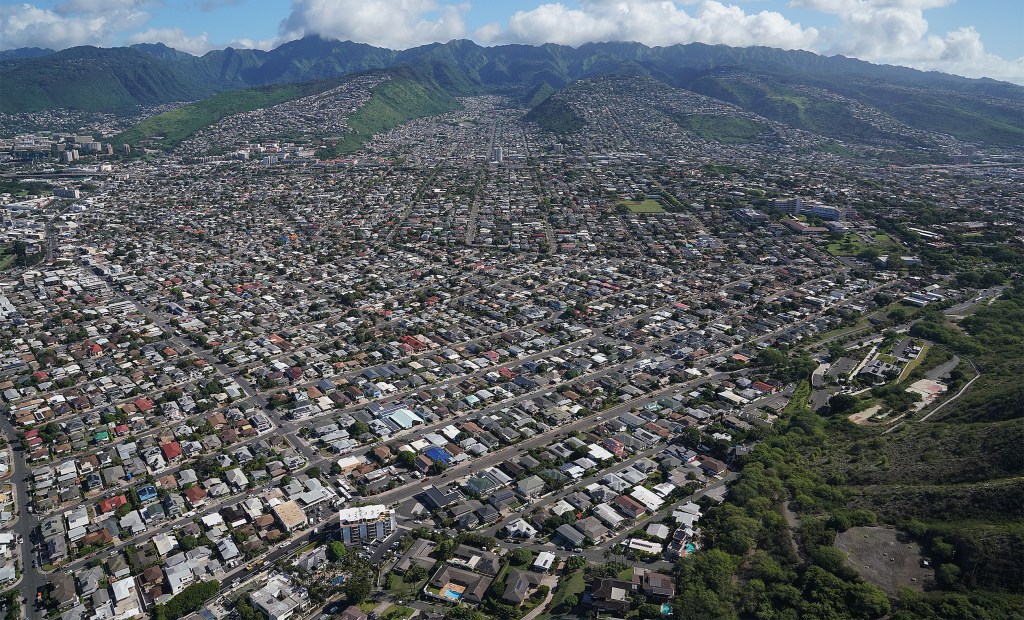
Honolulu Department of Permitting Director Dawn Takeuchi Apuna wrote to Civil Beat on Friday if lawmakers had approved the bill, it would be unlikely to affect neighborhoods like Kaimukī with many of its small lots already built up to the maximum with homes. The effects would be seen in older neighborhoods with larger lots.
“This would create an exponential number of dwelling units compared to the existing circumstance. It would mean the housing density in R-10 areas would rise by potentially four times,” she said.
For example, a 10,000-square-foot lot in Mānoa or ʻĀina Haina could be split into four lots and then further developed into 12 separate residential dwellings where only one house stood before.
Apuna wrote that “Impacts to infrastructure, especially water, sewer and roadways, could be significant. Since those lots are already allowed to have a primary dwelling unit and two accessory dwelling units (ADU & ohana), we feel there is already sufficient residential density allowance.”

Another concern Apuna had was that the bill would have reduced parking requirements to only one space per unit, meaning residents in dwellings with more than one car would have to seek street parking.
It is already difficult for emergency vehicles to navigate through some neighborhoods with narrow streets made even narrower by parked cars, she noted.
At public hearings for the bill, supporters included the Maui Chamber of Commerce, AARP Hawaii, Hawai‘i YIMBY, and Grassroot Institute of Hawaii. All of them wrote it would provide more fee simple homes for Hawai‘i residents.
Christine Otto Zaa of the group HI Good Neighbor submitted testimony opposing the bill, citing safety concerns.
“Many older neighborhoods were not designed for significantly higher density and often lack sidewalks, have narrow streets, and limited stormwater drainage systems. Planning is needed to address pedestrian and traffic safety, flooding concerns, and infrastructure capacity as density increases,” she wrote.
A Better Way To Address Housing Crisis?
Increasing housing density is not necessarily a bad thing, depending on where and how it is done.
Architect Steve Yuen thinks a better way to expand homeownership is through planned developments such as condominium townhomes and small detached cluster-home condominiums in new subdivision areas, rather than trying to squeeze many tiny houses onto small lots in older neighborhoods.
“While individual fee-simple ownership is important, condominium ownership works better when people live close together because shared obligations help maintain order and infrastructure,” he wrote in a position paper.
In new housing areas, a developer can plan for enough parking and shared open space and ample setbacks — features that make life better for residents.
Yuen is a retired principal of Group 70. As a Kaimukī resident, he says he understands firsthand the community concerns.
Hawai‘i’s housing crisis will not be solved by building one fee-simple house at a time.
Chang says when tens of thousands of new houses are needed, a more meaningful solution will be to build residential condominium towers in new developments by Honolulu’s rail stations and in the planned new Honolulu Stadium development.
“We need to keep looking high and low for solutions,” he says.
Whatever solutions lawmakers pursue, they need to avoid unintended consequences and respect the neighborhoods people already call home.
 Sign up for our FREE morning newsletter and face each day more informed.
Read this next:

Local reporting when you need it most
Support timely, accurate, independent journalism.
Honolulu Civil Beat is a nonprofit organization, and your donation helps us produce local reporting that serves all of Hawaii.
ContributeAbout the Author