Don't Undermine Hawaiʻi's Safe Routes To School Program
A bill under consideration would give the transportation department broad authority to direct program funds for its existing projects, without going through the legislatively mandated evaluation process of the other proposals.
March 22, 2026 · 4 min read


About the Authors


Following a year marked by historically high traffic fatalities and injuries for people walking and biking, Hawai‘i needs to strengthen — not weaken — our ability to create safe routes to school.
The state’s Safe Routes to School Program is only just beginning to deliver on reforms passed by the Legislature in 2023, yet a new bill risks undermining that progress before it has a real chance to succeed.
Through Act 244 of 2023, the Hawai‘i Legislature established the current SRTS framework “to prioritize the safety of keiki by fixing and simplifying the safe routes to school program, re-engaging community stakeholders, and appropriating funds to move priority projects and save lives …”

Ideas showcases stories, opinion and analysis about Hawaiʻi, from the state’s sharpest thinkers, to stretch our collective thinking about a problem or an issue. Email news@civilbeat.org to submit an idea or an essay.
Since its inception in 2024, the SRTS Advisory Committee, established under Act 244, has worked swiftly to advance its recommendations. This past summer, the committee recommended more than $12 million in worthy SRTS projects across the state, serving more than 5,600 students and their families. Projects funded are vetted by the SRTS Advisory Committee through a transparent process involving community stakeholders, ensuring prioritized projects reflect community and school needs, significant traffic risks, and more.
However, House Bill 2454 emerged this year, and is poised to disrupt this important community-driven momentum. If passed, the bill would grant the Hawai‘i Department of Transportation broad authority to direct SRTS funds for its existing projects, without going through the legislatively mandated evaluation process of the other proposals. Many fear it would also undermine the full spectrum of SRTS-related and community-supported solutions in favor of status quo actions.
The SRTS Program plays an important and uniquely positioned role in addressing transportation safety and access issues at the school level. When fully realized, it can also support learning and attendance, keep keiki active, reduce family transportation costs, and benefit communities statewide — because more than 75% of Hawai‘i residents also live within 1 mile of a school.
Conversely, the SRTS Program was not intended to serve as a funding source for ad hoc transportation projects. While some standard safety improvements may align with SRTS goals, the program was not designed to replace work HDOT is already performing within its roughly $620 million average capital budget for roads. For example, speed humps and similar traffic-calming measures are tools HDOT has long implemented through its normal coordination with counties. If HDOT wishes to propose using SRTS funds for such projects, the department already has the opportunity to go through the same process as other community proposals.
For our communities, the core issue is ensuring that Hawai‘i’s keiki can safely travel to and from schools, and that students’ daily experience is placed at the center of these decisions. Some SRTS projects occur on county roads, some are on state roads, and others are on a combination of both — such as projects already recommended by the SRTS Advisory Committee in Waiākea on Hawai‘i island.
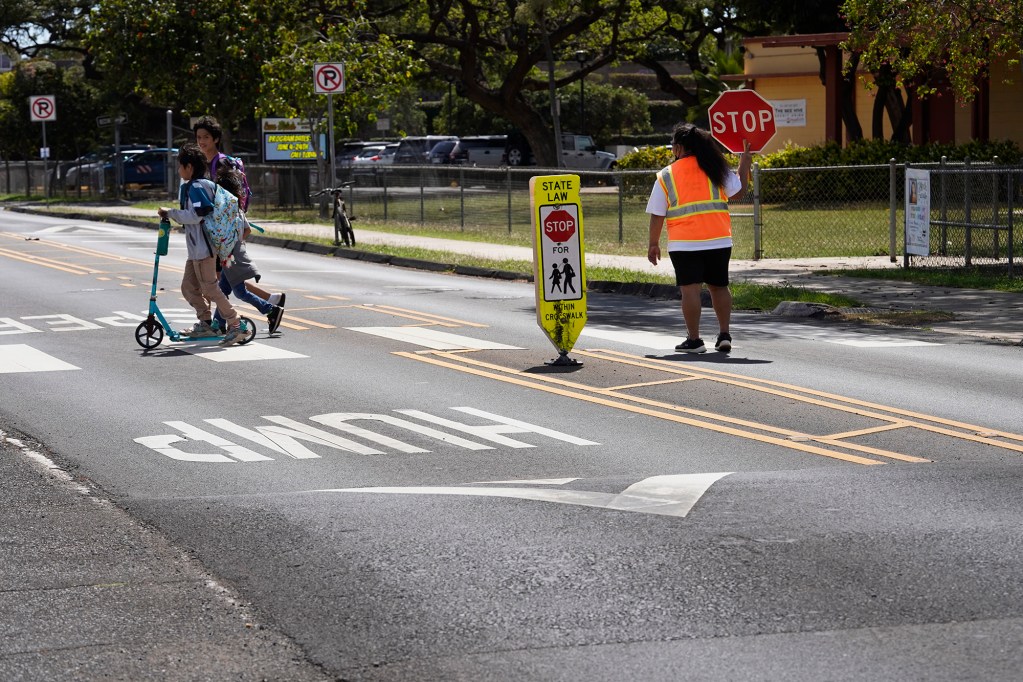
Less than half a mile away from the Waiākea schools, Kīlauea Avenue is a high-traffic corridor that serves several residential neighborhoods and has reported several crashes. Currently, there are no connected walking paths and bikeways along Kīlauea Avenue between Ohea Street and Haihai Street. Installing new, fully accessible sidewalks and bike lanes will provide children and all community users safe access.
Strongly supported by nearby community organizations and businesses, this project will construct sidewalks and striped, paved shoulders along Kīlauea Avenue in proximity of the Waiākea school complex. The Advisory Committee recommended providing funds for the state road nearby as well, when future funds were available.
More broadly, the SRTS Program provides an opportunity for the state to take a leadership role in coordinating safe routes to and from its schools. These are state schools, and safe access to them is a state responsibility, particularly as Hawai‘i has a declared traffic safety emergency.
HB 2454 is unnecessary at this time.
Lawmakers should allow the Safe Routes to School Program created under Act 244 to work as intended — prioritizing community input, addressing real safety risks, and protecting the daily journeys of Hawai‘i’s keiki.
We as chair and vice chair look forward to continuing to work with HDOT on our shared goal of ensuring safe routes to school.
To learn more about the SRTS Advisory Committee, visit https://hidot.hawaii.gov/highways/safe-routes-to-school-advisory-committee/
 Sign up for our FREE morning newsletter and face each day more informed.
Community Voices aims to encourage broad discussion on many topics of community interest. It’s kind of a cross between Letters to the Editor and op-eds. This is your space to talk about important issues or interesting people who are making a difference in our world. Column lengths should be no more than 800 words and we need a photo of the author and a bio. We welcome video commentary and other multimedia formats. Send to news@civilbeat.org. The opinions and information expressed in Community Voices are solely those of the authors and not Civil Beat.

Local reporting when you need it most
Support timely, accurate, independent journalism.
Honolulu Civil Beat is a nonprofit organization, and your donation helps us produce local reporting that serves all of Hawaii.
ContributeAbout the Authors