Will Bailey: Riders On The Storm
A look at how a Kona low shows up in real life on the east side of the state — small failures, stretched systems, and the point where things stop holding.
March 19, 2026 · 5 min read


About the Author

Last Friday it rained all day. Or close enough to count.
Wet in the morning. Off and on through the afternoon. Then heavy — blinding, the kind of rain that makes driving feel like guesswork more than control.
My wife works the night shift in Hilo. She’s been making that drive in it for weeks now. The worst of it always seems to meet her on the road.
That evening, the power spiked. Our generator panel shorted.
We noted it. Adjusted. Kept moving.
Small things break. You work around them. You wait for the sun to come back and even things out.
Most of the time, it does.

Ideas showcases stories, opinion and analysis about Hawaiʻi, from the state’s sharpest thinkers, to stretch our collective thinking about a problem or an issue. Email news@civilbeat.org to submit an idea or an essay.
It Doesn’t Take Much
I went down to my dad’s place the next day.
He’s on the grid. Old ranch house. Power. Big catchment.
The rain had settled in. Nothing dramatic. Just enough that you could feel it building.
Rain on the tin roof. Steady. Water shot from the catchment overflow. The yard was already soft.
He sat there with his coffee. I had mine. The national news droned.
We both remembered last year.
He said, “We should take those greenhouse tarps down.”
I said, “Yeah.”
And then we both just went to sleep.
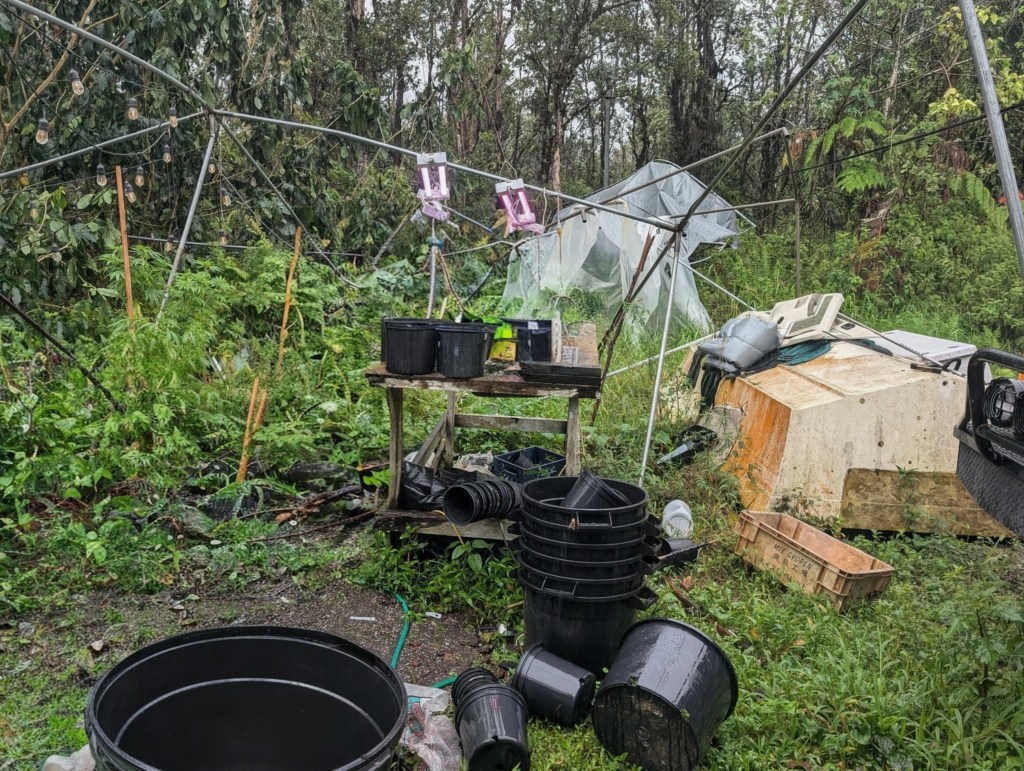
In the morning, the front greenhouse was gone.
Just gone.
The lights were still there, hanging, still on.
The carport was twisted up like a busted umbrella, tapping the power line in time with the wind.
The power went out a few hours later.
A few days of rain that doesn’t let up. Systems already worn. A missed chance to take something down when you knew you should.
And suddenly you’re cooking everything in the freezer before it goes bad. Running a camp stove by candlelight. Letting things go that can wait.
The first day, it feels temporary.
By the second, you start to adjust. You find the candles. Move things around. Check the fuel.
By the third, the rhythm changes. You stop reaching for switches. Stop expecting light when you flip them.
After three days, you feel it.
After five, whole neighborhoods are still without power.
You start to hear it in pieces. A road closed somewhere. A transformer blown. Someone running extension cords across a yard. Someone else hauling water.
Fallen ʻōhiʻa blocked the driveway. Rapid ʻōhiʻa death the previous summer had rotted their cores.
They go over easy once the wind picks up.
Someone checking on a neighbor. Someone else not answering.
The lines aren’t just down. They’re stretched thin. Crews moving from one break to the next. Fixing one thing, finding two more.
You start to notice the gaps. The time between when something breaks and when someone gets to it.
Nobody says it out loud, but you can feel it — how much of this only works as long as nothing really goes wrong.
How much of it depends on timing. On sequence.
And when they do, how quickly it starts to slip.
When The Signal Comes Back
When I was about 15, I saw a film that stuck with me.
A cosmonaut living alone in a sealed biodome on some distant jungle planet. Clean air. Dry floors. Systems holding.
Every day he steps outside into the jungle.
One day, he tracks something back in.
A leaf.
When he wakes up, the dome is the jungle.
It’s wet. It’s raining.
Once the signal came back, you could see it.
Messages coming through all at once. Photos. Downed lines. Trees across roads. Water where it shouldn’t be.
Not panic. Just accumulation. One thing after another, adding up into something harder to ignore.
Not just here. All over this side of the island. Lines down. Roads blocked. Service stretched thin. People waiting.
The storm had already moved on in some places.
The effects hadn’t.
You think you’re living inside something stable. Something that will hold.
But most of it is just held at the edge.
A small failure. One thing carried across a boundary you didn’t think about.
And then it’s not separate anymore.
It’s inside.
What Remains
There’s a point where things narrow.
You stop thinking about plans. About schedules. About anything beyond what’s right in front of you.
Food. Shelter. People.
Maybe fuel, if you have it. Maybe light.
That’s it.
Everything else just falls away.
Eventually, the power comes back. Lines get fixed. Systems come online. The world resumes its shape.
Switches work again. Roads open. The small things return first.
But for a while, it didn’t hold.
 Sign up for our FREE morning newsletter and face each day more informed.
Read this next:

Local reporting when you need it most
Support timely, accurate, independent journalism.
Honolulu Civil Beat is a nonprofit organization, and your donation helps us produce local reporting that serves all of Hawaii.
ContributeAbout the Author