Aquarium Fish Extraction Puts Reefs And Community Practices At Risk
Amendments to House Bill 2101 unfortunately limit protections to Oʻahu and only for a limited time.
April 26, 2026 · 4 min read

About the Authors


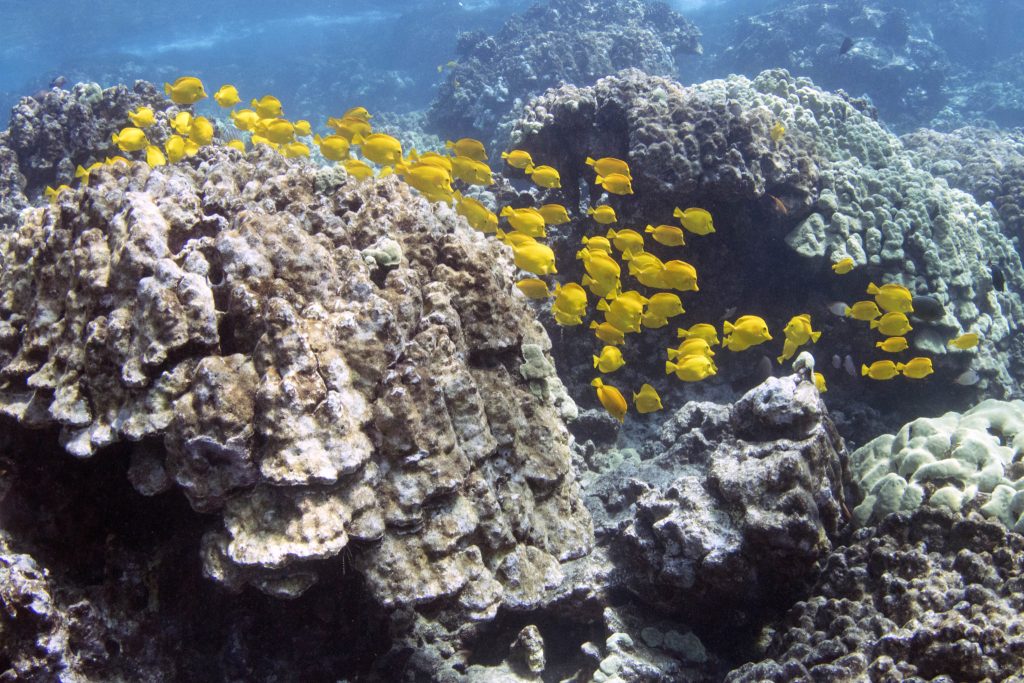
Hawaiʻi’s constitution is clear: the state has a duty to protect and conserve natural resources for present and future generations. For many in Hawaiʻi, nearshore reefs help sustain food security, Native Hawaiian customary and subsistence practices, recreation, and the cultural traditions that communities pass down through generations. When reef systems decline, those public benefits decline with them.
Hawaiʻi’s reefs are already under increasing strain from multiple cumulative stressors, including climate change, land-based pollution, and fishing pressure. All these challenges must be addressed. The Legislature has shown leadership in areas such as cesspool conversion and restrictions on harmful sunscreen chemicals. Fisheries policy should be part of that broader effort to protect our nearshore ecosystems.
Herbivorous reef fish play a critical role in reef resilience. Lauʻīpala (yellow tang) and kole (surgeonfish), heavily targeted by the commercial aquarium industry, help control algae and create the conditions coral need to survive and recover. As herbivore biomass decreases, coral reef resilience weakens.

A 2023 peer-reviewed synthesis of statewide reef monitoring data by state Department of Aquatic Resources and federal National Oceanic and Atmospheric Administration scientists found that in many moku — including the Hilo coast, leeward Maui, and all of Oʻahu — over 44% of surveyed reefs have herbivore biomass below levels associated with healthy reef conditions.
In West Hawaiʻi specifically, Department of Aquatic Resources monitoring has also shown that some reefs lost over 50% of coral cover during the 2015 and 2019 bleaching events, leaving little room for additional pressure, especially on key herbivorous species targeted by the industry.

These findings are directly relevant to House Bill 2101. Originally drafted as part of the Office of Hawaiian Affairs’ 2026 legislative package, the bill would have ended commercial aquarium collection statewide.
A later Hawaiʻi County-focused compromise would still have provided some immediate relief, as rules proposed by DAR and out for public comment would allow renewed collection to resume in West Hawaiʻi in the near future. Unfortunately, later amendments to HB 2101 limited the bill’s protections to Oʻahu and only for a limited time, stripping the measure of its practical effect.
Meanwhile, DAR’s rule-making proposal would allow seven applicants to harvest up to 200,000 reef fish annually on Hawaiʻi island. That would concentrate ecological pressure for narrow private benefit with taxpayers footing the bill for monitoring and enforcement of a complex and costly quota system.
The broader public would also bear the long-term cost of diminished reef resilience and reduced access, including West Hawai‘i communities that most directly rely on subsistence fishing, such as Miloli‘i.
Lawmakers still have a clear path forward: restore HB 2101 as a permanent, statewide prohibition.
Commercial aquarium fishers claim that banning aquarium harvest would threaten their livelihoods, but the industry has been largely shut down since 2017, so the bill as originally written, would simply maintain the status quo, and prevent renewed extraction pressure on our already degraded reefs. The Supreme Court ruling relied upon by the industry addressed the environmental review process, not ecological and social impacts, and the 2023 DAR/NOAA study shows now is not the time to introduce new stressors on our reefs.
Lawmakers still have a clear path forward: restore HB 2101 as a permanent, statewide prohibition that includes Hawaiʻi Island, where commercial aquarium fish extraction is poised to resume. Fulfilling Hawaiʻi’s public trust responsibilities means taking the long view by protecting reef ecosystems so Native
Hawaiian rights, customary practices, and community access remain viable for future generations.
At its core, this is a question of values and priorities: protecting a few specialized commercial interests or protecting the reef systems and community practices that sustain Hawaiʻi’s culture, food security, and way of life.
 Sign up for our FREE morning newsletter and face each day more informed.
Community Voices aims to encourage broad discussion on many topics of community interest. It’s kind of a cross between Letters to the Editor and op-eds. This is your space to talk about important issues or interesting people who are making a difference in our world. Column lengths should be no more than 800 words and we need a photo of the author and a bio. We welcome video commentary and other multimedia formats. Send to news@civilbeat.org. The opinions and information expressed in Community Voices are solely those of the authors and not Civil Beat.
Read this next:

Local reporting when you need it most
Support timely, accurate, independent journalism.
Honolulu Civil Beat is a nonprofit organization, and your donation helps us produce local reporting that serves all of Hawaii.
ContributeAbout the Authors