Did A Senate Committee’s Private Discussions Violate Hawaiʻi's Constitution?
Ways and Means was voting publicly on the state budget before Committee Chair Donovan Dela Cruz suddenly ordered a recess. Why did he do that?
April 22, 2026 · 5 min read

About the Author

The state Senate Ways and Means Committee, known as WAM, manages issues related to the state budget, House Bill 1800.
The Hawaii Military and Community Relations Office, or MACRO, is a state agency created in 2023 with $8 million plus funding provided by the U.S. Department of Defense.
MACRO’s mission is to evaluate and manage “public sentiment” and create an “employment pipeline” in the K-12 public school system to support defense industry growth here in Hawaiʻi.

Why is it important to bring up WAM and MACRO?
For one thing, the U.S. military “wants Hawaiʻi to be a hub for Pacific arms manufacturing” and our lawmakers support that, the Honolulu Star-Advertiser reported in February. As I wrote in my blog at the time, “Can’t make this stuff up. And it’s sickening.”
It’s also important to bring up WAM and MACRO to illustrate when our lawmakers actually help to make that happen, all while appearing to subvert the Hawaiʻi Constitution.
First, a little context: In 2025, $1.3 million of state taxpayer funding was inserted into the state’s two-year budget in support of MACRO, and during the ongoing 2026 legislative session, MACRO via the passage of Senate Bill 3240 was seeking an additional $1.3 million. When the general community became aware of SB 3240, testimony flooded in and the House Public Safety Committee killed the bill.
Within days, it was discovered that $1.3 million had already been inserted into the state budget for MACRO — “$650,000 of state taxpayer funds in each fiscal year” of the current budget, as Maui Now reported on March 6, 2025.
According to multiple sources, these funds had simply been “inserted” by the House — without any public notice or discussion — into the state budget during the 2025 legislative session.
Unsurprisingly, the hundreds of citizens who had worked hard to oppose SB 3240 began furiously calling and emailing WAM committee members. Their message was simple: Stop using state taxpayer funds to pay for defense industry public relations and job recruitment efforts targeting public school students.
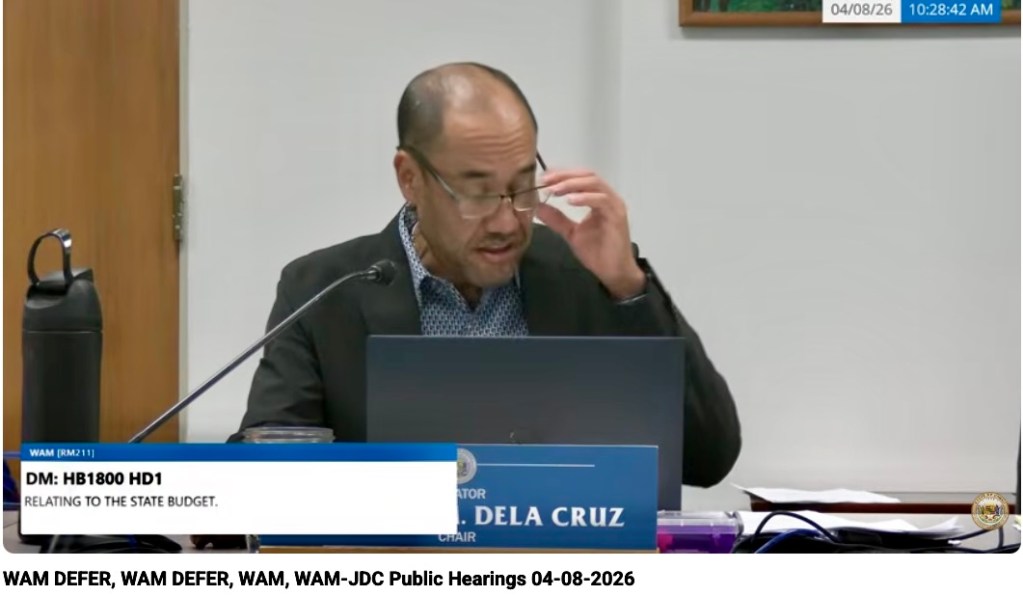
Then, those same citizens watched and listened to the April 8 WAM public meeting and decision making on HB 1800 this year. They were shocked by what they saw (and didn’t see).
Please watch the video. Forty-five seconds into the meeting, WAM Chair Donovan Dela Cruz says, “The recommendation is to pass (HB 1800) with amendments. Any discussion?”
Six seconds later, a committee member says, “The MACRO issue … the one we’ve been getting emails on …”
Another committee member responds, “Oh, yeah, the MACRO issue!”
The chair then says, “Okay, recess.”
And suddenly everything stops. For 13 seconds, “the MACRO issue” is seemingly on the table for public discussion. Then? Nothing but silence — and for 55-seconds, a blank screen.
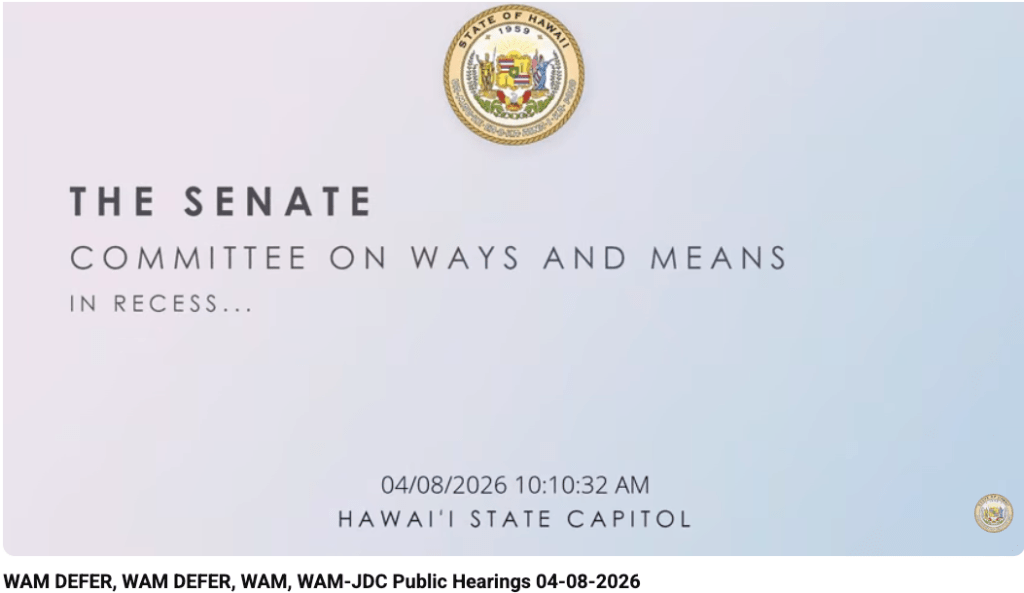
Exactly what was discussed during that 55-second private conversation between Dela Cruz and committee members? We’ll never know.
Then, Dela Cruz reconvened the public meeting. Image and sound came back online. He reviewed the budget and called for the vote, which was unanimous in support.
There was no mention of MACRO. Not one committee member asked any further questions about MACRO or said anything at all about its funding or impact on the budget. No member said anything about anything.
The meeting was adjourned.
Why This Is A Concern
Article III, Section 12, Paragraph 3 of the Hawaiʻi Constitution states: “Every meeting of a committee in either house or of a committee comprised of a member or members from both houses held for the purpose of making decision on matters referred to the committee shall be open to the public.”
The facts are indisputable:
- On April 8, the WAM committee held a meeting for the purpose of making decisions on matters referred to it.
- During that meeting, the committee chair called a recess and prevented the public from seeing or hearing what was being discussed by the committee.
- During that recess, the committee discussed, in private, the topic of MACRO within the context of budget decision-making.
- When the meeting reconvened, the chair publicly announced the WAM decision on HB 1800, the budget. However, all conversations referencing MACRO and the budget, and the actual process of decision-making for the entire budget, were held privately in discussions that were not open to the public.
And this wasn’t the first time.
On March 3, WAM “heard” and passed the previously referenced SB 3240. Like the WAM decision-making for HB 1800, the entire decision-making for SB 3240 was conducted in private. Watch this bill fly through on YouTube after the chair says, “The recommendation is to pass unamended. Any discussion?”
There was no discussion; there were no questions. The committee members just sat in silence. And then the vote was called. All 12 committee members present voted in support of SB 3240.
How is it possible to make a decision without any discussion? Is the chair a mindreader? Had every single committee member already made their decision before the meeting started, without discussing the issue or upcoming decision with the chair or other members?
Of course not.
Before the public meeting, the chair had to have discussed various options in private conversations (in-person or virtual) with committee members. And then, at the public meeting, he announced the decision made in those private discussions — in clear violation of the Hawaiʻi Constitution.
Though this matter is similar to that being litigated by eight citizen plaintiffs in Acasio v. House of Representatives, there are important distinctions.
In the Acasio case, the House Advisory Committee on Rules and Procedure met and made decisions without any public meetings whatsoever, not even fake ones.
In both SB 3240 and HB 1800, however, WAM went through the charade of holding public meetings — but every single word of the committee’s actual decision-making discussions occurred behind closed doors.
Why must regular citizens be forced to go to court just to make our lawmakers follow the Constitution?
 Sign up for our FREE morning newsletter and face each day more informed.
Community Voices aims to encourage broad discussion on many topics of community interest. It’s kind of a cross between Letters to the Editor and op-eds. This is your space to talk about important issues or interesting people who are making a difference in our world. Column lengths should be no more than 800 words and we need a photo of the author and a bio. We welcome video commentary and other multimedia formats. Send to news@civilbeat.org. The opinions and information expressed in Community Voices are solely those of the authors and not Civil Beat.
Read this next:

Local reporting when you need it most
Support timely, accurate, independent journalism.
Honolulu Civil Beat is a nonprofit organization, and your donation helps us produce local reporting that serves all of Hawaii.
ContributeAbout the Author