Beth Fukumoto: What High School Graduations Ought To Mean To All Of Us
They’re a reminder of who we are and who we are still trying to be.
June 1, 2026 · 9 min read


About the Author

The closest thing I can compare a Hawaiʻi high school graduation to is a wedding. At least that’s the only other life event that has ever left me so sleep-deprived, frantic and overjoyed all at once.
Last Saturday, my niece graduated from Mililani High School. My family spent months preparing, making candy lei, coordinating visits, booking senior photos and mailing announcements. Somehow, I still ended up with glue on my hands as I ran into the graduation ceremony, hoping the giant sign with her name on it would dry in time.
My sister and I made the sign together, the same way I made hers 20 years ago when glitter, Eva foam and sepia-toned photos felt like a real production. This time, it was a Canva design printed straight to a 20-inch x 30-inch poster board. In theory, it should’ve been easier, but when we read the FAQs we realized our first version wasn’t anywhere near big enough. The maximum allowable size was 5 feet by 8 feet.
We decided our only option was to double it — not an easy task at 9 p.m. on a Saturday. And, that’s how my sister and I found ourselves carefully aligning two halves of her daughter’s photo onto my old wedding arch with unbelievably sticky FlexTape and spray glue in a University of Hawaiʻi parking lot.

The ceremony itself — Stan Sheriff Arena, 600-plus graduates, three mandatory rehearsals — was the most traditional part. Structured, necessarily so. Moving that many teenagers through a commencement in two hours is an educational feat in itself. But, as anyone who has had the privilege of knowing a Hawai‘i graduate knows, the ceremony is only the beginning.
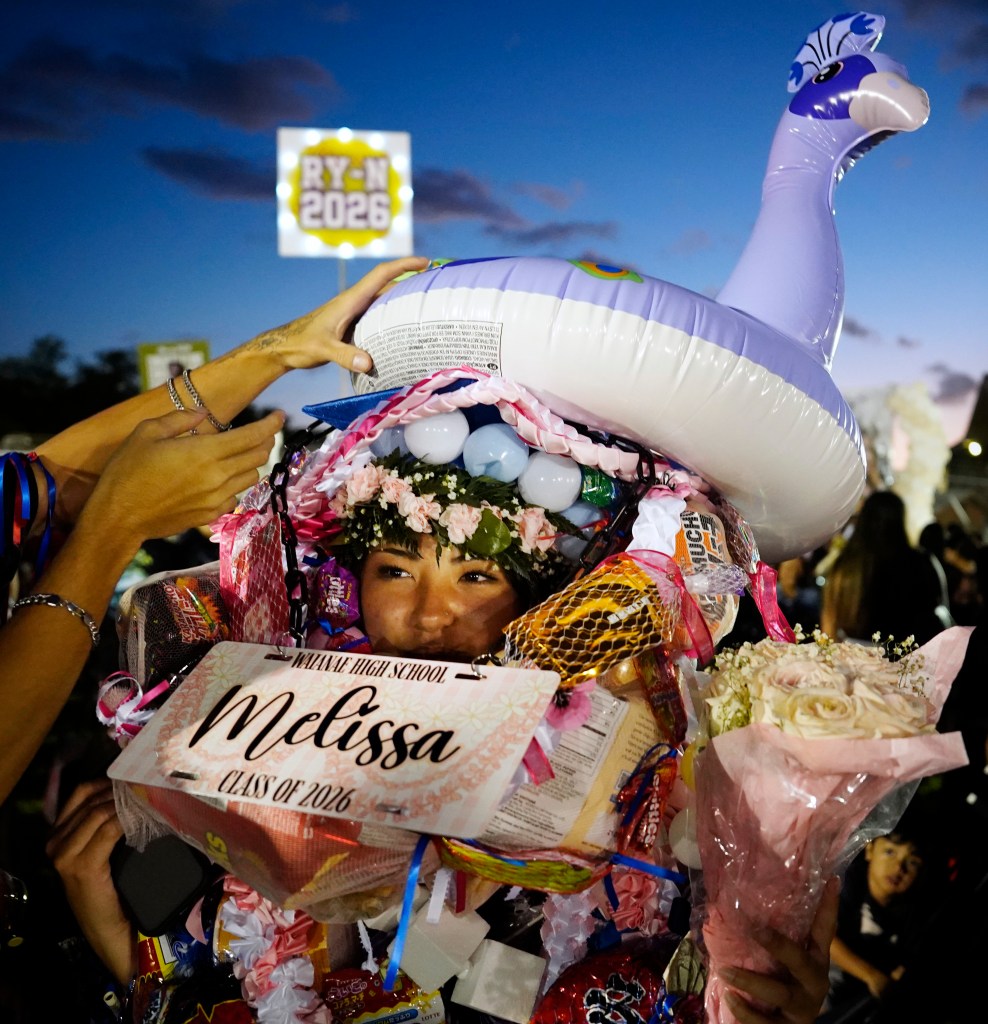
When the gates opened onto both the football and baseball fields afterward, that’s when the celebration really started. My sister and I hauled the sign, complete with battery-powered twinkle lights to mark the way, through the crowd looking for my niece. The field buzzed with thousands of people shouting names, sounding horns and a Bluetooth speaker blasting mid-2010 pop.
No two families were celebrating the same way, but the same intensity could be found everywhere. It’s the beautifully unique way we do graduation here, and as I stood there watching people from every part of my niece’s life find each other, I started wondering why. That question sent me down a rabbit hole of a century’s worth of newspaper archives and histories going back even further.
I started with the people who were here first. Malcolm Nāea Chun’s “No Nā Mamo,” a book on Hawaiian cultural beliefs and practices, explains that the Hawaiian word for education — aʻo — simultaneously means to learn and to teach. Knowledge was never meant to be held individually. It flowed in both directions, from teacher to student and back out to the community.
King Kamehameha III understood this. In 1824, he declared what historians describe as a “government of learning,” establishing a public school system across the islands. The examinations that followed — called hōʻike, meaning to show or demonstrate — were not quiet, individual affairs. They were massive community celebrations. Families and neighbors gathered to watch students display what they had learned. The idea that a young person’s educational milestone belongs to the whole community, that it should be witnessed and celebrated together, is not a modern invention.
Neither is lei giving. Long before graduation ceremonies existed in Hawaiʻi, Puanani O. Anderson-Fung and Kepā Maly explain in “Growing Plants for Hawaiian Lei ” that the lei carried a profoundly felt personal and spiritual significance, representing love, honor and respect. In ancient Hawaiʻi, lei were used in religious offerings and as chiefly regalia. Giving one was never casual.
Everything that came after — every lei draped over a graduate’s shoulders, every sign hauled across a parking lot, every envelope pressed into a young person’s hands — was layered on top of a foundation that was already here.
When immigrant families arrived, they added new meanings and traditions. For many families who came to work Hawaiʻi’s sugar plantations, education offered a way out. Despite the demands of plantation work, long commutes, and after-school Japanese language classes, students pursued schooling with what historians describe as significant ambition.
Meanwhile, the schools themselves had their own agenda. In the 1930s and 1940s, public school activities — student government, clubs, sports — were deliberately designed “with the purpose of assimilating the practical aspects of American democracy,” socializing immigrant youth into American civic life. Education was the path in, but it was also the mechanism of assimilation.
That tension came into sharp relief during World War II. Within two months of Dec. 7, 1941 public school enrollment across the islands had dropped by half. Twelve school properties were requisitioned by the military, with a total of 171 classrooms and eight auditoriums taken over. Between 500 and 600 McKinley students left school after Dec. 7, and fewer than half of the remaining students returned when schools reopened.
The ones who did graduate did so under conditions that stripped away almost everything that normally surrounded a commencement. At McKinley, seniors received two tickets each — no printed invitations, military police on campus. The ceremony’s theme was “The Code of a Good American.” Punahou was even more direct, calling its no-frills ceremony a “War Graduation.”
While most schools were limiting lei, guests and gatherings, Farrington High School’s class of 1942 got nothing. The school had been taken over by the Army after Pearl Harbor and converted into a hospital for the wounded. The class never walked, never received diplomas. One of those students, Ethel Nishimoto, finally got hers 82 years later on her 100th birthday.
But the traditions that survived the war didn’t just survive, they grew. By 1968, a Honolulu Star-Bulletin reporter called the Hawaiʻi graduation “a costly tradition” and set out to document exactly why. The answer came down to flowers and obligation.
Graduates commonly received as many as 40 lei. A parent named Mrs. Nagy explained the social mechanics plainly: “The responsibility falls on us, the parents, to see that our children have enough leis to show that they are sufficiently cherished.” And the reciprocal pressure: “You can’t very well just say ‘congratulations’ to these friends’ children when everyone else is handing out leis.”

Running parallel to the lei tradition was the Japanese American custom of reciprocal gift-giving — a system of mutual obligation called kosai that governed life-cycle milestones. A graduate’s high school commencement was their formal entry into this network: they received cash gifts from family, friends and relatives, which they would someday repay in kind. Dennis Ogawa captured the spirit of it in “Jan Ken Po” through a Sansei student’s wry complaint: “My mom made me save all my graduation money so I could give it away to all my relatives who are graduating.”
That’s the tradition I was raised in, but our graduation rituals come from everywhere. It’s dozens of traditions that have been living next to each other long enough to start borrowing from one another, like origami money lei. And, every so often, when something disrupts it, we’re reminded just how powerful they are. Like when COVID shut down schools, families invented drive-by lei ceremonies rather than let the moment pass unmarked.
That’s why last Saturday’s graduation felt like so much more to me than watching my niece finish her high school career. It was a gathering of an entire town and a wider community commemorating an idea older than everyone present — that no one achieves anything on their own; we succeed together. It was a reminder of who we are and who we are still trying to be.
For many of the graduates on those fields, Hawaiʻi will become somewhere they’re from rather than somewhere they live. The cost of housing remains a defining economic reality that shapes what comes after the diploma. Students who leave for college on the mainland often don’t come back, not because they don’t want to, but because they can’t afford to. The celebration carries that weight, even when nobody says it out loud.
It’s also a reminder that the system that makes these celebrations possible has not kept its promise equally. Native Hawaiian students remain underrepresented in higher education, which is a direct consequence of the same Americanization campaign that moved immigrant families into the professional class. The schools designed to teach students “the practical aspects of American democracy” were the same ones suppressing ʻōlelo Hawaiʻi, the Hawaiian language, in classrooms across the islands. The foundation this celebration stands on was built on a culture that those schools actively worked to erase.
We, the graduates included, have a responsibility to address these wrongs and inequities together, too. The impulse on that field — to show up in force for each other — is the right one. The question is whether we’re willing to extend it past the football field. The community that strings flowers at midnight, hauls signs through parking lots and presses cash into envelopes is capable of demanding more from the institutions that determine the world these graduates step into.
 Sign up for our FREE morning newsletter and face each day more informed.
Read this next:

Local reporting when you need it most
Support timely, accurate, independent journalism.
Honolulu Civil Beat is a nonprofit organization, and your donation helps us produce local reporting that serves all of Hawaii.
ContributeAbout the Author