Kirstin Downey: Tracing The Footsteps Of Hawaiian Royals Abroad
Queen Emma paid a visit to this small museum in the English countryside 160 years ago.
June 30, 2026 · 6 min read


About the Author

Scholars have spent decades tracking down ancient Hawaiʻi treasures, many dispersed to the winds, given away as gifts, sold or bartered to explorers in the first decades after the archipelago’s existence became known outside Polynesia.
They have ended up in many places, but most particularly in the United Kingdom, in museums large and small, because so many of the first seafarers to arrive on our shores were British. And once there, many objects have been moved from place to place.
It takes a long journey from the islands, almost literally to the other side of the earth, to see some of them for yourself. But Queen Emma, the wife of Kamehameha IV, who ruled Hawaiʻi from 1856 to 1863, even after a long sea voyage to the United Kingdom, found the time to make a detour to a small medieval market town 55 miles north of London, Saffron Walden, to catch a peek at one of these precious items lost from Hawaiʻi.

Ideas showcases stories, opinion and analysis about Hawaiʻi, from the state’s sharpest thinkers, to stretch our collective thinking about a problem or an issue. Email news@civilbeat.org to submit an idea or an essay.
I spent the past six weeks working in the British archives looking for material for a biography I have been researching about King Kaumualiʻi of Kauaʻi. Born in 1780, his life was irrevocably affected by the arrival of European visitors in 1778.
A high point of my stay in London was a visit to the British Museum’s recent exhibit, Hawaiʻi: A Kingdom Crossing Oceans, so evocatively described by my fellow Civil Beat columnist, Makana Eyre, a few weeks ago. The exhibit was spectacular, and also had some intriguing connections to Kaumualiʻi, including one of its highlights, which was a feathered cloak given by his uncle, Chief Kahekili, to Capt. Charles Clerke, who took over command of the expedition after Capt. Cook died at Kealekekua Bay.
But the search for records and documents in Hawaiʻi took me also to Saffron Walden, which got its name because it formerly marketed the spice saffron. It’s the home of a charming, old-fashioned museum that houses an exhibit on Polynesia.
Queen Emma made the trek to visit the Saffron Walden Museum herself in May 1866.
At that time the Saffron Walden owned a splendid feather cloak that had belonged to Hawaiian King Liholiho, the son of King Kamehameha. The British Museum exhibit, in fact, was a commemoration of the 200th anniversary of Liholiho’s visit to London, where he’d sailed in hopes of an audience with British King George IV.
Kaumualiʻi, Liholiho’s stepfather, was worried about the rigors of the trip, particularly as the young king had recently been ill, and he urged him not to go. But Liholiho was determined and he set off with his wife Kamāmalu on what became a five-month voyage, arriving in England in May 1824.
Liholiho visited the British Museum in June 1824. By that time, the museum had four cases dedicated to what it called the Sandwich Islands, including feathered cloaks and helmets, carved wooden serving dishes and hand-fashioned tools and weapons.
Liholiho and his wife tragically died of measles while awaiting the royal meeting. But the British government cemented its relationship with Hawaiʻi by bringing the bodies home for burial. They rest today at Mauna Ala, the royal cemetery at Nuʻuanu.
The British Museum’s holdings of Hawaiian objects now comprise the largest single repository of Native Hawaiian works outside of Hawaiʻi. The exhibit catalog lists some 70 pages of items it holds from the islands — in total some 950 objects, including 29 feathered capes, about a fifth of those known to be in existence.
The small museum at Saffron Walden is at the opposite end of the scale.
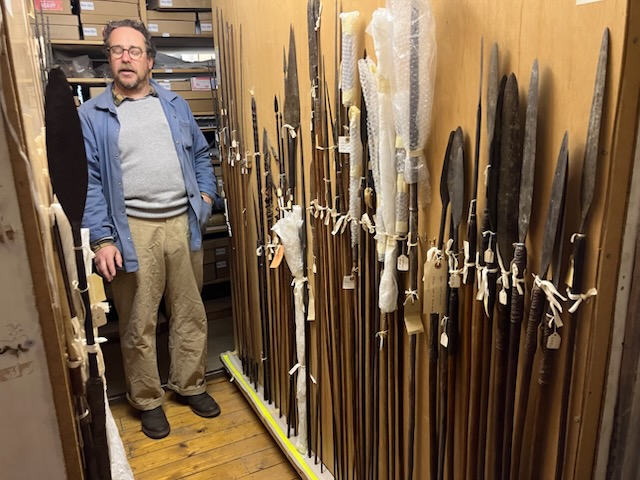
When I arrived, Simon Hilton-Smith, collections assistant for human history, warmly welcomed me, gave me a tour of the Polynesian exhibit and even ushered me into the museum’s storage rooms, where I was able to see some of the many items housed there.
The museum was founded in 1833 by three wealthy public-spirited science enthusiasts, one Catholic, one Protestant and one Quaker, a rare ecumenical collaboration for the day, according to Hilton-Smith. They wrote everyone they could think of to ask for items that represented the history of both science and human culture.
Over the centuries the museum has accumulated almost five dozen items from Hawaiʻi, including spears, antique bowls and yards and yards of colorful cloth made from kapa, known in the past as tapa.
Hawaiʻi’s Queen Emma visited in the 1860s and presented the museum with gifts, including kapa cloth, Hilton-Smith recounted, as well as a feathered kāhili, with a handle made of polished ivory and ebony.
He said she had been particularly interested in seeing a feathered cloak that Liholiho had taken to England.
In fact, Emma persuaded the museum to allow the cloak to travel to France, where the Hawaiian kingdom was putting on an extensive exhibit in a grand pavilion at the Paris Exposition Universelle, a world’s fair, according to J. Susan Corley, writing in the “Hawaiian Journal of History.“
The cloak came to Saffron Walden as a bequest from the family of Frederick G. K. Byng, who had served as diplomatic liaison to Liholiho during his visit to London. They said that Liholiho had given it to Byng as a gift, and they, in turn, gave it to the museum as a gift.
Hilton-Smith allowed me to go through the pages of the museum’s hand-written collection register from the 1880s, with its carefully rendered depictions of the items in its holdings. The feathered cloak is painted as vibrantly beautiful, red with yellow stripes.
Unfortunately, however, the museum later came under financial strain and, in 1948, the cloak and a few other items were sold to the Scottish national museum for 600 pounds.
Then, when the Scottish museum put the cloak on display in 2011, word of the exhibit circled back to Hawaiʻi. Corley alerted people there to its latest whereabouts in the pages of the “Hawaiian Journal of History.” For preservation purposes, the cloak has been rotated in and out of display. The public will be able to see it again in a few years.
It marked yet another move for the cloak, which had traveled from Honolulu to London to Saffron Walden to Paris, back to Saffron Walden. It now rests in Edinburgh.
 Sign up for our FREE morning newsletter and face each day more informed.
Read this next:

Local reporting when you need it most
Support timely, accurate, independent journalism.
Honolulu Civil Beat is a nonprofit organization, and your donation helps us produce local reporting that serves all of Hawaii.
ContributeAbout the Author