UH Mānoa ASL Interpreter Training Program Needs Critical Funding
The consequences of this shortage extend well beyond the classroom. A lack of qualified professionals in hospitals and courtrooms can be a matter of life and death.
June 1, 2026 · 8 min read


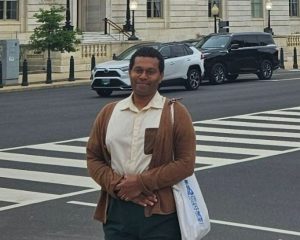
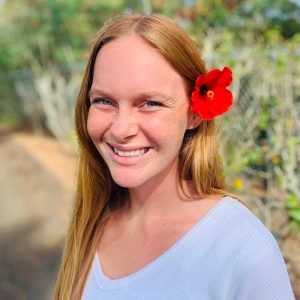
About the Authors


The Disability and Communication Access Board advocated for a bill to establish a bachelor’s degree for an American Sign Language interpreter training program at the University of Hawaiʻi Mānoa.
“I never had an ASL interpreter until I was in the fourth grade,” recalls Justin “Pono” Tokioka, DCAB communication access specialist, who was born and raised on Kaua’i.
Tokioka’s experience is not unusual. For thousands of deaf residents across Hawaiʻi, access to qualified interpretation remains inconsistent, unequal, and in some cases, entirely absent.
According to a 2024 report led by the Disability and Communication Access Board, Hawaiʻi faces a significant shortage of ASL interpreters. An estimated 2,800 residents and 500 daily visitors rely on ASL, but there are only 30 certified interpreters statewide.
Access is especially uneven on neighboring islands like Kauaʻi and Maui. When interpreters fly to neighboring islands to work, that means one or more interpreters are not available on Oʻahu.

Ideas showcases stories, opinion and analysis about Hawaiʻi, from the state’s sharpest thinkers, to stretch our collective thinking about a problem or an issue. Email news@civilbeat.org to submit an idea or an essay.
The consequences of this shortage extend well beyond the classroom. In Hawaiʻi’s hospitals, courtrooms, and schools, the lack of qualified professionals can be a matter of life and death.
Inga Park Okuna, an ASL interpreter on Oʻahu for 46 years, has seen on the front lines how a lack of clear communication puts patients at risk. “People did not understand their medicine. They did not understand their health concerns.
Without an interpreter, they would not have understood what this medicine was for, (or) how much to take. Some people came in with really horrible misconceptions about what was wrong with them — they thought they knew, and they were really off. I think, honestly, interpreting — we’re saving lives.”
Communication Access Is Vital
Providing communication access is not only vital in medical settings but also in the
courtroom.
Linda Lambrecht, a certified deaf interpreter on Oʻahu, who has decades of experience advocating for deaf clients in legal settings, explained, “I helped free three people from wrongful incarceration through my work.”
Lambrecht continued that something as small as a nod can lead to miscommunications and false assumptions with serious potential legal consequences.
Despite miscommunication that can result from a lack of interpreters, the funding request has faced pushback from those who believe the use of technology and written communication are sufficient.
However, these are dangerous misconceptions. The common misconceptions are: ASL is a signed form of English.
“I helped free three people from wrongful incarceration through my work.”
Linda Lambrecht, a certified deaf interpreter
American Sign Language is a structurally different language from English. In English, word order is very linear, while ASL uses space, movement, and facial markers. Hand location, shape, orientation and movement, facial expressions, and eye gaze all convey crucial meanings.
Written English can substitute for an interpreter.
For many in the deaf, hard of hearing, and deaf-blind communities, written English is a second language. English homonyms and idioms may lead to confusion. This makes communicating with handwritten notes ineffective and risky in high-stakes environments.
The Time Is Now
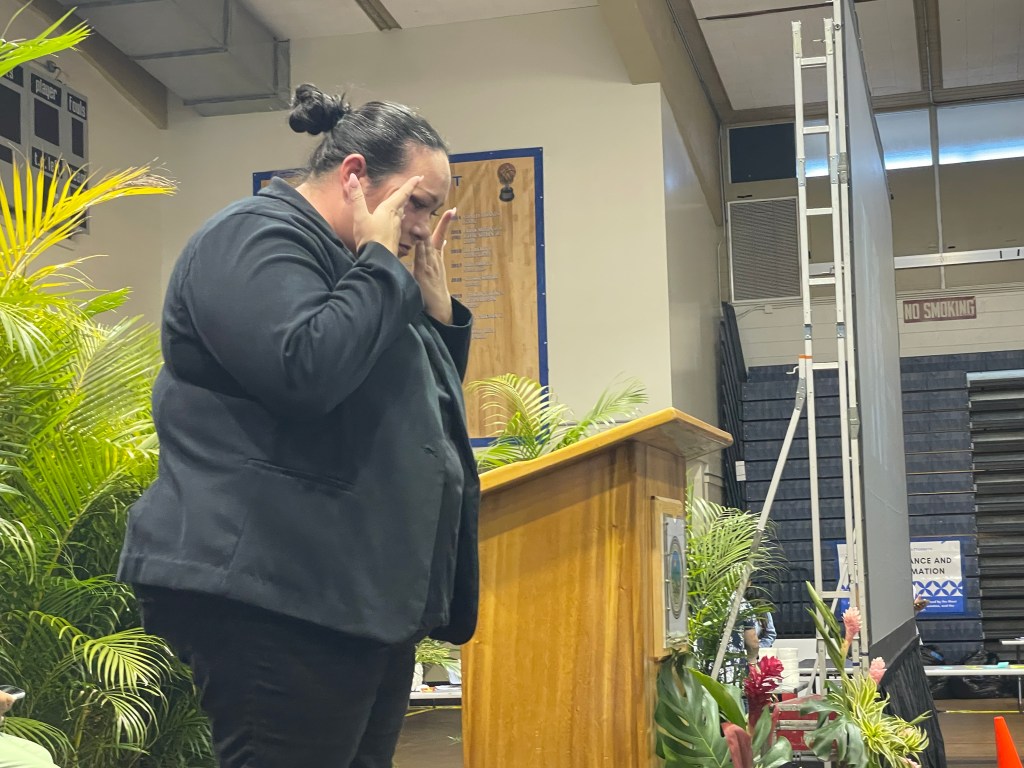
Andrea Berez-Kroeker, associate dean of the College of Arts, Languages, and Letters at UH Mānoa, states, “The pandemic really laid bare the shortage of qualified interpreters. When DCAB reached out to the Dean’s Office in fall of 2025 to start discussions about implementing a training program at Mānoa, we knew the time was right.”
Hawaiʻi is currently one of only eight states in the country that does not offer a local Interpreter Training Program. Without a locally grounded ITP, the state has relied on importing talent from the mainland. However, this has been failing due to the islandʻs high cost of living.
Sabina Wilford, head of operations at Hawaiʻi Interpreting Services, explains that the shortage of interpreters is complicated by a loss of interpreters due to both high living costs in Hawaiʻi and a shift to remote work during the Covid-19 pandemic.
University of Hawaiʻi students Armando Molina Gómez, a Ph.D. student in linguistics; and Michol Malia Miller, a graduate student, created this video.
“When Covid hit, a lot of people started going remote,” Sabina says. “There’s a shortage of qualified people. We lost about eight people a couple years ago. They all moved back to the mainland within a period of one or two years.”
While remote access offers flexibility, she explains that the downside is a depleted local workforce.
“That’s not leaving people in the pool to go out and do the local work.”
The consequences of having insufficient interpreters are already visible and affecting the community. The DCAB report cites the 2023 Maui wildfires as an example.
Lifesaving Information
For the first three days following the disaster, there was no on-site ASL interpreter available for emergency press conferences. Many deaf residents, consequently, were left out from receiving the vital, lifesaving information.
Without a permanent and local training program, residents remain at the mercy of an inequitable system.
Interpreting services “are not just a convenience,” the report concludes, “they are a fundamental right.
Zoh Qureshi, an ASL instructor at UH Mānoa, shares his initial shock when he first arrived in Hawaiʻi.
“When I moved here, I had envisioned that there would be interpreter access. And my bubble burst. There’s weak human rights here. They don’t have rights when you ask for an interpreter. There’s a shortage. There’s not enough.”
One of the authors of this article, Leniker Thomas, who is deaf, also experienced this lack of available interpreters when he began his studies at UH Mānoa in fall 2024.
Even though the university has support for students like Leniker, it was difficult to secure interpreters for his courses.
In light of this situation, House Bill 1800, which merged Senate Bill 2412 and House Bill 2588, proposed $140,000 to fund the first step in establishing a bachelor’s degree program for ASL interpreter training at the University of Hawaiʻi Mānoa.
The DCAB stresses the importance of acquiring Hawaiʻi’s culture for interpreters practicing in Hawaiʻi.
Tokioka says, “It’s important for interpreters who move here from the mainland to understand Hawaiʻi’s culture, language, and the local deaf community here in Hawaiʻi too. It’s not only the Hawaiian language or general regular speech, how people speak in Hawaiʻi, but also the deaf community.
There’s a local aspect to our sign language and the interpreters have to get involved with the deaf community and build relationships.”
The DCAB report also emphasizes that “knowing ASL” is not enough to serve as an interpreter.
Interpreting is a complex skill that requires mastery of linguistic skills, cultural knowledge, and ethics.
“Interpreting is a specialized skill that takes specialized training. Just because you know a language doesn’t mean you have the capability to interpret — especially with sign language, where we do simultaneous interpreting. We don’t stop. We just keep going.” Okuna says.
To address and accomplish the necessary skills to become ASL interpreters, DCAB argues for a specialized training program to be established at the University of Hawaiʻi Mānoa’s Department of Linguistics.
Amy Schafer, chair of the Linguistics Department at UH Mānoa, stressed that “the scientific literature firmly establishes that when deaf children fail to receive full language access, such as when there are not enough sign language interpreters at their schools or they cannot go to a specialized school for the deaf, their language development suffers, with measurable consequences that last to adulthood.
Knowing this body of literature, it is unconscionable to me for the state to not do all it can to ensure that we have all of the interpreters and communication support that we need for the people of the state.”
Currently, over 365 students are enrolled in ASL learning courses at UH Mānoa, with many more on waitlists, proving that the local demand and interest is already surging.
Until the program is formally established, ASL instructor Zoh Qureshi has one piece of advice for his students: “Get active in the local deaf community.”
The establishment of this program would mark the first bachelor’s degree in ASL interpreting in Hawaiʻi’s history — a milestone that DCAB says is long overdue.
Hawaiʻi must ensure that for our deaf, hard of hearing, and deaf-blind communities, communication access is recognized not as a luxury but as a fundamental human right.
To increase the pool of 30 ASL interpreters, in which about five will retire in less than five years, the time is now to implement an ASL ITP for our community’s future and for the coming generations.
This article was developed in a graduate course on public sociolinguistics during the spring semester of 2026 at the University of Hawaiʻi Mānoa. Armando Molina Gómez, Michol Malia Miller and Christina Higgins contributed to this article.
 Sign up for our FREE morning newsletter and face each day more informed.
Community Voices aims to encourage broad discussion on many topics of community interest. It’s kind of a cross between Letters to the Editor and op-eds. This is your space to talk about important issues or interesting people who are making a difference in our world. Column lengths should be no more than 800 words and we need a photo of the author and a bio. We welcome video commentary and other multimedia formats. Send to news@civilbeat.org. The opinions and information expressed in Community Voices are solely those of the authors and not Civil Beat.

Local reporting when you need it most
Support timely, accurate, independent journalism.
Honolulu Civil Beat is a nonprofit organization, and your donation helps us produce local reporting that serves all of Hawaii.
ContributeAbout the Authors