Are Hawaiʻi’s Elections Safe From Donald Trump?
The president and his minions are doing everything they can to limit voting nationally. So far, they are failing “bigly.”
July 19, 2026 · 12 min read

About the Author

Despite what’s described as an “unprecedented” assault on the right to vote by the Trump administration, national and local experts tell me Hawaiʻi voters should feel confident in safely and securely doing their civic duty this year.
That’s largely because the courts, the Congress and the Constitution have for now blocked the president’s multiple efforts to make it harder to vote.
It’s an urgent matter: Ballots for the Aug. 8 primary are set to begin arriving in Hawaiʻi mailboxes by Tuesday, if not sooner, and official ballot drop boxes are already being rolled out including 17 on Oʻahu.
And on Saturday the Hawaiʻi Office of Elections tested voting equipment at the State Capitol with the help of official observers representing political parties, community groups and individuals.

In addition to a string of court victories denying Trump’s efforts to suppress the vote, Judith Mills Wong, president of the League of Woman Voters of Hawaiʻi, said Hawaiʻi is in a much better position to withstand attacks on voting than other states. She credits it to a state government, a Legislature, an attorney general and office of elections that she described as “very pro-voting.”
“The Legislature passed vote-by-mail and has taken several other steps to secure our elections,” she said via email. “Our AG has joined other parties to sue to stop the most egregious attacks on our process and continues to watch the national situation to be ready to act again. Our Office of Elections has already developed many of the safeguards that other states are just beginning to consider.”
And yet, election concerns fester.

Just last week Trump fired the remaining two Democratic members on the U.S. Election Assistance Commission — “the latest example of Trump’s efforts to overhaul elections and groups that work to support them,” The Hill reported.
The independent, bipartisan commission was formed in the wake of the disputed 2000 Gore v. Bush presidential election to help improve the administration of and participation in elections.
Most recently, in a primetime address Thursday that was not carried on multiple major broadcasters, Trump again raged about how the 2020 election he lost to Joe Biden was somehow rigged. He accused China of interfering and claimed government officials intentionally played down the efforts.
“The president said his purpose ‘is not to weaken confidence’ though critics say he has done just that,'” CNN reported.
The next morning, Homeland Security Secretary Markwayne Mullin said officials who don’t cooperate with the administration’s election security efforts “may be slapped with fines — and potentially prison time,” Politico reported.
Here at home, meantime, the Hawaiʻi Elections Commission (which oversees the Office of Elections) canceled a public meeting earlier this month that was intended to have commissioners select a temporary chair.
Raymund de Vega, who handles voter services for the Office of Elections, said in an email he could not comment on why the meeting was canceled, the status of the search for a chair and when the commission might meet again.
This is the same commission, mind you, that investigates and holds hearings for receiving evidence of any violations and complaints about our elections. Based on our recent electoral history, I think it’s a safe bet that there will indeed be complaints in Hawaiʻi come Aug. 9.
And based on what happened in 2020 — and on Jan. 6, 2021, and what Trump said Thursday — I think it’s a very good bet that Trump and Co. will cry foul should the midterms not go the GOP’s way. It’s not beyond imagination that this president in particular might deploy federal troops, seize voting machines and stop counting ballots.
The Ballots Question
That’s presuming the ballots even get mailed out, of course.
Scott Nago, Hawaiʻi’s chief election officer, said at a recent legislative briefing on the 2026 primary and general election that it is was “very unlikely” that the U.S. Postal Service would be forced to comply with a recent Trump federal order restricting delivery of mail-in ballots.
“My understanding is it’s very unlikely, because it’s been enjoined by the court, and I don’t know if there’d be enough time for a court to (act),” he told lawmakers July 8 at the Capitol, two days after a court intervened to stop Trump’s order. “It would affect the whole nation, so I don’t know if there’s enough time for the court to actually overturn that.”
Still, state Sen. Karl Rhoads posed a hypothetical question at the briefing: What if the USPS does, in fact, refuse to deliver the ballots? Is there a plan B?
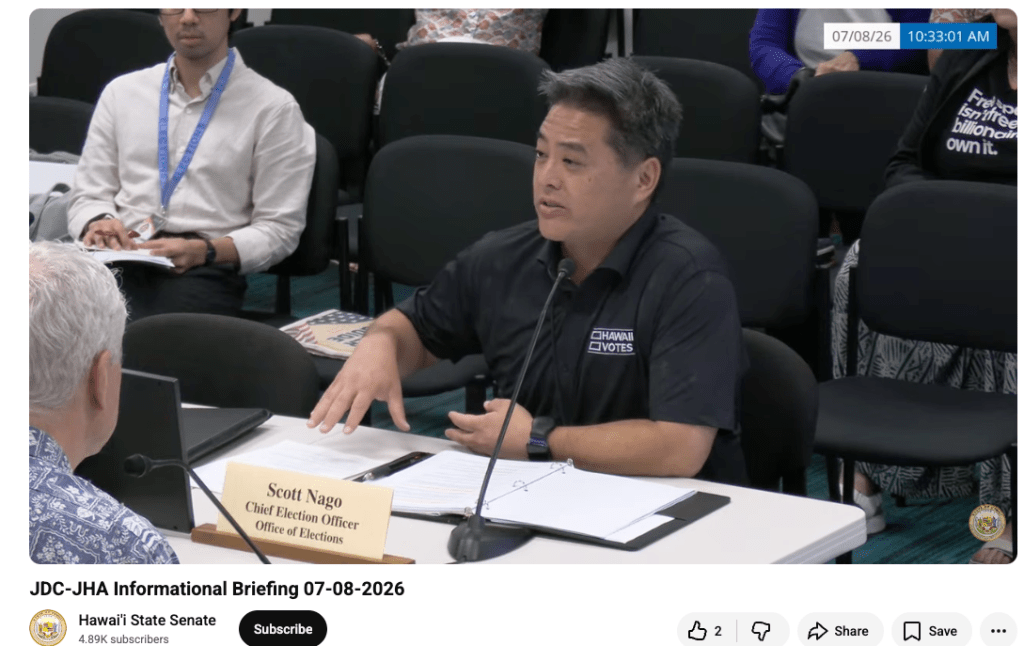
Nago said he was reluctant to engage in hypotheticals. But he did indicate that his office would have to do something if ballots were not delivered.
“Our mission is to provide convenient, accessible services to the voters, and that’s what we have to do,” he said.
To that end, Nago said it was possible that more voter services centers could be opened. Another option is for the Hawaiʻi attorney general to sue the USPS.
And then there is the option of trying to find “a different way to deliver the mail,” meaning FedEx or the United Parcel Service — a very expensive alternative, said Nago. Such a scenario was improbable for the primary, he explained, as other states have already held their primaries. Nago said it would be unfair to hold some states “to a different standard.”

Rhoads said he generally agreed with Nago that the courts would not act to aid the Trump administration.
“I think it’s a very unlikely scenario, especially the way the court cases have fallen so far,” he said at the hearing. “But I do think you probably better start thinking about the worst case scenarios, because what the government is threatening is that they will not mail the ballots, and that would throw a serious monkey wrench in your efforts to have an election.”
Rhoads indicated that the Legislature could help with the added expenses.
The Trump Threat
Trump, as everyone knows, believes the 2020 election was stolen from him. He is wrong about that, and there is plenty of evidence and dozens of court rulings to back that up.
Trump is also wrong that voting by mail is easily susceptible to fraud (of note: he and Melania actually vote by mail), that if mail-in balloting is to be allowed then ballots should be delivered and counted on election day (Congress leaves those decisions to the states, and it’s impossible to finish the count in large vote-by-mail states like California).
The president is also wrong that the feds should have access to state voter rolls and other data to ensure they are legitimate (as noted already, states run elections, not the federal government), that electronic voting machines can be hacked and manipulated (that’s a pretty remote possibility, say the experts) and that documented proof of citizenship and photo identification is needed to prevent noncitizens from voting (this is extremely rare).
The real danger to U.S. elections, say experts with the independent, nonpartisan law and policy Brennan Center for Justice, actually comes from Donald J. Trump.

“What we are witnessing from the Trump administration is unprecedented,” Sean Morales-Doyle, director of the center’s Voting Rights and Elections Program, told me in a recent phone call. “For the first time I think really in our nation’s history, the primary threat to our elections is coming from the White House, and that has taken the form of a comprehensive campaign to undermine our elections, that includes these letters to election officials but really includes a multi-pronged campaign — everything from multiple executive orders being issued, using the Department of Justice to harass and intimidate, removing the election security apparatus in the federal government.”
That campaign, however, has been unsuccessful, said Morales-Doyle, because of pushback from the courts, other elected officials, the states and voters themselves.
“We’re continuing to see this campaign play out,” he added. “In some ways, it’s looking more desperate every day — and I think that that’s the case with these (DOJ) letters — but it is being successfully thwarted thus far, and that is encouraging.”
One proposal still alive is the federal SAVE Act (or SAVE America Act), a “show-your-papers” requirement for voters to produce a certificate of birth or a passport to register to vote.
“Unfortunately, the House has passed it twice now, and they can keep on passing it if they want, but the prospects in the Senate are quite dim,” said Morales-Doyle. “They haven’t been able to get it done so far, and there’s no sign of that changing.”
Hayne Yoon, senior counsel in the Brennan Center’s Voting Rights and Elections Program, agreed with her colleague and expanded on his points in the same phone interview.
“In the criminal investigations context, we’ve seen the Justice Department take steps in a number of different jurisdictions to actively investigate the elections from 2020, and so far those do not appear to have led to any charges of election officials,” she said. “And again, it seems part and parcel of the administration’s attempts to undermine faith in our elections.”
Could Trump still somehow halt the midterms?
“The president has no power to cancel our elections,” said Morales-Doyle. “He has no power to stop our elections. So far his campaign to undermine our elections has lost in court every single time it’s been challenged.”
“I would say to the Hawaiʻi voters, go vote and encourage your family members, your friends, folks in your community to vote,” said Yoon. “Voting is one of our most fundamental rights. It’s what makes us a strong democracy. There is no reason to have any doubts in our elections, and folks should feel confident and comfortable and safe in voting.”
The Divided Commission
Another worry about the midterms has been fostered by the Hawaiʻi Elections Commission itself, which for several years has been plagued by allegations of elections fraud and demands to fire its chair and the chief elections officer.
Investigative panels have found what are described as voting irregularities in the 2024 general elections in Kauaʻi and Hawaiʻi counties that some commissioners suggest call into question the final results as well as the entire voting process.
The elections commission has also asked the Legislature to return the state to same-day, in-person voting with some exceptions such as military personnel stationed overseas. And they’d like audits of the full 2024 election.
Those findings and requests have gone nowhere, however. Meantime, the commission is so divided that it has not been able to agree on a new chair or even a temporary one to replace Mike Curtis, who completed his term June 30.
High turnover has also impacted the commission’s work. Ralph Cushnie, the commissioner who has led efforts to question the integrity of Hawaiʻi elections, was just reappointed by House Minority Leader Lauren Matsumoto to a new four-year term. But a Cushnie ally, Dylan Andrion, unexpectedly quit his term two years before it was scheduled to end.
GOP Sen. Brenton Awa selected Tamara McKay, a former chair of the Hawaiʻi Republican Party, to replace Andrion. Awa also selected Jason Bryant to replace Lindsay Kamm, whose term expired last month. He is a member of the Army National Guard and a systems engineer.
And just this week House Speaker Nadine Nakamura named Liana Horovitz to replace James “Kimo” Apana, whose term also just ended. Horovitz is a history professor at the University of Hawaiʻi Maui College.
The updates come courtesy de Vega. “Beyond that, we are unable to provide comment on the Commission due to pending litigation,” he said last week.
Speaking of litigation, doubts about election integrity, the kind that Trump has been sowing since before he first ran for president in 2016, continue to swirl even in Hawaiʻi.
Rep. David Tarnas, who chaired the informational briefing with Sen. Rhoads last month, thanked Nago, the chief election officer, for trying to counter fake narratives through a Rumors vs. Facts section on the elections office website.
Nago said the website has been updated to reflect the present reality. They include the following entries:
- Rumor: Voters are required to provide proof of U.S. citizenship to register and vote. Fact: Hawaiʻi voters are not required to provide proof of U.S. citizenship to register or vote.
- Rumor: Because proof of U.S. citizenship is not required, there are no guardrails to prevent non-citizens from voting in Hawaiʻi’s elections. Fact: There have been no confirmed findings of widespread non-citizen voting occurring in Hawaiʻi’s elections.
- Rumor: My personal information is widely available to bad actors because I am registered to vote. Fact: Election officials do not release sensitive personal identifying information such as your Social Security number, Hawaiʻi driver’s license, or Hawaiʻi State ID information through public information lists.
Voting in Hawaiʻi is safe, then, but is it guaranteed to remain safe?
“It is true that the current administration continues to attempt to disrupt the election process,” said Mills in an email earlier this month. But the remedy, she argued, is voting.
“The most important thing individuals can do is to vote. Your vote sends a message to the federal government and every candidate running that you are paying attention and you refuse to have the right to vote taken away from you.”
 Sign up for our FREE morning newsletter and face each day more informed.
Read this next:

Local reporting when you need it most
Support timely, accurate, independent journalism.
Honolulu Civil Beat is a nonprofit organization, and your donation helps us produce local reporting that serves all of Hawaii.
ContributeAbout the Author