Kirstin Downey: Waimānalo Kauhale Project Catches Many Off Guard
The Green administration is moving quickly despite Native Hawaiian concerns that the homeless project will push out Hawaiians who have been waitlisted for decades.
July 20, 2026 · 9 min read

About the Author

Another controversial kauhale project is under construction, this one in Waimānalo, stirring fear and suspicion among some of the Native Hawaiian residents affected by it.
Gov. Josh Green’s signature initiative in office has been championing a string of speedy, pop-up construction projects to house the homeless. He is propelling this work forward through his unprecedented use of executive orders that bypass ordinary financial controls and land-use regulation.
Civil Beat reporting into Green’s program has uncovered multiple problems, including questionable spending, allegations of construction violations and $21,000-a-month utility bills. In April, the state auditor issued an urgent warning that the program was riddled with accounting flaws.
In Waimānalo, the complex has been developed quietly, without any of the public meetings that usually precede big development projects. Normally a project would be presented to the local neighborhood board for discussion long before it breaks ground.
But months into construction in Waimānalo, the dozens of residents who crowded into a small community room last Monday night, desperate for answers, received only a truncated, partial explanation of the plan.

Waimānalo residents are generally supportive of the need to help the homeless because high housing prices have affected all of them as well, but the level of local concern here seems more than justified.
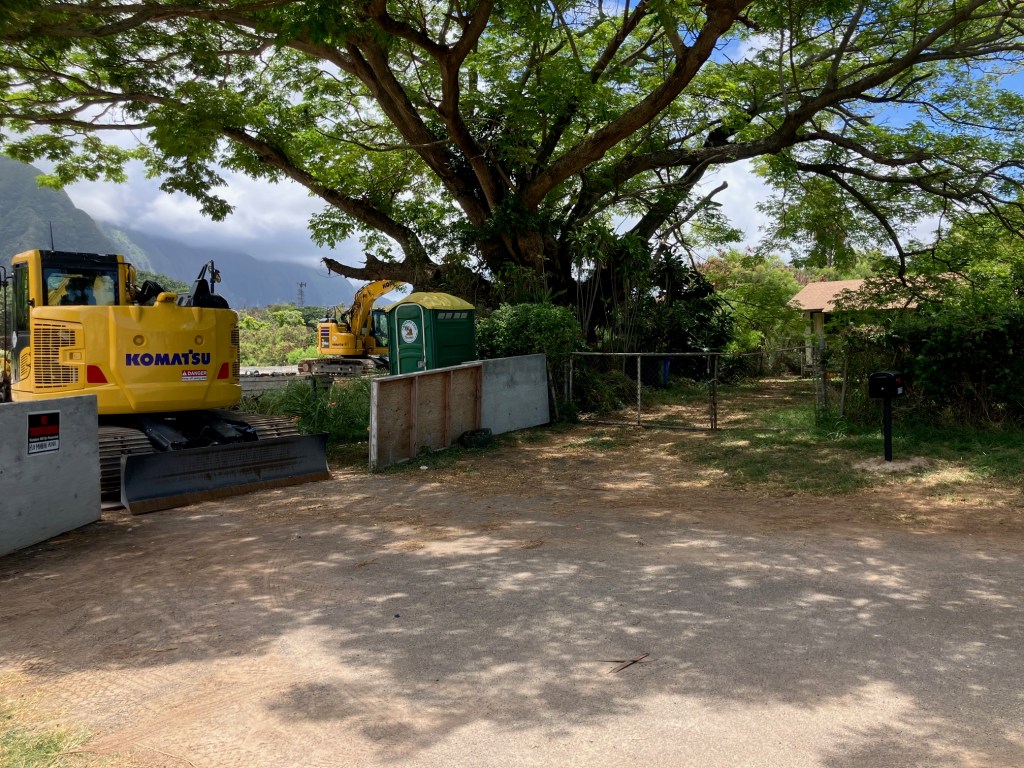
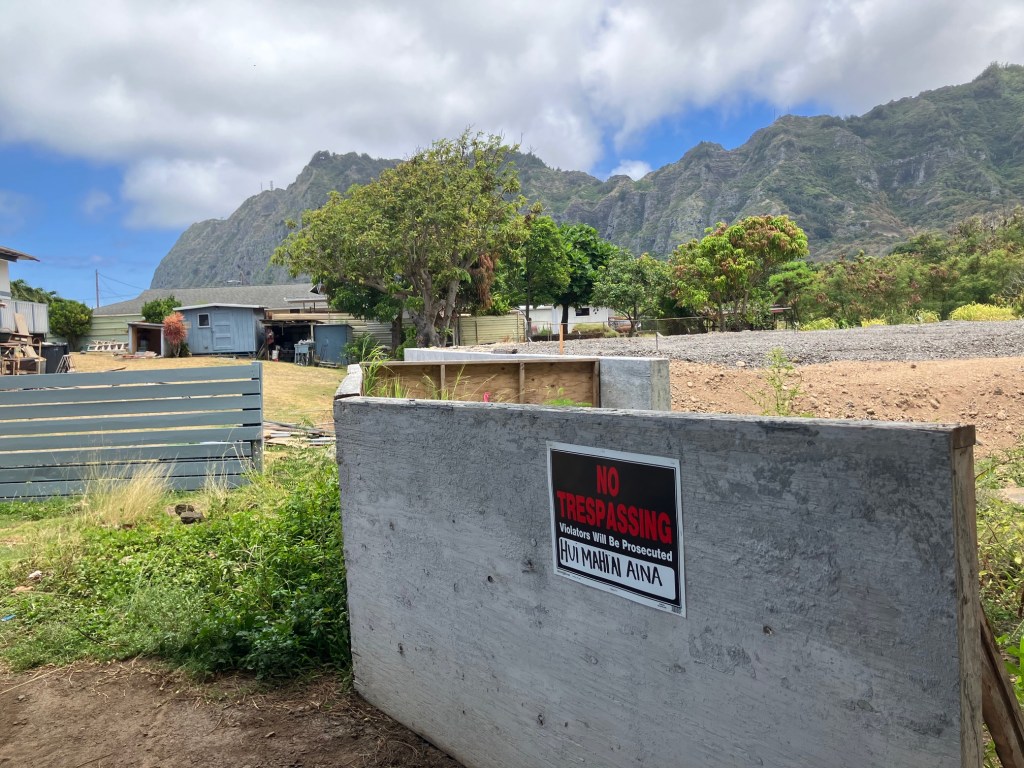
The expansive project abuts and looms over a rural family residential neighborhood in Waimānalo.
It is knowingly being built in a flood plain, in an area known for historic deluges, and the construction process has already caused flooding damage to neighbors. March’s Kona lows sent deep water flowing around the base of the project site onto the lawns of nearby homes.
Using carted-in dirt, the site is being elevated 13 feet, which is higher than surrounding homes. A 4-foot retaining wall was built to hold the foundation in place and compensate for the additional flooding that likely will occur. It was constructed without city permits.
Construction was initiated without a review by the State Historic Preservation Division, in a place that has been culturally significant to Hawaiians for centuries.
Built on state-owned land mauka of ‘Olu‘olu Street, the project is within the general area of the Hawaiian homelands, in a place designated for Hawaiian homes more than a century ago — with only a fraction of the homes ever having been built for their intended beneficiaries.
Foliage and bushes, including fruit trees and Hawaiian medicinal plants, were bulldozed without obtaining city permits.
Green has arranged for the project to be initially managed by the institutionally secretive state Department of Human Services. That is a particularly sore spot for area residents because DHS is very familiar to them as the agency that failed to provide adequate oversight of a 6-year-old girl in Waimānalo, Ariel Sellers. Waimānalo residents organized a massive community search for her body and have avidly followed the effort to prosecute the child’s adoptive parents, who are alleged to have tortured and murdered her. The community continues to hold regular remembrances of her.
DHS, in fact, has a sadly consistent history, chronicled over the past decade by Civil Beat Investigations Editor John Hill, of neglect, incompetence and resistance to recognizing defects and remedying them.
Much remains unrevealed about this project, including how many homeless people will be housed in Waimānalo, and where they will be coming from.
At the Monday meeting, the project development leader, Duane Kurisu, said he is building 116 units, without specifying exactly what kind of units they will be, but a local homeless advocate has told people that in fact the project will include 300 units and house as many as 1,000.

Many local residents consider the situation a crisis in Waimānalo. More than 400 have signed a petition asking for it to be stopped.
A group of government officials and developers managing the project were asked to attend the meeting by council member Esther Kiaʻāina. Kiaʻāina told attendees that she had been involved in plans for the site a decade ago when she worked for the state, when it was proposed as a center for agricultural education. During the Covid-19 pandemic, she said, the site was repurposed into a homeless housing complex.
Many local residents said they had no idea a project was being put into motion until the work began. For months, they said, their questions have gone unanswered.
The event on Monday occurred during the monthly neighborhood board meeting in a conference room at the school library. It was managed by Kimeone Kane, board chairman, in a tightly controlled way that minimized opportunity for debate or discussion, despite the intense emotion displayed by the participants.
The topic was given a limited 30-minute time window, mostly consumed by quick and superficial presentations by the project’s developers and terse bulleted comments by stern-faced government officials with an air of administering bad-tasting medicine to an unwilling patient.
Residents were not allowed to give their views on the construction project but were told they would only be permitted to ask narrowly framed questions. They were told to cut their comments short and that it was rude to make speakers on other issues wait until next month’s meeting to talk. Despite the gravity of the situation, people making extraneous and verbose presentations took up much of the board meeting time.
Elected officials were not asked to explain what their roles had been in the development of the project. Rep. Lisa Marten, a Kailua resident who represents Waimānalo in the Legislature, and who chairs the Human Services and Homelessness Committee, was there but did not publicly address local residents’ concerns or provide insight into her role in conceiving the project.
Anton Krucky, Honolulu’s director of community services, essentially told residents that they were responsible for solving the Windward side’s homeless problem, including providing housing for people from Kailua and Kāneʻohe. He said there are 192 homeless individuals on the Windward side of the island.
He said it was a state-managed project but indicated that some homeless services would be provided by the city.
However, an auditor last week called one of the city’s marquee homeless services programs so ineffective and confused that it is impossible to properly assess it.
The project’s developers said the governor’s executive order allows the permitting process to be expedited, but they will still be required to obtain permits for a certificate of occupancy when the project is completed. They said the project would be built to conform with health and safety laws, including federal flooding standards.
Residents asked whether it would be possible to conduct an audit of how the contract between the developer and the state’s Department of Land and Natural Resources came to be signed because they indicated they were suspicious of insider dealing. The developers said audits would be performed as a matter of course when the project is completed because private funds are being used as well as public money.
Residents asked if Hawaiian homelands beneficiaries who have waited for decades for homes or homeless people who are Native Hawaiian would be given preference to move into the new units. Some participants indicated that would be the case, but a state official pointed out that the site was owned by DLNR, not the Department of Hawaiian Home Lands, making that answer less reliable.
In interviews this week, Waimānalo residents said they are concerned about possible impacts to the sewage system, water supply, schools, street infrastructure and electrical capacity, but none of those issues were addressed at the meeting.
What a turn of events.
Waimānalo was intended by Prince Jonah Kūhiō Kalanianaʻole as an important Hawaiian homestead center. A 10-term U.S. congressman, Kūhiō orchestrated passage of the Hawaiian Homes Commission Act to provide a safe haven for Native Hawaiians at risk of being forced from the islands. He envisioned the homesteads as providing single-family homes with enough land for some subsistence farming, to house Hawaiian families and help them feed themselves.
Waimānalo initially fulfilled that dream. But while many Native Hawaiians live there now, they are sad to know their relatives are languishing on waitlists for homes that have never materialized.
Instead, they are watching as the state tears out fruit trees and gardens filled with medicinal plants to make room for homeless people from other places.
They are being denied the courtesy of being told the truth.
They have been denied the opportunity to comment on plans that directly affect them, and which they believe could have improved the outcome and the planning process.
City planning director Dawn Takeuchi Apuna told Waimānalo residents the state was doing this on its own under its “EO,” or executive order power, which gives it the right to cast aside ordinary review.
“They are trying to provide housing in this way,” she said.
Apuna, who presides over the delay-plagued permit-approval process, one of the roadblocks that Green is trying to sidestep, said that the city is now monitoring the project more closely.
Officials said the State Historic Preservation Division is expected to begin compliance reviews at the site, which has already been cleared.
When Green began adopting his method of governance by executive order in 2022, setting aside established local land-use regulation, it was met with much criticism. The American Civil Liberties Union and the Sierra Club sued, alleging the governor was exceeding his permissible power to respond to short-term emergencies.
The state’s attorney general, Anne Lopez, who is appointed by the governor, said it was just fine.
In 2025, the Hawaiʻi Supreme Court ruled against the governor, saying he had overstepped his authority. But he has continued to use executive orders in the narrow area of affordable housing.
On Wednesday, he announced his 24th consecutive executive order related to helping solve the crisis of homelessness.
 Sign up for our FREE morning newsletter and face each day more informed.
Read this next:

Local reporting when you need it most
Support timely, accurate, independent journalism.
Honolulu Civil Beat is a nonprofit organization, and your donation helps us produce local reporting that serves all of Hawaii.
ContributeAbout the Author