Jeta: Unifying Makiki's Unspoken Creative Culture
To recognize what is already growing, sometimes we just need to look a little closer.
August 4, 2026 · 6 min read

About the Author
Along Makiki’s southern edge, moments from the Lunalilo Freeway, the Honolulu Museum of Art (HoMA) safeguards Hawaiʻi’s largest collection of fine art. Across the street, its sister institution, the HoMA Art School, brings studio art classes to the island.
Yet Makiki is rarely known for its creative culture, even with the epicenter in its backyard. Rather, it is Hawaiʻi’s legacy that gives the modest residential neighborhood much of its recognition.
Land Before Legacy
Upon landing on Oʻahu in 1795, Kamehameha I marched his troops toward Punchbowl en route to the Battle of Nuʻuanu. His victory at the Pali cliffs paved the way for his eventual unification of the Hawaiian Islands.
Kamehameha I then redistributed Oʻahu’s land to the aliʻi (chiefs) who carried him to power. Among the coveted ahupuaʻa (land divisions) was Makiki, prized for its loʻi kalo (taro patches) and granted to Chief Kameʻeiamoku, who was later immortalized alongside his twin brother on the Hawaiian Kingdom coat of arms. The king married the daughter of High Chief Keʻeaumoku Pāpaʻiahiahi, whose name now marks the prominent road connecting Makiki to Ala Moana.
Keʻeaumoku’s daughter was Queen Kaʻahumanu, the wahine punahele (favorite wife) among dozens of Kamehameha’s political marriages. After converting to Protestantism, she ordered the 224-acre Ka Punahou tract in Makiki to be given to missionaries, who established a boarding school. The academy still stands today, needing no introduction as Punahou School.
Makiki has always been a place where roots have grown—its story did not end with its history.
Belonging at a Crossroads
Two centuries after the legendary Battle of Nuʻuanu, I found myself calling Makiki home. On the morning of Juneteenth, I sat with a friend at Makanai, the bustling new coffee spot nearby. Amid the hissing espresso machine and hubbub of early rush, I proclaimed, “I’m proud to live here.”
With a rueful chuckle, my friend responded, “Well, you’re in the minority.” This friend is also my neighbor, whose family has been in Makiki for generations. His grandfather attended Punahou School, followed by his father, him and his brother. Over the years, he has seen friends and family leave in search of opportunities not found here.

Ideas showcases stories, opinion and analysis about Hawaiʻi, from the state’s sharpest thinkers, to stretch our collective thinking about a problem or an issue. Email news@civilbeat.org to submit an idea or an essay.
Makiki is a unique cross-section of Hawaiʻi: dense urban corners juxtaposed with sleepy suburbia, with even slivers of jungle. The residents are just as varied: Native Hawaiians, generational families, transplants and renters like me, still forging a place in the community.
And yet, transience makes it hard to cultivate pride and belonging here.
When Makanai moved into the space left vacant by longtime neighborhood staple Sure Shot, it was largely welcomed with fanfare. Finally, somewhere for the community to gather and hopefully feel proud of where they live.
But a trendy coffee shop alone will not keep anyone from leaving. Without deeper roots, Makiki may never become a place of permanence.
Softening the Grind
Perhaps there are other ways to make a neighborhood worthy of home. Makiki may not be an arts district, but its walk-ups, mid-rises and single-family homes are canvases for creative expression.
Anyone who has sat through rush hour traffic between Piʻikoi and Pensacola in Makiki knows the gritty, cortisol-spiking underpass. Could art alleviate the experience?
A mural on the side of Kewalo Apartments serves as a proof of concept. Before the intersections, passersby are greeted by the haunting gaze of model Mahina Garcia Florence, portrayed as a modern Hawaiian moon goddess wearing a red lei poʻo (fern head lei). Painted by artist Kamea Hadar, it offers a brief respite amid the disarray on Lunalilo Street, and, more importantly, something to point to as home.
Now imagine the Keʻeaumoku bridge lined with murals instead of defaced walls.
The transformation could be powerful, but public art raises the question of gentrification. Unlike Kakaʻako, which historically housed warehouses and shops, Makiki is almost entirely residential, with far fewer commercial strips. Its identity stems mostly from those who live here.
In theory, that makes Makiki less susceptible to displacement. Here, art may have the chance to bring people together without replacing them.
Bloom Where You’re Planted
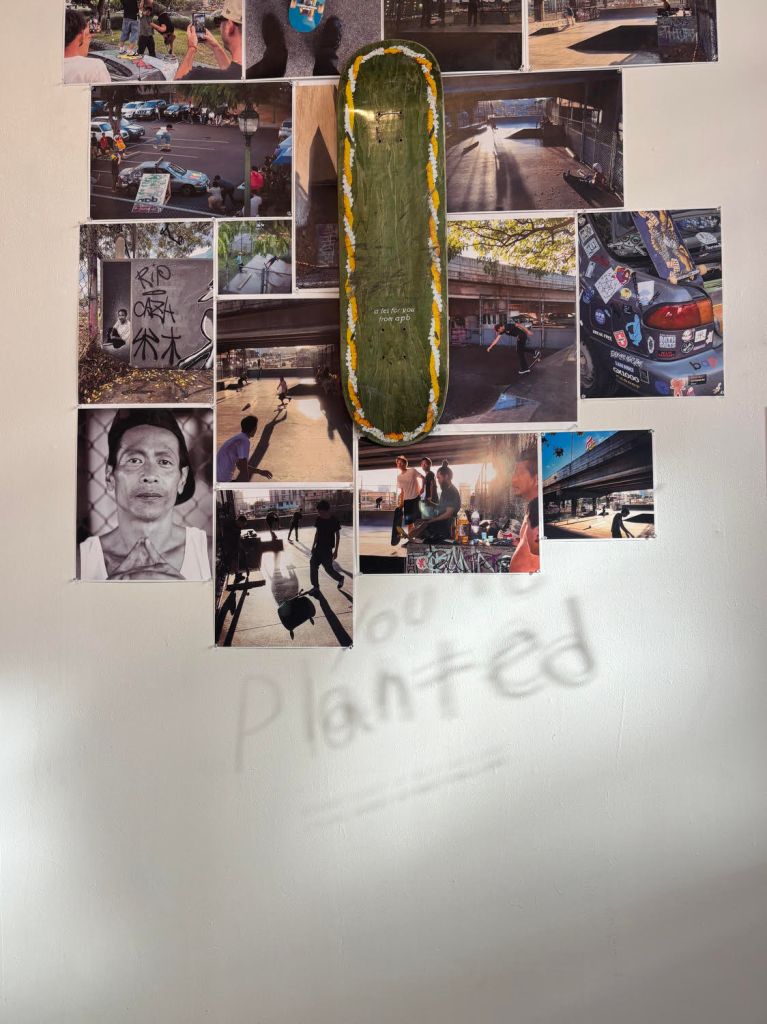
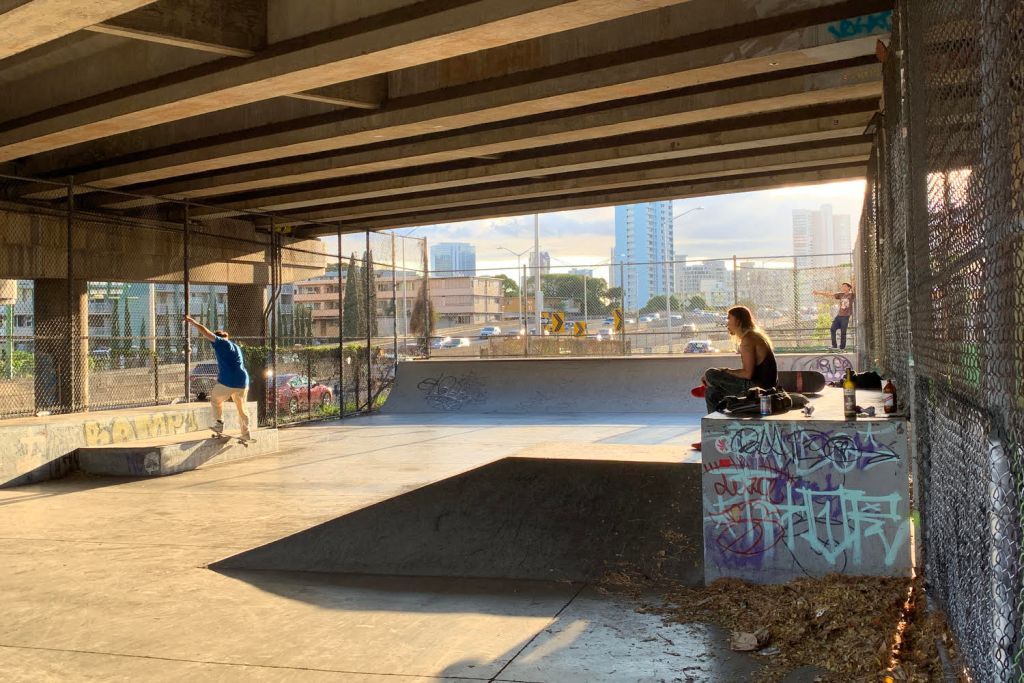
For those in the know, pride already runs deep within pockets of Makiki, like the skaters at Makiki Skatepark. That community recently became a centerpiece for a solo exhibition at Kaiao Space by photographer Matt Mallams, who documented his history with the park.
Though he has never lived in Makiki, Matt became a regular beneath the concrete overpass along Keʻeaumoku Street. Even as a haole, the unspoken language between skateboarders let him seamlessly integrate.
And he just kept showing up.
“I do see people come and go,” Matt says. “People move here for a year or two and leave, but when you put in your time, you’re part of the community. I’m a local there because I put in the time.”
His exhibition, titled “Bloom Where You’re Planted,” showcased decades of journals and memorabilia alongside two multimedia installations: “Makiki Skatepark (2026),” a photo essay arranged around his old skateboard, and “Makiki Parking Lot (2019),” a large print assembled with journal books.
Matt believes honest photography happens where trust is already established: “What made the Makiki project special was that I wasn’t an outsider looking in. I was part of it.”
Matt still skates at the park today. At the opening, his friends, the same skaters featured in his photographs, stood among the crowd.
Some no longer call Makiki home. But none of them have left the park behind.
Already in Bloom
Since moving to Oʻahu, I’ve lived in Makiki. It’s the only home I know on the island, and as an artist, it easily became a source of pride.
Fresh malasadas at the annual Punahou Carnival are my treasured tradition; I can always time my visits to avoid the crowds, a privilege of living near the school. Around the corner, Central Union Church stands in its New England Colonial Revival architecture, a style brought to the tropics by missionaries, seldom found outside its titular region.
On the same block, Harbors Vintage offers more than secondhand streetwear. It’s a watering hole for creatives, with a second-floor art gallery, live music events, and space for local artists to sell their work. On the opposite side, our neighborhood beer garden Beer Lab pairs its open-air seating with an eclectic collection of murals along its walls.
Our streets may lack large-scale public art, but the creative culture is already here, scattered islands on a map waiting to be unified. We don’t need to plant anything new. Just look a little closer—it’s already blooming.
 Sign up for our FREE morning newsletter and face each day more informed.
Read this next:


Local reporting when you need it most
Support timely, accurate, independent journalism.
Honolulu Civil Beat is a nonprofit organization, and your donation helps us produce local reporting that serves all of Hawaii.
ContributeAbout the Author