Jeta: What's Left Of The Artists In Kakaʻako
How HART’s rail is displacing the creative community.
August 18, 2026 · 7 min read

About the Author

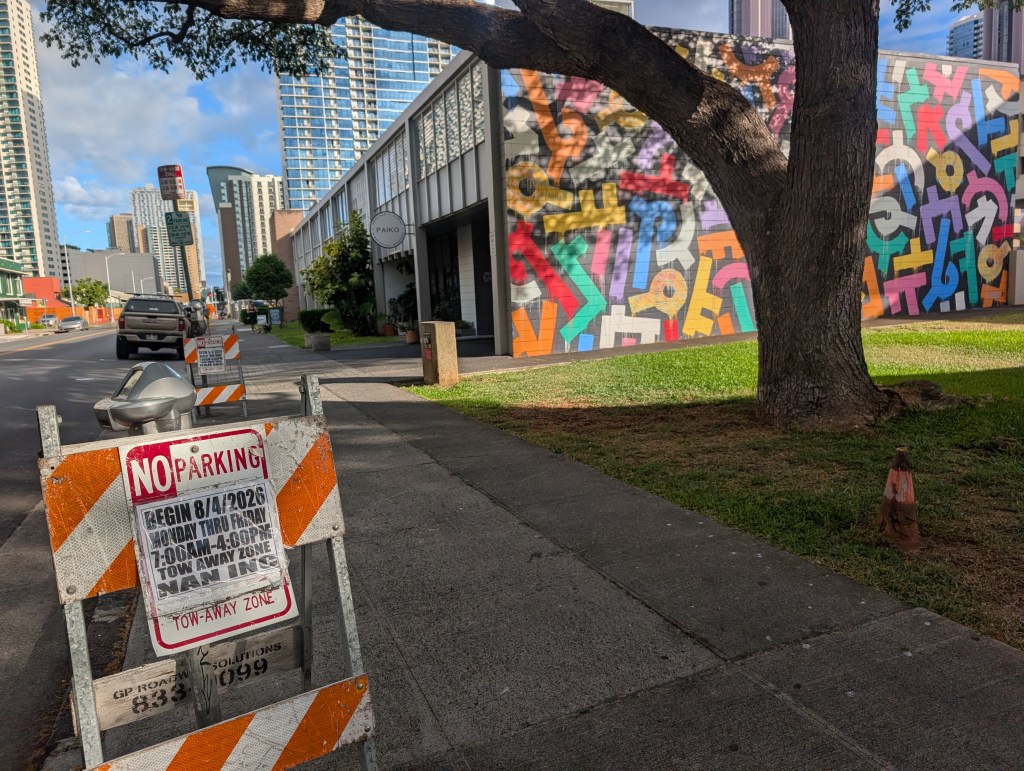
A commercial concrete building sits on the outskirts of Kakaʻako between Punchbowl and South Street. If not for a mural by artists Aaron de la Cruz and Andrew Schoultz, one might not guess the lackluster Halekauwila Plaza houses some of the most prominent artists behind Hawaiʻi’s mural movement.
Among the tenants who helped transform the once crime-ridden neighborhood into an art hub is Jasper Wong, founder of World Wide Walls. In 2012, Wong co-founded Lana Lane Studios to provide affordable spaces for local artists. When Kamehameha Schools reclaimed the property in 2023 for new condos, they gave Wong a lease at Halekauwila.
As master tenant, Wong invited several former residents to join him. Though rent has nearly doubled since Lana Lane, he has maintained below-market rates for his creative community.
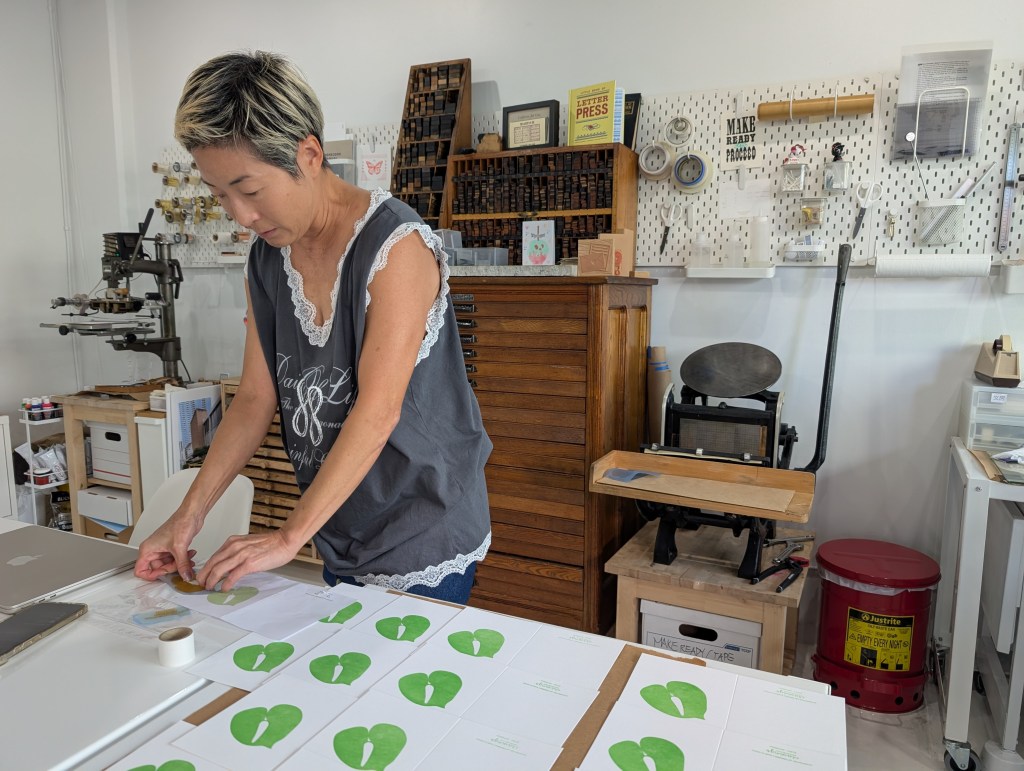
The move allowed artist Celia Cheng to open the first storefront for her design studio. Since relocating, Cravings Media has become one of the only studios in Hawaiʻi offering introductory letterpress workshops.
By Way Of Everything Else
Cheng, now 52, didn’t set out to be a printer, but she never ignored what called to her. She spent her childhood between Hawaiʻi and Taiwan, attending Punahou and then boarding school in Connecticut. For college, she turned down Rhode Island School of Design for Georgetown University, later transferring to Columbia University to study Japanese Literature.
In New York, she moved through investment banking, assistance to celebrity chef Joe Bastianich, a stint at the Wall Street Journal and graduate school at School of Visual Arts, where she launched “Cravings,” a lifestyle publication she ran full-time for over a decade.
Marriage brought Cheng to letterpress through handmade wedding invitations; divorce turned it into a business and brought her back to Hawaiʻi. She returned expecting a temporary reset, only to be entirely remade.
Setting Up Shop
In 2018, Cheng joined Lana Lane, purchasing her first tabletop presses for her 100-square-foot studio. Embraced by the local creative community, she experienced a rebirth.
“People from my prior life don’t even recognize me,” she said. “I was wound up before with deadlines and projects, timelines and budgets. Now I’m in T-shirts and jeans every day. Once I was able to explore my creative side, I could feel again.”
Cheng eventually moved into a larger space and invested in a 700-pound industrial letterpress, the same press she uses for workshops today.
Cravings Media became her sanctuary: “When you’re in there, you don’t think about anything else. You can disconnect and really create from your heart. I finally found my flow.”
But new development now threatens her future in Kakaʻako.
Built For Displacement
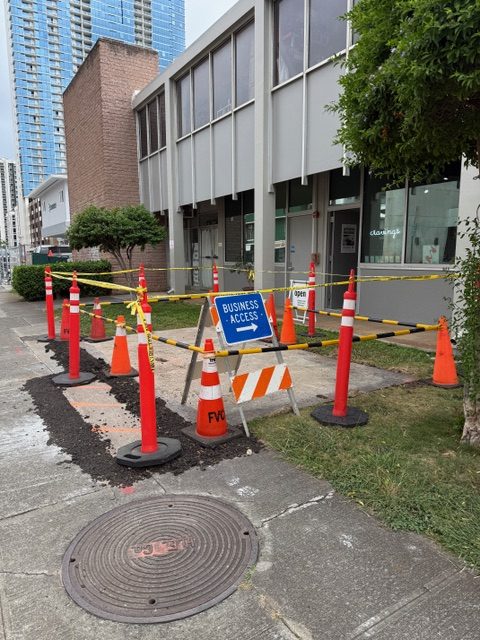
Cheng moved into the street-facing unit with intention, remodeling it to grow her roots at Halekauwila Plaza. She handmakes letterpress stationery, selling from her studio and wholesale to local retailers like Honolulu Museum of Art Gift Shop, Native Books, and Foodland. Monthly workshops and open studio sessions bring her craft to the community.
Barely two years in, the disruption began.
The Honolulu Authority for Rapid Transportation, in charge of building the rail, started potholing outside her shop last year, blocking the entrance for six weeks. She said sales dropped 100%. A collaborative event with Gangway Gallery upstairs recouped just 9% of the loss.
When tenants voiced concerns, they got the runaround. Serving as liaison, Wong says, “Most of the issues stem from poor communication with HART. Whenever we ask for plans, they send us to (Kamehameha Schools). But KS doesn’t seem to know a lot either.”
Colliers, the building’s property manager, has also been kept out of the loop.
Since rail construction began in 2011, the project has been plagued by costly delays. Originally set for completion in 2020 at $5 billion, that section of rail is now projected to open in 2031 at over $10 billion.
What has never changed is the Civic Center Station location. Project documents dating to 2008 show it planned for Halekauwila and South Street. By 2014, Kamehameha Schools was designing development around the future station.
The neighborhood these artists helped build was always slated for redevelopment.
No Recourse
“I’m super scared because there is the possibility I might shut down,” Cheng says. “I can’t sustain potholing on a longer basis.”
HART plans to place a column outside her shop. When engineers surveyed the site, they mentioned demolishing a structural pillar to fit the oscillator, raising questions about the building’s survival and further displacement.
At HART’s June board meeting, Cheng and Courtney Monahan of Paiko, a botanical shop at Halekuawila Plaza, testified. CEO Lori Kahikina responded: “Everyone knew the rail was coming.”
Cheng left without answers. “They are imposing on me, and I’m asking for help. The least they can do is provide rent abatement. It’s a drop in the bucket for them.”
On The Record
When I attended HART’s community meeting on July 15, I got a taste of the uphill battle.
Project Director Vance Tsuda spoke for 15 minutes before announcing there would be no Q&A, directing attendees instead to HART employees throughout the crowd. One attendee raised a hand anyway: “Wouldn’t a live session be more efficient?”
Tsuda responded, “Some people are too shy to ask. We want to ensure everyone gets one-on-one time for their questions.”
I approached Alexandra Reed Lasley of LTL-Team, HART’s program manager, who assured me the public involvement (PI) team would contact every affected business, then flagged down a PI representative from Nan Inc. to handle my questions.
The representative shared the hard truth: Businesses could once apply for grants through the Office of Economic Revitalization, but the office has been defunded and will cease operations on Aug. 14. HART won’t be allocating funds for relief. When I asked why, they suggested I talk to Chief Operating Officer Michael O’Keefe.
I grew frustrated and left. Other attendees, I later learned, had played the same game of hot potato.
On The Books
For nearly a decade, property owner Walter Takara fought to protect his tenant, Service Printers, from HART. The family-owned business, Hawaiʻi’s only union print shop, had served Kalihi on Dillingham for over 40 years until HART’s acquisition displaced them. HART’s March 2026 financial report cited $1.1 million in relocation payments to the business.
Spending under the Transit Property Acquisition and Relocation program, overseen by Krista Lunzer, tells a volatile story: $361,000 in March 2025, $5.8 million in April, $9.2 million in December—and over $6.2 million in April 2026 alone, despite projections of just $100,000.
If HART can absorb sudden multimillion-dollar expenditures, why can’t they support businesses displaced by construction? And if landlord advocacy helped Service Printers, could Kamehameha Schools do the same? Or offer rent abatements as the landowner poised to benefit from the rail?
What Remains
The artists who helped build Kakaʻako shouldn’t have to pay for its success.
“Artists are really trying to enhance communities, but for landowners, it just brings opportunities for development,” Cheng says.
In its proposed development near Civic Center Station, Kamehameha Schools states, “Local art will be incorporated into the building to create a sense of place.”
But how can they do so when there is no place for the artists who create it?
 Sign up for our FREE morning newsletter and face each day more informed.
Read this next:

Local reporting when you need it most
Support timely, accurate, independent journalism.
Honolulu Civil Beat is a nonprofit organization, and your donation helps us produce local reporting that serves all of Hawaii.
ContributeAbout the Author