Labor Votes: Discontent At The Polls
Candidates who have practical ideas for turning the economy around and exhibit empathy for Americans worried about how to pay their bills could receive the bulk of the union vote.
September 6, 2026 · 5 min read

About the Author

When union workers and their families gather this Labor Day, some may ponder Ronald Reagan’s memorable refrain, “Are you better off now than you were four years ago?”
All workers – unionized or not – are dealing with higher prices for food and gasoline.
For America’s unionized workforce, the overall state of the economy is bleak. Threats from AI and robotics abound. Pledges by U.S. and international corporations to invest in new plants remain largely pledges. The roughly 400,000 federal job cuts during President Donald Trump’s second term have disrupted lives. Many of these jobs were previously represented by labor unions.
As a labor studies scholar, I believe weariness and wariness will accompany blue-collar voters to the polls in November. As such, the candidates who have practical ideas for turning the economy around and exhibit empathy for Americans worried about how to pay their bills could receive the bulk of the union vote.

The Union Vote
Over generations, the majority of union members have sided with Democratic candidates, even if that support has wavered since the 1970s.
The 2024 presidential campaign was no exception. The majority of union members voted for Democratic candidates, but at a far lower rate than in the 1960s.
Why does this matter in 2026?
Union voters play a bigger role in Michigan, Pennsylvania and Nevada, three swing states where the share of voters who belong to unions is above the national average of 10%. In closely contested House and Senate races, even a small shift in union votes could influence the outcome.
What’s In Store This November?
How large is the union vote?
The latest Bureau of Labor Statistics figures show that the percentage of U.S. unionized workers has fallen over the past four decades.
In 1983, 20.1% of U.S. workers were represented by a union. In 2025, the rate was 10.0%, or 14.7 million people. Union membership among public sector workers (32.9%) is more than five times higher than that of private sector workers (5.9%). In close elections, the volatility of these voting blocs matters.
During the 2024 presidential campaign, Trump promised to reduce consumer prices, bring back manufacturing jobs and respect workers’ rights.
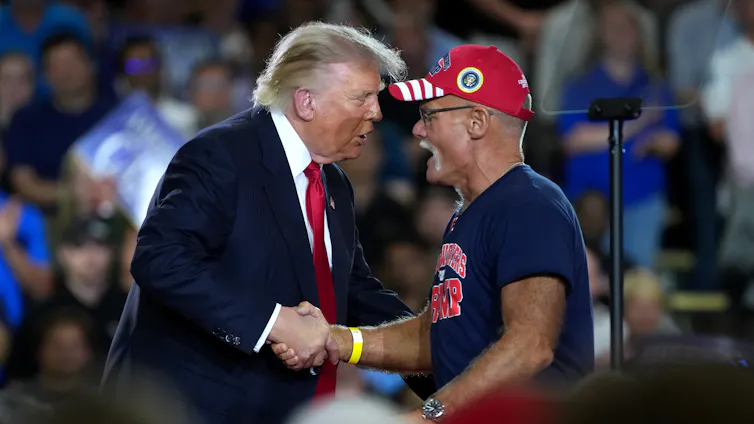
As the midterm elections approach, I believe the president’s performance on these issues in the eyes of union voters will determine which party controls the House and Senate. And the signs are not promising for Trump, with recent polls indicating the president’s support among union households is eroding.
Manufacturing Jobs And Inflation
The U.S. economy has lost 75,000 manufacturing jobs since January 2025, a 0.6% decline. These jobs have steadily declined since the 1980s, so Trump’s policies are not solely to blame.
Furthermore, Trump’s off-again, on-again tariffs may help some U.S. manufacturers. That’s because tariffs can erase the advantages of low-cost overseas labor. As economist Laura Veldkamp noted in July 2026, Trump’s tariffs “made it more profitable for American manufacturers to set up and produce here.”
The bigger problem, though, is that even if some manufacturing returns to the U.S., the work will likely be done with the latest manufacturing technologies, which tend to reduce the need for workers. That does not bode well for significant job creation.
In July 2026, Moody’s financial analyst Mark Zandi told Marketplace that more manufacturing output “doesn’t translate into jobs.” He explained that there has been more activity in the tech sector and in the defense-aerospace industries, but “these factories just don’t employ a lot of people.”
Additionally, Trump has not established a clear plan to lower inflation. The U.S. Department of Agriculture reports that food prices in July 2026 were up 3.0% from July 2025. This increase is slightly above the historical average.
There’s one more factor to consider. Many older blue-collar workers – many of them former union members – across New England, the Great Lakes, Ohio and western Pennsylvania remain angry about the epic industrial collapse of the 1970s and 1980s.
This kind of generational suffering can show up in the voting booth in a big way. And I don’t think voter surveys and polls are able to measure the depths of this rage.

Union Representation
The Civil Service Reform Act of 1978 allowed government workers to unionize. But a March 2025 White House announcement said the legislation had enabled “hostile Federal unions to obstruct agency management.”
Through an executive order and mass layoffs across the federal workforce in 2025, Trump has presided over a dramatic change in public sector collective bargaining in Washington, D.C.
Offering guidance on the 2025 executive order, the U.S. Office of Personnel Management directed federal agencies to end their collective bargaining agreement.
In response, the American Federation of Government Employees condemned the action in an email to its members, saying the Trump administration was “illegally strip(ping) collective bargaining rights from hundreds of thousands of federal workers.”
Federal unions have challenged the White House’s March 2025 executive order. In 2026, independent arbitrators have also ruled against the administration’s efforts to circumvent labor agreements with some federal workers. And in June 2026, a federal judge in Massachusetts struck down an effort by the Trump administration to exercise control over union elections at federal agencies.
Whether unionized industrial workers support their public sector counterparts remains to be seen.
This article is republished from The Conversation under a Creative Commons license. Read the original article.
 Sign up for our FREE morning newsletter and face each day more informed.
Read this next:

Local reporting when you need it most
Support timely, accurate, independent journalism.
Honolulu Civil Beat is a nonprofit organization, and your donation helps us produce local reporting that serves all of Hawaii.
ContributeAbout the Author