Jeta: Hawaiʻi’s Ghost Guy Keeps More Than Spirits Alive
Through ghost tours and storytelling, Lopaka Kapanui preserves the histories of a changing Hawaiʻi. One haunting tale at a time.
October 27, 2026 · 9 min read


About the Author
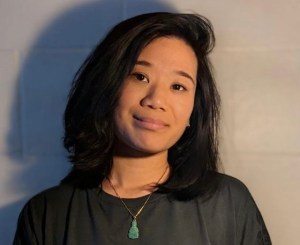
Who would you call if there’s somethin’ strange in your neighborhood? In Hawaiʻi, we have our very own “ghostbuster.”
Instead of a hazmat jumpsuit, our paranormal expert dons a full suit, sporting a white beard and tribal tattoos across the back of his head. He towers at over six feet tall, with 15 kids calling him grandpa.
Lopaka Kapanui is better known as Hawaiʻi’s Ghost Guy. Except Kapanui doesn’t actually bust ghosts. Instead, he keeps their stories alive through the Hawaiian tradition of moʻolelo.
Over the years, hundreds have sought out Kapanui to share firsthand encounters with apparitions, including reported sightings of the goddess Pele before volcanic eruptions. He has spent decades documenting and retelling these accounts, sometimes visiting homes to offer blessings.
“The process is to address the people who live in the home,” he says. “90% of the time, it’s not the house…the people need the blessing and reassurance, not so much the house.”
Kapanui suggests popular media has conditioned people to blame demons for their personal troubles. “Everything’s a demon,” he says. “People, rather than say they’re having marital problems, would rather say it’s a demon.”
For those seeking comfort, Kapanui offers the “body blessing method” passed down by his late Hawaiian mother.
He blesses the feet to anchor a person against spirits that might pull at them in their sleep; the hands to encourage good deeds; the shoulders to release emotional burdens; and the crown of the head to invite positive mana (spiritual energy).
But whether it’s a spiritual or personal matter, Hawaiʻi’s Ghost Guy is less concerned with the dead than with the living.
That, he said, was what his mother taught him.
Mending Broken Spirits
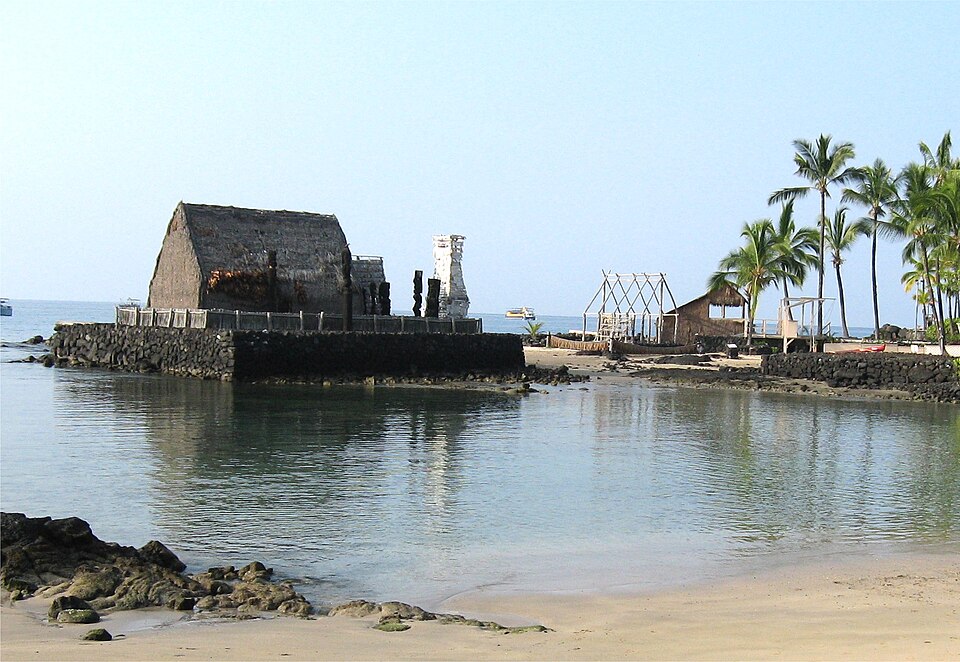
Growing up on the Big Island, Kapanui’s mother learned about the spirit world through encounters of their own. On her way to canoe paddling practice, she told him, she once took a shortcut through Kamakahonu, the former royal grounds of King Kamehameha I, home to the sacred Ahuʻena Heiau (ancient temple).
A chubby Hawaiian boy with a bowl haircut appeared. “Make pōloli au (I’m hungry),” he said. She offered him her kālua pig and poi, unknowingly feeding a kepalō (hungry spirit).
In this family story, Kapanui’s grandmother had prayed to protect her daughter, having anticipated danger. “Ua kaʻana like ʻoe i kāu mea ʻai? (Did you share your food?)” she asked immediately upon her return.
She warned her daughter never to take that path again, lest the spirit await, expecting to be fed.
Years later, while contemplating suicide, Kapanui’s mother offered water to a mysterious visitor at her door, whom she believed to be the goddess Pele. The encounter inspired her to dedicate her life to community and healing, eventually passing her ancestral knowledge on to Kapanui.
“E mau ana ka ʻike,” she emphasized. The knowledge must continue.
For The Living
Born into poverty and initially raised in an Oldsmobile station wagon, Kapanui was a severely malnourished infant, no bigger than a “rolled up newspaper.” At three months old, his mother gave him up for adoption to a Portuguese Catholic couple in Waiʻanae, he said.
Raised on Oʻahu, Kapanui reunited with his biological mother as a teenager, reconnecting with his Hawaiian heritage, including ʻōlelo Hawaiʻi. When his siblings showed no interest in learning her traditions, she turned to Kapanui, offering to pass down her knowledge through vigorous oral instruction.
“No notes. No recording. I talk, you listen. For the next three years, every night after pau, you repeat everything back,” he recalls her telling him.

Ideas showcases stories, opinion and analysis about Hawaiʻi, from the state’s sharpest thinkers, to stretch our collective thinking about a problem or an issue. Email news@civilbeat.org to submit an idea or an essay.
Lessons lasted two to three hours nightly, sometimes until sunrise, covering plant medicine, sacred waters, and the concept of pono (righteousness). He learned that people who die with unresolved issues or broken hearts can become “broken spirits.”
Unlike ghosts, which Kapanui describes as residual energies replaying like a broken record, spirits possess awareness and can interact with the living.
On the final night of training, his mother made it clear that her teachings were “not about you.” Being a healer means serving others selflessly.
She died the next day.
Preserving The Dead
Before becoming Hawaiʻi’s Ghost Guy, Kapanui practiced moʻolelo through hula. In the 1990s, he danced with an all-male hālau led by his cousin Keone Nunes, serving as an alakaʻi (assistant leader) who taught dancers the history and stories behind each dance.
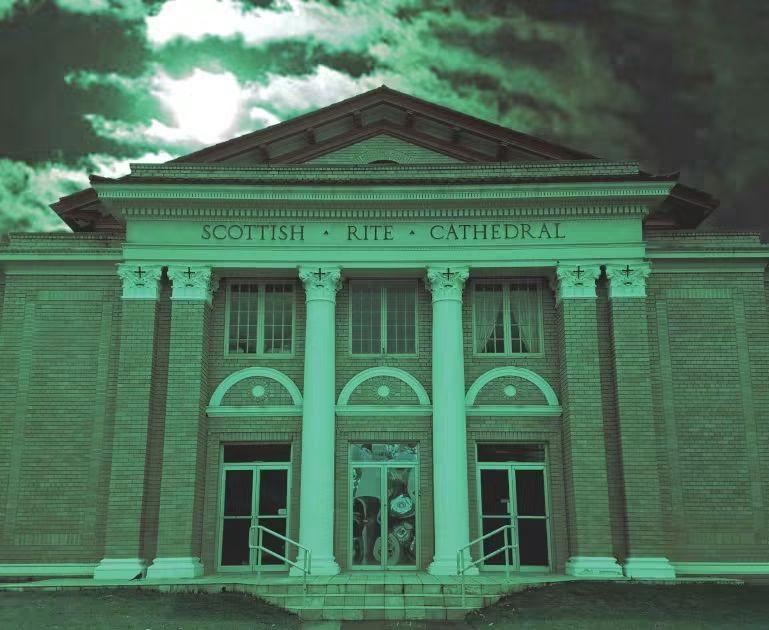
At the time, historian and professor Glen Grant had already pioneered ghost tours in Honolulu’s historic neighborhoods.
In the 1970s, Grant, then a graduate student living with four male roommates on University Avenue, reported strange phenomena at home. Their elderly Japanese landlord reported that a former resident had hanged herself in the kitchen after her husband’s infidelity, leaving behind a broken spirit that vehemently hated men.
According to Kapanui, Grant told a story of how all four roommates died one by one in car accidents. Grant, the sole survivor of the group, escaped a crash with only a facial scar.
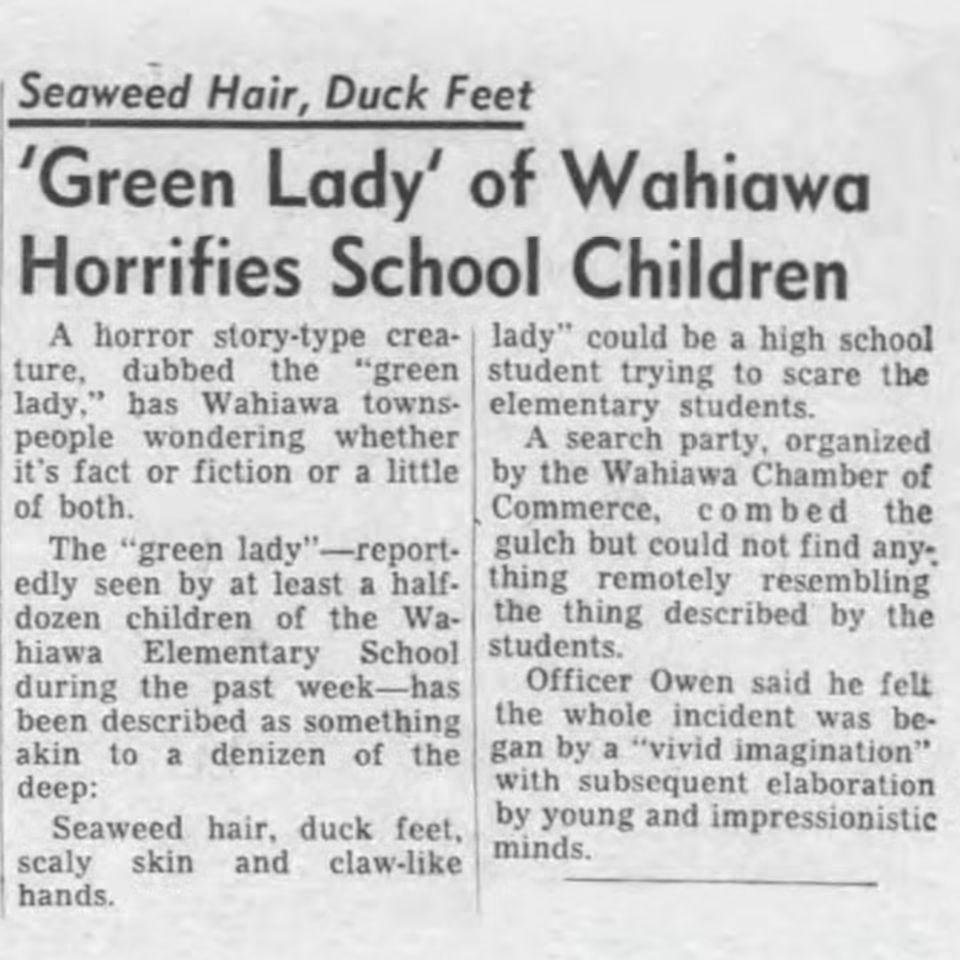
Grant’s fascination with the supernatural and desire to preserve Hawaiʻi’s disappearing landmarks coalesced in his ghost tours. “It’s like your town vanishing right in front of you,” Grant told the Honolulu Star-Bulletin in 1996.
Chunky’s Drive-In, Mōʻiliʻili Store, even a small green building near Kapaʻakea and King Street, all had become forgotten relics of Hawaiʻi’s past.
On his first ghost tour, Kapanui admired Grant’s command of Hawaiian folklore, recognizing stories his mother had told him, all backed by historical research. Nunes, a close friend of Grant’s, later asked him to fill in for a tour. A natural raconteur, Kapanui then began regularly leading tours under Grant’s mentorship.
“Don’t be me,” Kapanui recalls Grant as advising him. “Make this your own thing.”
Grant also warned him about the greater scrutiny he’d face as a Native Hawaiian storyteller.
“I’m a haole. If I mispronounce a Hawaiian word, people forgive me,” the Jewish man from Culver City told him. “But you, you’re Hawaiian, one wrong piece of information, you’ll be crucified.”
In 2003, after Grant’s death, Kapanui succeeded him. The rest, as the story goes, is history.
Marching With Ghosts
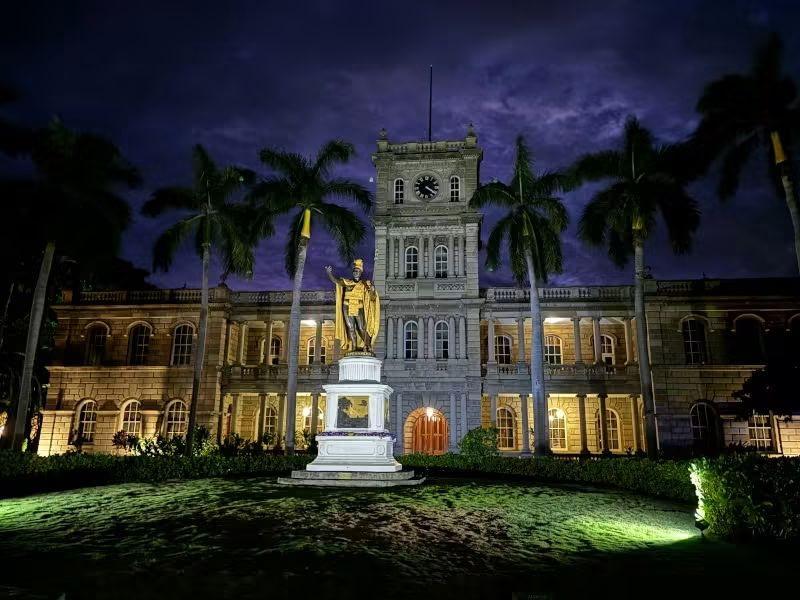
As a haʻi moʻolelo (storyteller), Kapanui carries forward his mentor’s legacy through extensive historical research, cultural traditions, and supernatural accounts retold with permission from those who shared them.
I attended his “Honolulu Night Marchers” tour, beginning at the Kamehameha Statue. Kapanui led us through downtown Honolulu’s haunted past, along paths associated with the huakaʻi pō (night marchers), the spirits of deceased Hawaiian warriors and chiefs.
It was Friday, Sept. 18, the day of former Hawaiʻi Gov. George R. Ariyoshi’s memorial ceremony. His body still rested in the State Capitol rotunda as we walked from the Judiciary Building to ʻIolani Palace.
Earlier that day, Kapanui had attended Ariyoshi’s service with the Royal Order of Kamehameha I, a Hawaiian fraternal organization dedicated to cultural preservation.
“You know, I write a column, too,” Kapanui told me. “The best part about it is traveling to other islands for research.”
If his practiced delivery, laced with humor and suspense, wasn’t a tell, I realized then that Hawaiʻi’s Ghost Guy is undyingly passionate about ghost stories.
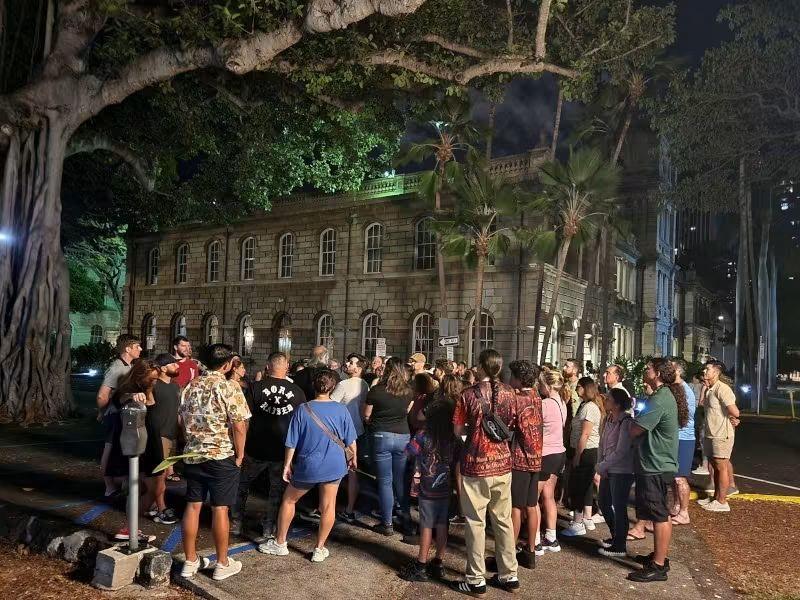
That night, the group of 16 was predominantly white, with Kapanui and me appearing to be the only people of color. My mainland upbringing had trained me to be hyperaware whenever I was outnumbered in a group, but this time I found it amusing: When was the last time I was a racial minority in Hawaiʻi?
Kapanui’s tours do not fabricate scares or stage paranormal activity, relying instead on culturally authentic moʻolelo passed down through generations. But some may still find the experience unnerving.
“I know it’s a ghost tour,” Kapanui says. “But really, what I’m looking for is people to have a spiritual experience.”
He recalls a pregnant woman who became so overwhelmed she fainted. On mine, a young girl cried as we approached the Korean and Vietnam War Memorials, claiming she heard voices in the dark. Prepared for such moments, Kapanui keeps Bluey Band-Aids handy, giving them to children for “protection.”
Selling The Supernatural
The Hawaiʻi Tourism Authority’s Spring 2025 Resident Sentiment Survey found that 88% of residents value authentic representations of Native Hawaiian language and culture, while only 52% believe tourism helps perpetuate it.
Mysteries of Hawaiʻi, the award-winning tour company Kapanui runs with his wife, Tanya, operates at the rare intersection of tourism and cultural preservation.
As Kapanui puts it, the local tourism industry is “dog eat dog.”
Having faced accusations of “selling out” his culture, he argues, “Fortunately, we’re not beholden to the Waikīkī market or any tourism authority. We’re our own entity. Yes, it’s a source of income. It’s how we pay the mortgage and put the kids through school.”
During my tour, Kapanui wove ʻōlelo Hawaiʻi into his moʻolelo, introducing his audience to the Hawaiian language beyond the commercialized “aloha” and “mahalo.”
“I always tell them [the critics], if you’re that much in doubt, come be my guest and see it for yourself,” he says. “It’s not for any kind of exploitation.”
This Saturday, Oct. 31, Kapanui will take the stage at Blue Note Hawaiʻi in Waikīkī for “Tales of Haunted Hawaiʻi,” challenging the “postcard version” of paradise through traditional storytelling.
More than entertainment, his work preserves histories that might otherwise be forgotten, especially as Hawaiʻi undergoes rapid development.
Take Halekauwila Street, where discoveries of iwi kūpuna (ancestral remains) during archaeological surveys for HART’s rail project have sparked questions about cultural preservation.
Even amid modernization, the living have a responsibility to honor the past. Without haʻi moʻolelo like Kapanui, we bury more than our dead. We bury their stories, too.
 Sign up for our FREE morning newsletter and face each day more informed.
Local reporting when you need it most
Support timely, accurate, independent journalism.
Honolulu Civil Beat is a nonprofit organization, and your donation helps us produce local reporting that serves all of Hawaii.
ContributeAbout the Author