Beth Fukumoto: In West Maui, Old Rules Of Hawaiʻi Politics Are Unraveling
A Green Party candidate has a chance of prevailing in a part of Maui that seems primed to disrupt the ruling order.
October 30, 2026 · 7 min read

About the Author

The most interesting legislative race in Hawaiʻi this year is in West Maui, where a Lahaina organizer running as a Green has the state’s biggest unions behind him and nearly everything else lined up against him.
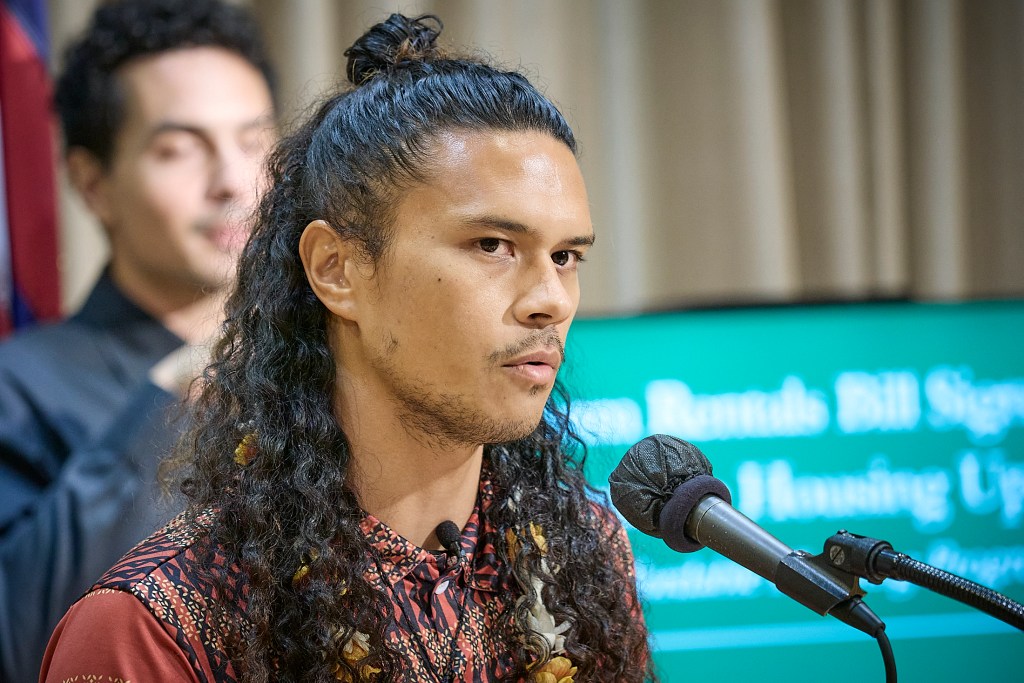
Pāʻele Kiakona, a leader of Lahaina Strong, is the Green Party nominee for state House District 14, which covers West Maui. That alone would make the race unusual, but his opponents add to it. Rep. Elle Cochran won the seat twice as a Democrat before switching to the Republican Party in March, and Sne Patel is trying to win it back for the Democrats.

Three years after the fire, the old rules of Hawaiʻi politics seem to be breaking down in West Maui.
Kiakona told me running was “definitely a hard decision to make.” After the fire, Lahaina Strong protested at Kāʻanapali resorts for housing for displaced families and pushed for the law letting counties phase out vacation rentals. That work led him to switch his studies from agriculture to environmental science, he said, hoping to fight for his community through environmental law and Hawaiian affairs.
“This was always kind of a goal for me,” he said. “I didn’t think it would happen so quickly.”
Asked why he’s running as a Green, he pointed to what he saw after the fire: “a lot of disaster capitalism” at the Capitol and “a massive gap” in district leadership, with Cochran, then a Democrat, missing 85% of House floor sessions in 2025.

Ideas showcases stories, opinion and analysis about Hawaiʻi, from the state’s sharpest thinkers, to stretch our collective thinking about a problem or an issue. Email news@civilbeat.org to submit an idea or an essay.
He also said Hawaiʻi voters don’t fit either national party. Most want strong environmental protections and a solid middle class but also value self-determination. Forcing them to pick one party, he argues, means choosing between priorities.
He knows a lone Green might “have a hard time caucusing in the building,” but he says he learned at Lahaina Strong that when the community shows up and puts pressure on lawmakers, party doesn’t matter. “At the end of the day, the community is my caucus,” he said.
That pitch has won him unusual allies. The state’s five largest unions by membership – the Hawaiʻi Government Employees Association, the Hawaiʻi State Teachers Association, the International Longshore and Warehouse Union, the United Public Workers and Unite HERE – all back Kiakona, though they usually line up behind Democrats.
The teachers union’s endorsement has an extra twist: Patel narrowly beat Ashley Olson, president of HSTA’s Maui chapter, in the Democratic primary.
Not every union is with him. His Democratic opponent, Patel, has the Teamsters and the building trades, led by the carpenters. Nearly every other power broker has lined up with Patel, too. It seems the system is coalescing to take Kiakona down.
Even the Democratic Party of Hawaiʻi, which has given no money directly to candidates since the primary, spent about $95,000 in late September on two digital ad buys, one supporting Patel and a Leeward Oʻahu Senate candidate, the other opposing Cochran, now the seat’s Republican incumbent, and a Leeward Oʻahu House candidate. West Maui is the only race in both.

The money tells the same story. More than $16,000 of the roughly $76,800 Patel has raised came from legislators’ campaigns, including those of top House leaders and the chairs of the Finance, Health, and Water and Land committees. He has also taken money from the realtors’ and building trades’ political action committees and from companies – including Altria, Kalshi and Matson – and a carpenters-funded super PAC has included him in ad buys worth hundreds of thousands of dollars.
Kiakona’s money looks different. He signed a pledge from Our Hawaiʻi to turn down contributions over $100 from corporate PACs and says he hasn’t taken “a single dollar from any corporate interests.” His biggest institutional donor is the ILWU, at $2,000.
Cochran, meanwhile, has barely raised money. She reported no donors besides herself until late September, when two national Republican groups gave her $2,000 each. The Hawaiʻi Republican Party, which gave $2,000 apiece to seven other Republican House members, hasn’t given her anything.
As of Oct. 19, Patel had about $13,300 in cash for the final two weeks, Kiakona $11,100, and Cochran $1,400.
The money shows who is backing Patel and Kiakona, but not what separates them. On the surface, the candidates sound alike. Cochran calls affordability the core issue, Patel talks about infrastructure and long-term housing, and Kiakona about the cost of rebuilding. All three promise to keep local families in West Maui. The question is whose record matches their promises.
Vacation rentals, central to West Maui’s housing fight since the fire, are one of the areas where their records diverge. Kiakona helped lead Lahaina Strong’s push for a state law to regulate vacation rentals, and Cochran voted for it at every House vote. There’s no record of Patel testifying on it. He does have close ties to the industry: He directs sales for a Lahaina vacation rental company and owns a condo that was taxed as a vacation rental before the fire destroyed it.
Whether this decides the race depends on who votes, and 2024 offers some clues. West Maui moved to the right: Trump won 41%, up from about a third in roughly the same area in 2020. Cochran, a Democrat then, ran about 430 votes behind Kamala Harris, but her Republican opponent didn’t pick those votes up. Roughly 700 voters skipped the race entirely.
That makes Cochran the race’s biggest unknown. Now a Republican, she may keep her own supporters, pick up the roughly four in 10 who previously backed Republicans, or lose both. She has spent only about $5,400, but she’s the best-known name on the ballot. If she holds the Republican vote while Patel and Kiakona split the rest, she could win with a plurality.
But Greens have done well here before. In 2018, Jen Kamahoʻi Mather won nearly 19% in the old West Maui district against a Democrat and a Republican, the best showing by a Green in a three-way legislative race in the state since at least 2016. And it’s possible voters who split their ticket for a Republican in 2024 might do the same for a Green.
That isn’t far-fetched. After the 2024 election, Rep. Alexandria Ocasio-Cortez asked her Instagram followers why some voted for both her and Trump. Some described both as outsiders. Some of West Maui’s Trump voters might see a Green outsider the same way.
Kiakona has more going for him than any other Green candidate in recent memory: the largest unions, about as much cash as Patel, and a grassroots movement that grew out of the fire. He says voters who might arrive with a misconception about him often leave saying, “Okay. Well, you got my vote.” After the PBS Insights debate, he said, about 200 people turned out to wave signs for him.
Whether or not that momentum turns into votes, we will see. In three years, the district has watched Lahaina burn, residents scatter and its representative miss most of last year’s floor sessions. Few places in Hawaiʻi have more reason to feel politics as usual isn’t working. On Nov. 3, voters will tell us whether all of that is enough to disrupt who holds power.
 Sign up for our FREE morning newsletter and face each day more informed.
Local reporting when you need it most
Support timely, accurate, independent journalism.
Honolulu Civil Beat is a nonprofit organization, and your donation helps us produce local reporting that serves all of Hawaii.
ContributeAbout the Author