Denby Fawcett: 'The White Lotus' Gets Many Things Right About Hawaii -- For A Change
Despite its honest depictions and lovely soundtrack, the HBO series got little attention from Hawaii media.
September 28, 2021 · 9 min read


About the Author

“The White Lotus” is a six-part TV series about rich, white people who come to a fictional luxury resort in Hawaii for a week and wreak havoc on themselves and on the hotel staff.

I am writing about the series because it has been practically ignored by the media here, not hyped like many of the detective series and silly find-your-mate-in-the-tropics reality shows filmed in Hawaii.
“The White Lotus” is social satire that encompasses the raw physical beauty of Hawaii while nailing many aspects of island life that disturb local residents, especially now with plenty of time to reflect during the pandemic.
“The White Lotus” was produced during lockdown last year on Maui at the Four Seasons Resort Maui at Wailea.
Just the suggestion of sarcastic jabs at wealthy tourists might seem a mean spirited turn-off, but writer-director Mike White has created a remarkable production for HBO — probably the only TV series I have seen that delves into what’s corrosive about Hawaii’s economic dependence on tourism.
And White does it with empathy. His hotel workers are not extras in the background but real people caught in their own sometimes tragic missteps just like the visitors they are hired to serve. In White’s writing, the wealthy tourists are obnoxious, enslaved by their sense of entitlement, but sometimes they emerge as surprisingly human.
Notable actors in the ensemble cast are Jennifer Coolidge, who is expected to win many awards for her role as a boozy, needy heiress, Tanya McQuoid; Connie Britton, Steve Zahn and Kamehameha Schools graduate Kekoa Kekumano.
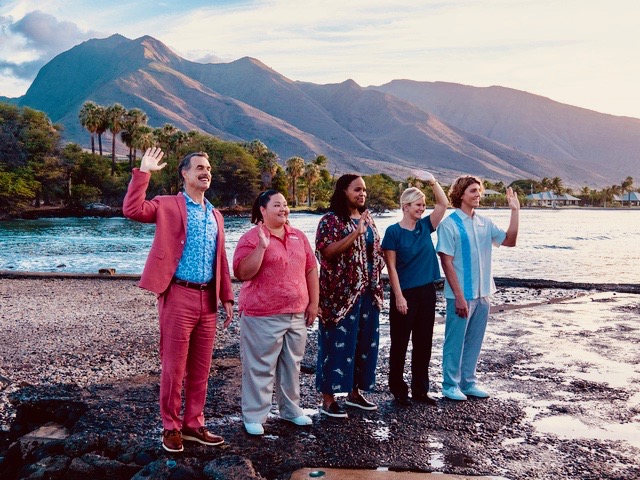
Their characters’ personal stories erupt like Kilauea when they come to the resort to escape their daily woes, only to run smack into trouble — much of it caused by them — then leaving behind a trail of wreckage when they head home, including a dead body and a Native Hawaiian hotel worker ruined for life.
It’s amazing that local Hawaii media has focused so little attention on “The White Lotus” when big shots like The New York Times did four separate reports about it and The New Yorker magazine was “White Lotus”-obsessed in three different gushing articles, calling it “one of the best shows of the year.”
Maui film commissioner Tracy Bennett said local response to “The White Lotus” was disappointing; some Honolulu news reporters didn’t even bother to reply to his invitation to a big bash July 5 for the series premier.
“I wish more Hawaii media had bought into it. Maybe there was little interest in the premier party because it was on a holiday weekend during the pandemic. I was hoping it would get more traction locally,” Bennett said.
My purpose in this column is to say why I admired “The White Lotus,” not to spoil it for you by revealing the story lines.
First, one of the key reasons to watch “The White Lotus” is that it features Hawaii in a lead role instead of relegating it to a backdrop, like most series filmed here such as “Hawaii Five-0” and “Magnum P.I.” — both mainly focused on crime fighters and their sidekicks zig-zagging frantically around Oahu to solve a murder a week rather than dealing with anything that might actually happen here.
Also, “The White Lotus” astounds local viewers with its incredible soundtrack, a combination of pulsating, nervous flute and drum sounds punctuated with Martin Denny-type tropical bird calls that are creatively juxtaposed with 19th century Hawaiian hymns sung a cappella, as well as songs loved by halau hula, such as “Nani Wale Lihue.”
The Hawaiian choral music in the series is from the 2008 CD “Na Mele Hawaii: A Rediscovery of Hawaiian Vocal Music” by The Rose Ensemble of St. Paul, Minnesota.
Many of The Rose Ensemble’s songs in “The White Lotus,” such as choral renditions of “Aloha Oe” and “Hawaii Aloha” are familiar and comforting to local audiences, not the usual pop, steel guitar dentist office music you hear on other films about Hawaii.
In an email exchange, the group’s founder and artistic director, Jordan Sramek, said The Rose Ensemble was picked to be in the show after “The White Lotus” artistic team heard its CD. One of its songs earlier had been in an episode of “Hawaii Five-0.”

Sramek said the 2008 recording is part of The Rose Ensemble’s “ongoing endeavor to unveil significant cultural treasures” of world music from across many centuries in 25 different languages, including Hawaiian.
Sramek says the ensemble produced the CD after two years of research and three separate trips to Hawaii to meet with local cultural experts, working in collaboration with Native Hawaiian musicologist Amy Kuuleialoha Stillman, an associate professor at the University of Michigan.
From the very beginning, it is apparent that “The White Lotus” is going to be different when the opening credits roll out over a richly textured wallpaper dotted with images of a monkey with a hibiscus tucked behind his ear, a tiger napping on a oversized anthurium leaf, and stylishly perched on a palm leaf, an apapane, the endangered Hawaiian honeycreeper.
Ominously, the credits continue, sliding over pictures of rotting fruit, three paddlers in a Hawaiian canoe about to be swamped and a coiled snake ready to strike … symbolic of the dark plot encounters to come.
The series was written and shot with lightning speed under pandemic restrictions at the Four Seasons Resort Maui after HBO got in touch with White in early August 2020. White wrote almost all of the script after he got to the hotel in September, prepped the show, assembled the cast and was ready to begin shooting in late October; the filming was done by the end of the year.
“Which is fascinating. Talk about pressure,” says Hawaii film commissioner Donne Dawson.
White is best known for “Year of the Dog,” “School of Rock” and the HBO series “Enlightened” with Laura Dern, part of which was filmed on Kauai. White later purchased a home in Hanalei.
White’s history in Hawaii goes back to when he was a San Diego teenager and his parents brought him to the islands on vacations. His father, a minister, had friends from his seminary days living in Hawaii.
In a Hawaii Public Radio interview, he said the trips to Hawaii were his first exposure to a place that was not his home, a culture that was not his own, and ever since he has tried to learn more about Hawaii’s history and culture.
The crew took over the entire Maui resort during the shooting of “The White Lotus,” where the most lavish suites can normally fetch up to $17,000 a night — even modest standard rooms facing the back of the hotel cost about $1,500 per night.
It was a boon for the resort, which had been shut down at the time. Staff members were rehired to care for the cast and crew.
Keeping with strict pandemic protocols, cast members were tested for Covid-19 three times a week and masked except for the exact moments when they were being filmed. They were restricted in a bubble with security guards posted to make sure none of them stepped outside of the resort grounds.
Honolulu singer and actress Loretta Ables Sayre, who plays a hotel housekeeper in “The White Lotus,” called her own month-long stay at the Four Seasons “wild and fun” but far from the pampered experience a guest would normally expect in a five-star hotel.
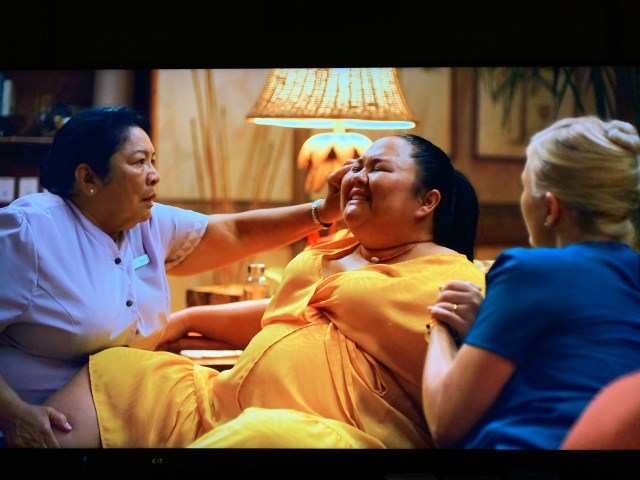
Sayre says they picked up their breakfasts and lunches in plastic foam boxes handed out at the bar that she usually took back to her luxurious room to eat because there were very few socially distanced tables at which to sit.
For dinner, most of the cast was on its own. She said she usually dined on what she called “hurricane type emergency foods,” such as packaged saimin, using the hot water kettle in her room. There was no microwave.
“The bad news was the food. The good news was I lost 10 pounds,” she said.
Sayre, a Radford High School graduate, was nominated for a Tony Award for her 2007 debut as Bloody Mary in a Broadway production of “South Pacific” and has acted in numerous TV series.
Sayre said that the hotel housekeeper she played in “The White Lotus” flashed by on the screen in seconds and only one of her lines made it into the series, but she was grateful to be around stars such as Molly Shannon and to be a paid actor during Covid when everything else was shut down.
Sayre, who has performed as a jazz singer in Honolulu luxury hotels for more than 30 years, said White got it right capturing the fate of many hotel staffers.
“They spend their lives working so hard to provide the guests the experiences the workers cannot have themselves,” she said.
White got it wrong in only one sentence near the end of the series when actor Fred Hechinger, playing Quinn the teenaged son of the wealthy Mossbacher family, has become enamored of Hawaiian canoeing culture and elects not to return home with his family. He says has been invited to go on “a” Hōkūleʻa instead of “the” Hōkūleʻa.
Hawaii film commissioner Dawson, a Native Hawaiian, says she wishes White had asked about the appropriate reference to the famous voyaging canoe even though his incorrect wording will probably slip by most mainland viewers.
The series has been renewed for a second season with a different set of actors playing a new set of characters in another resort owned by the fictional White Lotus hotel chain.
Too bad. I would like to know more about Quinn and if he is really able to escape from his clueless but well-meaning parents and some of the other tormented characters whose lives are certain to implode after they leave Hawaii.
 Sign up for our FREE morning newsletter and face each day more informed.

Local reporting when you need it most
Support timely, accurate, independent journalism.
Honolulu Civil Beat is a nonprofit organization, and your donation helps us produce local reporting that serves all of Hawaii.
ContributeAbout the Author