These Solutions To Hawaii's Problems Are At Hand
Example: To bring down the cost of goods, repeal the Jones Act or exempt the state from it.
March 3, 2022 · 6 min read

About the Author

Starkly at the forefront of issues facing Hawaii is our economy. Soon, many candidates will tout this theme, but without specific viable solutions, their rhetoric will be empty, worn slogans.

Enough is enough. Hawaii has the worst business climate in the country and is well known for its corrupt government reputation. So much so, multinational commerce avoids Hawaii like the plague, small businesses have left and our brain drain is unprecedented with our talented youth now on the mainland with better-paying opportunities.
Who in their right mind would hang around with unbearable business, housing, and living costs and only fragile, low-paying tourism and limited military industries for financial support?
Symptomatic of our mishandled economy is the fact that small tech companies would have loved to start up here because of our ideal climate. However, our electric company financially cannot provide the electric outputs small techs demand. Yet, when a successful, strong mainland utility offered to buy our ailing utility, our Public Utilities Commission, despite the electrical union’s acceptance of the new utility, inexplicably rejected them!
Along with Covid-19 superficial shutdowns, continuing even with a no longer lethal virus that factually is on its final stage, the harm to our economy has been due to longstanding adverse government policies that no candidate dares to address.
Things should never have been this way. Note the following:
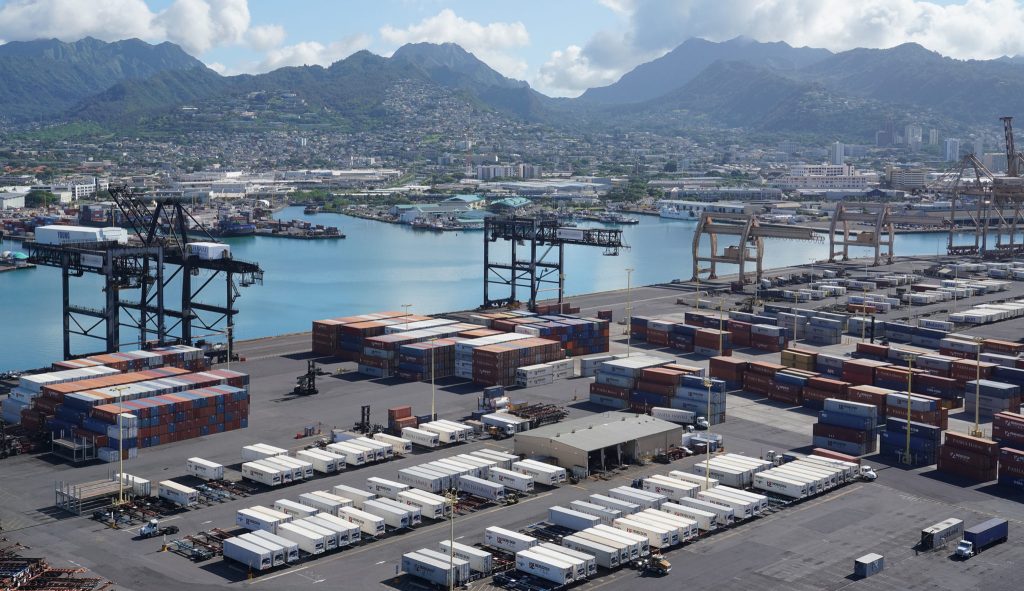
Problem: The Jones Act prohibits foreign ships from landing directly in Honolulu, presumably to protect domestic shippers. If Asian shippers could directly deliver goods here, our businesses, farmers, and residents would enjoy supplies, building materials, fertilizers, food, etc., at low Asian prices! Instead, we are faced with higher costs due to extra shipping costs in picking up goods from Los Angeles.
Solution: Repeal the Jones Act or exempt Hawaii from it. All local elected officials must lobby our congressional representatives to achieve this.
Problem: Another major cause of our high living costs and poor business environment are our extreme taxes. Our general excise tax, unique to Hawaii, is applicable to virtually every business transaction, unlike a retail-centered sales tax or excise tax on tobacco or cannabis as in other states.
Here, you see it in services for telephone, cable TV, electrical, plumbing, carpentry, painting, attorney, architect, contractor, hardware, building materials, landscaping, groceries, medical, restaurant meals, entertainment shows, all retail items, dental, fuel, etc.
Also, our income tax (11%), next to California (13.3%) is the second-highest in the country, far above New York’s (8.8%). In total, we are the highest taxed state in the country.
Solution: Replace the GET and our income tax with a simple low flat tax whose revenues can easily be retrieved by computer from companies’ payrolls and sent to the state’s tax department. The goal here is to transfer capital from wasteful bureaucracies to wealth-creating private enterprises and citizens in freer markets.
Problem: Additionally, a major cause of our high living costs and bad business environment are our outdated land use policies that drive up our land and leasing costs, making commercial growth and delivering adequate housing supply infeasible and extremely costly. The burden lies in the thick, double layer of state and county land-use processes and regulations.
All other states have counties determine land use density with state land use agencies setting general goals and direction. Here, the state Land Use Commission decides on specific spatial growth limits in quantity and location, adding to counties’ land use density determinations.
Environmental-conscious Oregon has approximately 11 clean industries protecting agriculture whose land use is administered by counties according to state goals.
Solution: Delegate land use to county home rule under state goals’ guidance. Clearer accountability for land use practices can then be made at the county level.
Having only one level of review will radically eliminate unnecessary development costs and lower the cost of housing and commercial leasing. Furthermore, adjustments to land use practices can be done easier at this level to meet changing community needs and demands.
A booming economy from lower taxes ironically will fill state government coffers, thereby affording outlays to counties to fund sufficient land use staffing.
Severe mismanagement occurs with high centralization as opposed to de-centralized, empowering management common in excellent organizations.
Problem: An extreme cost to employers is workers’ compensation. To create a friendlier business climate this hazardous cost must be mitigated.
Solution: The law’s presumption clause automatically citing the employer guilty for a work injury must be replaced with a more balanced premise. As is, it is too costly for the employer to prove his innocence and his only alternative are settlements that can encourage numerous false claims.
Family values, faith, and the work ethic are the cornerstones of a strong community, not government programs. This is well documented in America’s prominence in history.
Fundamental Flaws
Hawaii is at a crossroads. The current crisis has exposed the fundamental flaws harming our community. Either we cowardly close our eyes to these flaws and accept empty slogans and hurt our children and their children more, or we boldly achieve the seemingly impossible.
Our climatic/logistical advantage, multi-cultural ethos, and linguistic expertise, creates a nexus between East-West multinational commerce, a potential modern Venice, a commercial hub between Asia and the United States.
Real leaders take immense leaps, outside of the norm, over infinite chasms.
Our entrepreneurs’ and children’s careers would launch from the laboratories of software companies, pharmaceutical, medical, new industry research, venture capitalists, stock exchanges, land-based relay satellite stations, astrophysics/space industries, headquarters of multinational companies and institutions, etc.
Like many small businesses, with now lower costs, agriculture and ranching would boom, whose prices would out-compete mainland foods. The resulting high diversification will then shield us from external economic cyclical threats providing higher paying, more continuing job opportunities and tenure.
Ironically, the economic boom will also result in much larger coffers for a more efficient state government, thereby financially capable in getting the homeless off the streets much as Singapore does.
Finally, emerging from Hawaii’s ensuing wealth creation would then be billionaires, home to Hawaii, more than happy to fund a BCS-caliber football and basketball team at the University of Hawaii, where athletes would prefer coming to than the chilly northern universities.
Real leaders take immense leaps, outside of the norm, over infinite chasms, radically changing societies and history. Our country’s founders did that. Do we have any in Hawaii?
 Sign up for our FREE morning newsletter and face each day more informed.
Community Voices aims to encourage broad discussion on many topics of community interest. It’s kind of a cross between Letters to the Editor and op-eds. This is your space to talk about important issues or interesting people who are making a difference in our world. Column lengths should be no more than 800 words and we need a photo of the author and a bio. We welcome video commentary and other multimedia formats. Send to news@civilbeat.org. The opinions and information expressed in Community Voices are solely those of the authors and not Civil Beat.
Read this next:

Local reporting when you need it most
Support timely, accurate, independent journalism.
Honolulu Civil Beat is a nonprofit organization, and your donation helps us produce local reporting that serves all of Hawaii.
ContributeAbout the Author