Danny De Gracia: Some Election Reforms May Be Too Much To Handle This Year
Shuffling the order in which names appear on the ballot and prohibiting nicknames may be a step too far.
April 17, 2023 · 6 min read


About the Author

During the 1976 Democratic Party presidential primaries, the late Arizona Congressman Mo Udall after losing to then former Georgia Gov. Jimmy Carter, famously griped, “The People have spoken – the bastards.”

Placing blame at the feet of voters for outcomes that politicians don’t like is an ongoing tactic as old as the practice of having elections, but is it really fair to blame voters if the way elections are handled are confusing or even intimidating?
Lately, Hawaii legislators have been on a “shake up the way we do elections” kick. Since the 2020 primary election, Hawaii has been handling elections by all-mail voting, though if you want to vote in-person, you still can if you go to a designated site.
Then in June, then-Gov. David Ige signed into law Act 47, which requires “any federal election not held on the date of a regularly scheduled primary or general election and any special election for a vacant seat on a county council” to be conducted by ranked-choice voting.
This session, the Legislature may be changing elections even further, with Senate Bill 47, which proposed to mandate “The names of the candidates shall be placed on the ballot for their respective offices in a randomized order, to the greatest extent possible.”
There’s also House Bill 1294, which says, “Notwithstanding any other law to the contrary, every candidate for public office in the State shall use their legal name for all election purposes.”
Both bills, as of the writing of this article, have received notice of disagreement between the House and Senate, and will require conference committee to reconcile the drafts (that is, to remove their defective effective dates, or else SB 47 won’t become law until long after Captain Kirk of Star Trek lives and dies on June 30, 3000) to pass them on to the governor’s desk.
While I can see the merits and potential of these as “reforms” to Hawaii’s election process, I’m more worried about the slippery slope of unintended consequences. Hawaii’s body politic has been pitched a lot of sudden procedural changes lately, and as anyone who’s ever been on a crash diet or exercise regimen knows, even the best changes if implemented too suddenly can wreak havoc on the body.
To begin, those of us who are involved in nonpartisan voter education or democratic reform work already have to beg, plead, cajole and hand-hold local voters to show up and be counted. Election Day, in spite of Hawaii now being an all-mail voting state, is still a state holiday, and yet people still make excuses for why they don’t have “time” to vote.
And now, we’re about to complicate matters even further by changing the order of candidate names – again, an exact quote from SB 47, “to the greatest extent possible,” and that seems super vague – and by changing some of the names that voters have come to be used to seeing for years, even in some cases, decades.
Will randomizing names really add more diversity, reform and transparency in elected government to Hawaii? Is the current alphabetical order listing of names a kingmaker?
Supporters of SB 47 seem to think randomizing names is an evidence-based best practice because of the negative “advantage” of alphabetical order. So is that why perennial candidate Duke Aiona keeps winning every election he runs in, and is the favored frontrunner to soon be Emperor of the Known Universe?
Is that why Hillary Clinton defeated Donald Trump in 2016, and spared us from an evil “Mirror, Mirror” alternate reality universe where a respiratory virus would be allowed to run rampant to the point of jeopardizing human existence and the U.S. Capitol would be stormed by violent mobs on the day the electoral college vote certification was scheduled to occur?
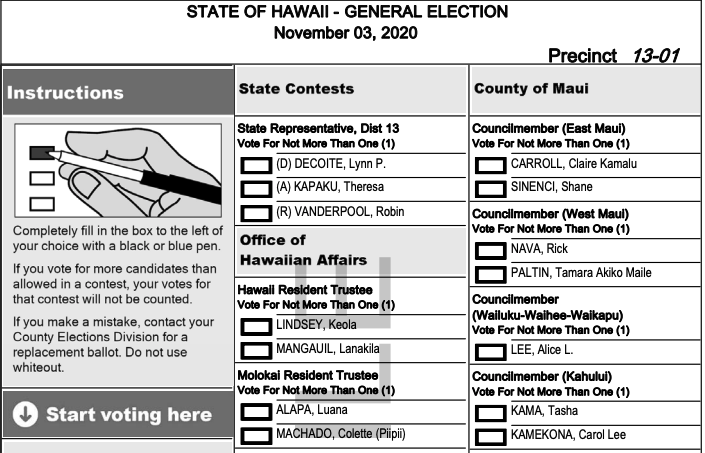
And yes, yes, of course, I agree, you should also be required to disclose your legal name when you run for office. But using preferred nicknames, especially in a place like Hawaii where some people have extremely long legal names, can also be beneficial especially when candidates want to seem more personable to the voters in their districts.
There’s also the issue of where in districts there are many voters of limited English proficiency, candidate names when transliterated into their multilingual equivalents can sound like something extremely offensive. This is why for many years when savvy candidates in California were asked to provide Chinese translations of their names, they would often provide alternate ballot names that translated to memorable statements when read in Chinese.
And what happens now if someone with a long Hawaiian name – who is currently known by a shorter, easier to remember common name – has to run for office with their full name on the ballot? Are they going to have to stop by the Lt. Governor’s Office to get a name change now?
If the actual goal is to get new blood in the Legislature, an easier way to do that is to enact term limits.
Personally? I’m worried about all these “reforms” happening too fast. In Hawaii, if these bills become law, we’re about to have the unique crisis of voters needing to be research geniuses in order to vote for their favorite people on the ballot. And while voters doing their advance homework is a good thing, so far, we’ve seen that voters in Hawaii don’t like doing anything beyond the bare minimum, if at all.
If we must have these things, then we’re going to have to flawlessly implement them and make sure that a thorough, relentless, and wide-reaching state and county-sponsored public education campaign eases voters into these new processes. But is that asking too much of our already incompetent government that can’t even cut the grass on median strips regularly?
Let’s be honest. If the actual goal is to get new blood in the Legislature, an easier way to do that is to enact term limits. Vote to self-sunset yourself and all your fellow legislators and then we’ll have a predictable and consistent means of reform.
But all this other stuff? Why do we have to make things harder for people to vote when they’re barely voting already?
 Sign up for our FREE morning newsletter and face each day more informed.
Read this next:

Local reporting when you need it most
Support timely, accurate, independent journalism.
Honolulu Civil Beat is a nonprofit organization, and your donation helps us produce local reporting that serves all of Hawaii.
ContributeAbout the Author