John Hill: Perplexing Questions That Demand Answers In The Wahiawa Child Abuse Death
The only way to prevent this horror from being repeated is by publicly dissecting exactly what went wrong.
February 19, 2024 · 7 min read


About the Author

It’s now been a month since the appalling death of Geanna Bradley, the 10-year-old Wahiawa girl tortured, bound with duct tape and starved, allegedly at the hands of her legal guardians.

And though the public cannot expect to have all the answers by this time, once again, very troubling questions about how this could have happened are going unanswered.
It’s not surprising. In the case of Ariel Sellers, the 6-year-old girl renamed Isabella by the adoptive parents accused of killing her, many questions remain unanswered two and a half years later.
Readers have been asking what they can do to prevent this from ever happening again. I believe the best answer is transparency, a full public airing of what went wrong in both the Ariel and Geanna cases.
So let’s examine a few of the most pressing questions in the Geanna case, starting with a close look at the timeline of what happened after she died.
Nothing could be done for the girl at that point, clearly, but one of the five children remaining in the house was a 4-year-old boy who had been adopted by Thomas and Brandy Blas. The other four were the Blas’ biological children.

The 4-year-old had been mistreated in almost unimaginable ways.
The criminal complaint and other documents filed in the case note that the boy, referred to as A.B., was found by a physician with expertise in child abuse to have “global developmental delays and an extremely small stature which is very likely due to psychosocial deprivation.”
He had been starved and abused “as indicated by multiple bruises and scars.” Though he was 4, he had not seen a pediatrician since he was 8 months old. Police noted that he appeared “very unsteady on his feet” and walked more like a toddler “in a disjointed fashion, as if he was just learning to walk.”
He had bruising on his lower and upper back, behind his ears and on his arms. He had been scratched. He had what appeared to be a human bite mark on his right thigh.
HPD investigators also retrieved a video of what appeared to be A.B. strapped in a car seat with what looks like vomit on his face.
In other words, this child had suffered massive deprivation and abuse. Which brings us back to the timeline.
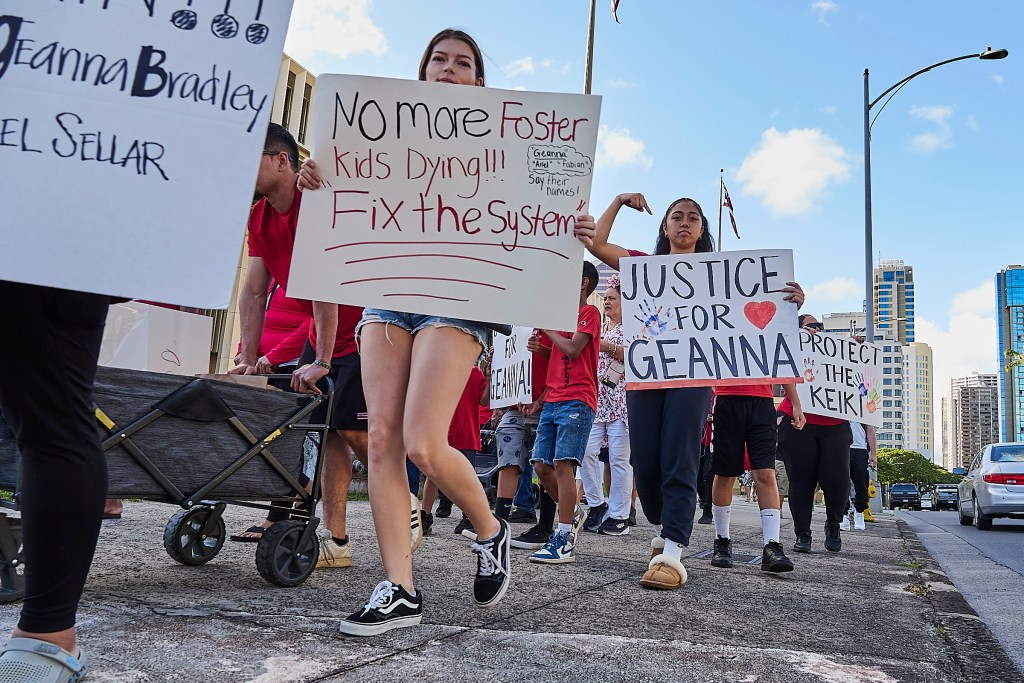
Geanna died on Jan. 18. But it was not until Jan. 23 — five days later — that A.B. was hospitalized. The court records do not indicate what happened during those five days. But given the severity of his condition, I have to ask the obvious. How could no one have noticed for five whole days?
I asked the Department of Human Services what kind of screening is done when children are removed from a home after it’s discovered that one child has been severely abused. The department said that children placed in foster care must first have a physical exam.
It’s performed by a doctor not under contract with DHS. “A more thorough medical examination of the child is done typically within a month of placement, which includes a mental health evaluation,” DHS said.
That means a doctor somewhere examined this boy right after Geanna’s body was discovered and cleared him to go to a foster home.
Why does this matter? Clearly, a child who has been through this kind of hell needs to get treatment and succor as fast as possible. Is the screening system working properly? And you would think that the authorities would want to get evidence right away, while it was fresh.
But here, again, the timeline raises perplexing questions, because it was not until Jan. 26 the police went to the hospital “to observe and take photos of A.B.”
So unless there were earlier instances when HPD observed and took photos of A.B. — and if so, they are not mentioned in the court documents — how did it take a full eight days after Geanna’s death for this evidence to be gathered? Are Child Welfare Services and HPD communicating?
Maybe, one hopes, there’s so much evidence that it won’t much matter.
I’m sure that there are HPD and CWS investigators who are as nauseated as the rest of us by what happened and are working very hard to make the case. But this timeline does not exactly instill confidence that everyone was working together to bring whoever committed these grotesque crimes to justice as efficiently as possible.
The picture painted in court documents is that Brandy and Thomas Blas and Brandy’s mother, Debra Geron, did all they could to isolate Geanna from the outside world, where people might see evidence of the girl’s severe abuse.
But there were cracks in that prison — and that raises some other baffling questions.

On Aug. 20, 2020, for instance, police discovered messages between the Blas couple. Thomas Blas, it appears, was at a doctor’s office with Geanna.
“The messages were regarding whether or not the doctors could tell how she was injured,” according to the criminal complaint. Brandy demanded to know what kinds of questions the doctor was asking. She advised her husband to “just like pretend … act fatherly.”
Doctors are mandated by law to report suspicions of abuse. So what happened here? What were Geanna’s injuries? Was she already being abused so badly that there would have been other signs in addition to whatever she was being treated for that day? Did Thomas Blas have a convincing cover story? Did he do a good job of “acting fatherly”? Or should someone have seen enough to arouse suspicions?
Then there’s the fact that Geanna was having monthly Zoom visits with a psychologist or psychiatrist — the court records use both titles. One of the Blases was with her at all of these 15-minute sessions.
Of course, it would be much harder to detect physical abuse on a Zoom call. But this, too, presents the tantalizing possibility that Geanna could have said something or exhibited behaviors that would have raised the alarm.
The Blases seemed very intent on insisting that the girl suffered from a multitude of psychological disorders, including the very unlikely diagnoses of bipolar disorder and schizophrenia, which typically do not come on until the late teens or early adulthood. Was the picture the Blases painted of Geanna’s pathologies enough to fool outsiders who otherwise might have been concerned about why she was so disturbed?
Perhaps the various mandated reporters just could not see it because the perps were good at hiding it. If so, they no doubt feel sick about it. But it sure would help the public understand this case to know more about these rare contacts between Geanna and people outside the family.

In 2018, Family Court Judge Bode Uale appointed the Blases to be Geanna’s legal guardians. What recommendations did Uale have from Geanna’s court-appointed representative — probably a guardian ad litem — the CWS social worker assigned to the case and others involved in the case?
CWS has disclosed that it received no reports of abuse about Geanna after the Blases became legal guardians. But it seems very probable that both Geanna and A.B. were being fostered by the Blases before they became, respectively, legal guardians and adoptive parents.
If that’s so, then CWS possesses copious records of the screening that was done of the Blas household before the placements, as well as the monitoring CWS was required to do while the kids were in foster care. In the case of A.B., that would have been just a couple of years ago.
I know from experience that CWS will not produce those records for the public or the media without someone — the Legislature, Gov. Josh Green, maybe even the federal department that oversees state child welfare agencies — forcing them to.
Or maybe a judge will do it.
 Sign up for our FREE morning newsletter and face each day more informed.

Local reporting when you need it most
Support timely, accurate, independent journalism.
Honolulu Civil Beat is a nonprofit organization, and your donation helps us produce local reporting that serves all of Hawaii.
ContributeAbout the Author