The Sunshine Blog: Looks Like Big Pay Raises Are Coming For State Leaders
Short takes, outtakes, our takes and other stuff you should know about public information, government accountability and ethical leadership in Hawaiʻi.
January 28, 2025 · 10 min read

About the Author

Show them the money: As the state Salary Commission was considering pay raises for Hawaiʻi leaders in late December, one of its members said it would be nice to avoid the political uproar that surrounded the 64% pay increases that the Honolulu City Council accepted last year.
“I really don’t want what we do to be a lightning rod,” said former state Attorney General Margery Bronster.
Good luck with that.
The seven-member commission moved closer Monday to recommending hefty pay raises for the governor, lieutenant governor, state department heads and legislators — several hundred top-tier government employees in all.
No votes were taken and Commission Chair Colleen Hanabusa stressed the numbers the commission was considering are not final. The panel’s recommendations for pay hikes that would be spread out over six years are expected sometime this legislative session.
The first-year raises are the biggies — including a proposed 35% pay hike for Gov. Josh Green and 40% for state legislators.

Some of those first-year raises would automatically kick in with the new fiscal year July 1 unless the House and Senate pass a resolution explicitly rejecting them. The lawmakers themselves are the exception — they cannot receive any raises recommended by the commission until after the next election in 2026.
Commission members have repeatedly raised concerns about the difficulty of recruiting capable people to serve as department heads and judges given the current salaries, and they seem eager to do something about that.
On Monday, they appeared comfortable with a proposal to raise the governorʻs pay by 35% on July 1, from $189,480 to $255,798. That would be followed by a 4% raise the following year and a 10% pay increase the year after that. Those raises would then be followed by three years of 4% increases.

Lt. Gov. Sylvia Lukeʻs pay could increase 18% July 1, from $188,400 to $222,312. That would be followed in subsequent years by increases of 4% and 7.5%, then three years of 4% increases.
The commission also appeared inclined to award raises of 20% for state department heads effective July 1, followed by 4% raises the year after and 7.5% raises the year after that. Those pay increases also would be followed by 4% raises for three years.
As for legislators, several commission members said they regard the jobs of representatives and senators as essentially full-time positions, and the panel is considering sizable raises for them as well. The House speaker and Senate president are currently paid $83,052 per year; other lawmakers are paid $74,160.
Most of the commission members appeared agreeable to awarding a raise of 40% to lawmakers (that would make it $116,272 for the leaders and $103,824 for everyone else) on Jan. 1, 2027, followed by an 8% raise a year later. Those would be followed by 4% raises in each of the next two years.
“I do think we need to explain that there’s a need for a living wage, that there’s a need for recruitment, and that the impact is not large on the budget, but it is large on how government runs and how government is viewed,” Bronster said at the Dec. 30 meeting.
Hanabusa remarked at the same meeting: “Government is people, and we have to pay people. If you want good government, you have to pay people, whether you’re talking about civil service or the people on the top. You’ve got to pay them, and we’ve got to get to the point where people understand that.”
Bobby lobby: Hawaiʻi Gov. Josh Green headed back to Washington, D.C., Monday evening, his second trip this month. The primary purpose is the same: to lobby against Robert F. Kennedy Jr., President Trump’s nominee to be secretary of the Department of Health and Human Services.
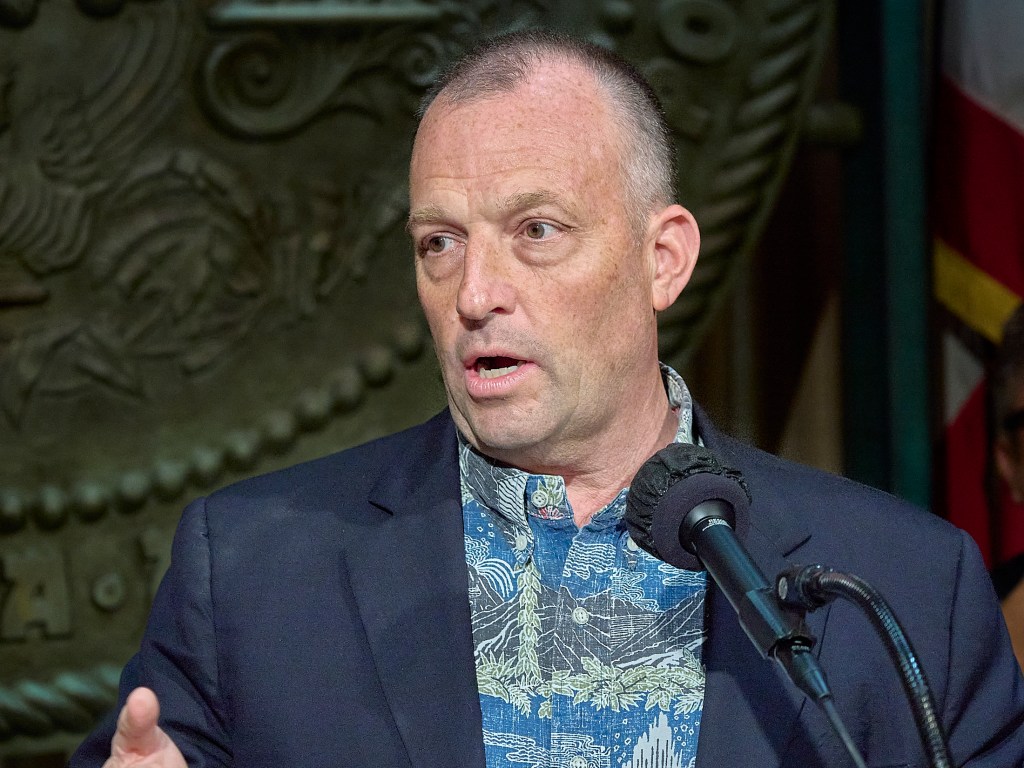
Green has repeatedly voiced his worries about the potential impact of Kennedy’s confirmation on Hawai‘i and the nation. The governor believes in the importance of “a science-driven approach” to public health, a press release explained. Kennedy is a well-known skeptic of vaccines.
The governor’s office insists the trip is official state business and comes at the request of U.S. senators and national health organizations. On the last trip, Green worked with a couple different advocacy groups and was featured in a video widely distributed by one anti-Kennedy group.
Beginning Wednesday, Kennedy is scheduled to appear before the Senate Finance Committee for the first of two hearings.
The governor returns Thursday. Lt. Gov Sylvia Luke is in charge until then.
Records request: Lawmakers are once again considering cutting some of the governor’s powers when it comes to states of emergency and the seemingly endless stream of emergency proclamations that roll out in some cases.
The Senate Public Safety and Military Affairs Committee wasted no time Monday unanimously advancing Senate Bill 353, which would prohibit the governor or a mayor from suspending requests for public records during a state of emergency, as happened during the coronavirus pandemic in 2020.
The measure also would allow the Legislature or city councils to end a state of emergency if they thought the emergency had passed and the governor or a mayor was dragging it out for no good reason.
James Barros, the director of the Hawaiʻi Emergency Management Agency, opposed the bill in testimony before the committee. (Good job, Chair Brandon Elefante, for making him state his objections openly at the hearing instead of letting him slip away and only submit written testimony.)
Barros, having been called back up to the hot seat, told the committee the governor needs to have the flexibility to do what needs to be done during an emergency and not have decisions overridden by the Legislature. He also expressed concern that if the Legislature prematurely undeclared an emergency, the agency would no longer be able to access disaster money.

“It closes avenues for us,” he said.
Senators weren’t buying any of that. Sen. Karl Rhoads was particularly concerned that Barros was implying the Legislature wouldn’t be able to tell if an emergency declaration was still necessary.
The governor and HI-EMA “would have an overall holistic perspective,” Barros said.
“And we don’t?” Rhoads countered.
Sen. Samantha DeCorte wasn’t convinced funding would be limited if the Legislature ended an emergency, and Sen. Carol Fukunaga pointed out that the language in the bill clearly covers what happens when an emergency ends.
The measure passed unanimously and now heads to the Senate Judiciary Committee for a hearing. That’s the committee chaired by Rhoads.
The Public Safety Committee also unanimously passed, with little if any discussion, Senate Bill 307, which would give people the right to record law enforcement activities. That one also will go to Rhoads’s Judiciary Committee for the next round.
Bills, bills and more bills: The Blog is happy to see so many of the sunshine bills we are tracking getting out of the gate early in this legislative session. With more than 3,000 bills filed and only enough time to hear a few hundred of those in a typical session, it’s encouraging to see measures seeking to improve accountability and transparency getting some early love.
Here’s what’s on tap for Tuesday when it comes to sunshine bills. House Judiciary Chair David Tarnas has an especially ambitious lineup:
Senate Judiciary – 9:15 a.m.
- SB 121 – Giving the Senate more time to consider and confirm judges.
- SB 124 – Making reapportionment based on the resident population rather than the permanent resident population.
- SB 175 – Increase mandatory retirement age of judges to 75.
House Judiciary & Hawaiian Affairs – 2 p.m.
- HB 131 – Allows records to be released for research purposes.
- HB 411 – Ethics Commission package: Uniform provisions for penalties under lobbying law.
- HB 412 – Ethics Commission package: Expands definition of lobbying to include high government officials when involving procurement.
- HB 413 – Ethics Commission package: Clarifies restriction on lobbyist contributions.

- HB 149 – Requires corporations to provide shareholders with a report of independent expenditures and political contributions.
- HB 369 – Campaign Spending Commission package: Return excess campaign funds or they go to the state.
- HB 370 – Campaign Spending Commission package: Revises partial public financing with increased amounts for each office.
- HB 371 – Campaign Spending Commission package: Restrictions on donations from contractors and grantees, company and organization officials and their family members.
- HB 372 – Campaign Spending Commission package: Prohibits campaign contributions to elected officials during session.
- HB 772 – Disallows use of campaign funds to buy tickets for fundraisers.
- HB 662 – Repeals exemption for use of a candidate’s own funds, makes contributions by family members subject to limits, amends loan amount from a candidate or family.
- HB 134 – Requires elections officials to provide an electronic system for filing nominating papers.
- HB 408 – Office of Elections package: extends deadline to register for voting by mail to 10 days before primary rather than 30 days.
- HB 141 – Elections Commission members to be confirmed by Senate.
Senate Government Operations – 3 p.m.
- SB 5 – Governor can fill a legislative vacancy by appointment for the rest of the term and the next term.
- SB 300 – Governor has to fill legislative vacancies by a certain deadline or Senate president or House speaker can do it.
- SB 1081 – Establishes the Legislative Budget Office to produce fiscal reports on bills and legislation.
- SB 711 – Requires Senate confirmation for state employees whose salary is greater than the governor’s, if it’s an employee in the governor’s office, or whose salary is greater than the head of the agency the person works for.
- SB 375 – Governor Package: Establishes a government restructuring commission.
- SB 270 – Kauaʻi County Council package: Allows any member of a board to attend an informational meeting as long as its not directed at that board.
- SB 405 – Allows neighborhood boards to discuss items not on the agenda if brought up by a government official.
- SB 406 – Caps the cost of reproducing a public record at 5 cents per page.
- SB 78 – Makes an application for voter registration part of certain state agency application processes.
- SB 381 – Requires that selecting heads of public agencies or divisions be done in open meetings through an open public process.
You can find all the bills and their details, as well as links to watch the hearings live, on the Legislature’s website.
 Sign up for our FREE morning newsletter and face each day more informed.
Read this next:

Local reporting when you need it most
Support timely, accurate, independent journalism.
Honolulu Civil Beat is a nonprofit organization, and your donation helps us produce local reporting that serves all of Hawaii.
ContributeAbout the Author