Kirstin Downey: Bills Could Speed Up Rebuilding Of Lahaina's Front Street
At least one proposal appears to be gaining traction in the Hawaiʻi Senate that would let home and business owners move forward with their projects.
February 21, 2025 · 6 min read


About the Author

Some of the regulatory mire that has choked Lahaina’s recovery may be clearing up.
Pending state legislation would allow buildings anywhere in Hawaiʻi that are destroyed in certain types of disasters to be rebuilt if the replacement structure has the same footprint and overall dimensions.

It seems odd that such legislation is needed at all, as it is hard to imagine why fire victims should be doubly victimized — first by the event and then by bureaucratic gridlock. But that has been the situation in fire-ravaged Lahaina, where owners of homes and stores have been left dangling for more than 18 months as beleaguered and overwhelmed Maui County officials drag their feet, seemingly struggling to juggle the conflicting demands of the state’s convoluted regulatory land-use thicket.
“All that’s been introduced is a positive for homeowners and commercial property owners,” said Kaleo Schneider, whose family owns several buildings on Lahaina’s Front Street that had housed 20 small retail stores, including Honolulu Cookie Co. and Wyland Gallery. “Anything that happens is a positive.”
Senate Bill 830, introduced by Sens. Troy Hashimoto and Stanley Chang, would narrow the definition of the term “development” in coastal zone management law by excluding some kinds of government oversight when properties are impacted by “certain events.” The legislation defines those events as things — like fires or earthquakes — that are so bad they cause the state’s governor or a county’s mayor to declare a state of emergency.
However, the bill specifically excludes properties harmed by “waves, storm surges, high tide or shoreline erosion.”
The measure won unanimous support Wednesday in a Senate Ways and Means Committee hearing chaired by Sen. Donovan Dela Cruz. He amended the bill to include proposed language from the state’s Department of Land and Natural Resources that would allow exemptions for structures that had been deemed lawful before the disaster occurred.
The DLNR’s testimony suggests that it will permit and promptly process “submerged land leases” that existed along Lahaina’s Front Street seawall, as that “stretch of shoreline has been armored for over a century.”
A companion bill in the House, House Bill 1181, has passed its second hearing before the Water and Land Committee and has moved to the Judiciary and Hawaiian Affairs Committee.
The legislation appears to be moving quickly.
Another measure that would help speed up reconstruction of Lahaina’s historic core is Senate Bill 1296, which specifically exempts some structures in the town’s Lahaina Historic Landmark District from being required to obtain what is called a Special Management Area use permit or minor permit, obligations that are ordinarily imposed on proposed new construction. That measure is sponsored by Sens. Angus McKelvey, who represents Lahaina, and Lorraine Inouye of the Big Island. It was approved by the Water and Land Committee, but the Judiciary Committee has not yet scheduled a hearing on it, and there is no companion bill in the House.
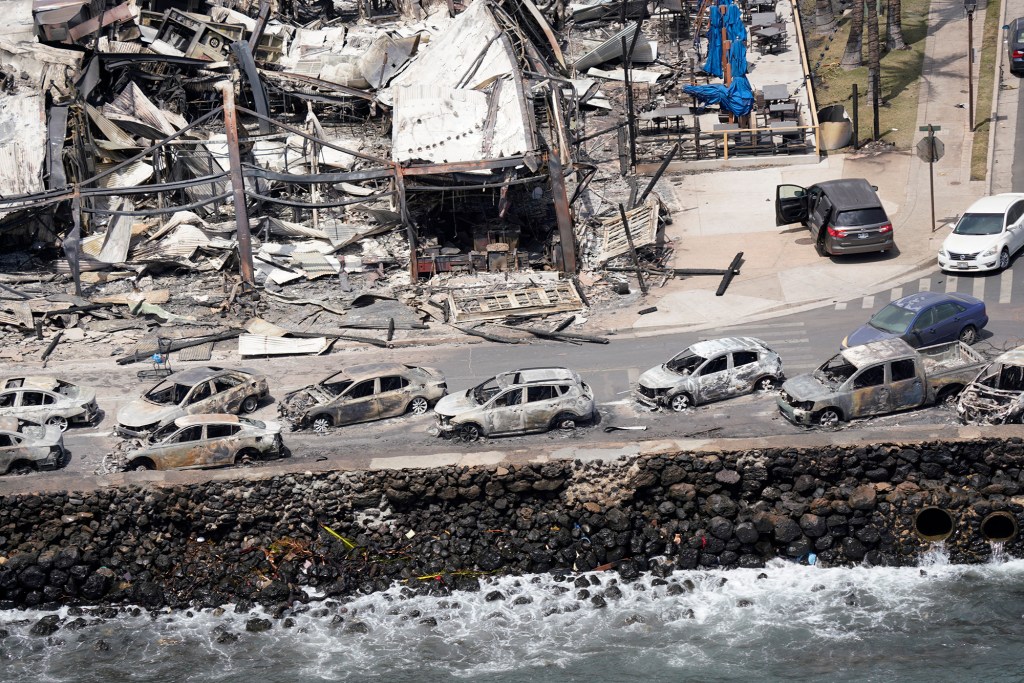
Lahaina is Hawaiʻi’s treasure box. This remarkably condensed area of about 2 square miles represents almost all of the distinctive periods of Hawaiʻi’s history — from the arrival of the ancient Hawaiians, through the ruling lineages of Maui, to the early Kamehameha dynasty and into the monarchy, to places associated with Hawaiʻi’s adoption of near-universal literacy in the 1830s and also to sites associated with the missionary, whaling and plantation eras. It’s also the single place that most comprehensively draws together the heritage of so many of the demographic groups that make up Hawaiʻi’s unique ethnic mix today.
Historically Lahaina has been an economic engine for Maui, and its most popular tourist destination. With the demise of the sugar industry, Maui is almost entirely dependent on tourism as its economic generator.
Maui’s mounting financial woes are underscoring the need to push Lahaina’s redevelopment ahead. The island’s hotel occupancy rate has been hovering at the lowest level in 35 years, except for the Covid-19 pandemic era, and its unemployment rate has fallen only because thousands of workers have moved away, according to the December 2024 forecast by the University of Hawaiʻi’s Economic Research Organization.
Lahaina’s displaced residents, meanwhile, became increasingly disturbed by the slow pace of rebuilding, with many reporting they have been told by Maui County officials that it could take up to five years before they could move back home, including two years to get through the county permitting process and two more years for construction work. They organized a letter-writing campaign to Gov. Josh Green, pleading for his intervention, and in December, Green issued a proclamation exempting some properties from coastal zone management restrictions.
Supporters of the proposed legislation say it will extend the governor’s protections.
“We need the bills to pass to be an additional buffer so we are still covered,” Schneider said.
Dozens of displaced Lahaina residents and business owners have submitted testimony begging the Legislature to act.
“As we struggle to pay our mortgage and condo fees for a home that doesn’t exist, our financial situation gets scarier by the day,” wrote Elise Strong, a Lahaina homeowner forced to move to Montana. “Lahaina has so much recovery to do. It is all so hard. Please help us to be able to come home, and to have a home again, as soon as possible. I don’t know how long we can afford these bills with no home to live in.”
The future of the separate historic landmark district bill is more uncertain. The Historic Hawaiʻi Foundation has endorsed the measure. Its executive director, Kiersten Faulkner, said she is also monitoring the other bills to see how they develop.
Prompt action by the Legislature is desperately needed, Schneider said.
“It’s necessary and a step in the right direction,” Schneider said. “We were sitting in the dark without anyone paying attention.”
 Sign up for our FREE morning newsletter and face each day more informed.
Read this next:

Local reporting when you need it most
Support timely, accurate, independent journalism.
Honolulu Civil Beat is a nonprofit organization, and your donation helps us produce local reporting that serves all of Hawaii.
ContributeAbout the Author