Lee Cataluna: Why Are We Sacrificing Sustainability For More Housing?
We’re paying a steep price for trying to jam too many people into a limited space that once allowed us to flourish.
February 23, 2025 · 4 min read


About the Author

There, in the produce section of the grocery store, was a sight that serves as an emblem for Hawaii 2025.
They’re selling guavas.
In the store.
Common guavas.
The kind that we used to pick in the backyard by the bucketful or carry down from the mountain in cloth rice sacks.
The kind grandma would use to make gallons of jam and jelly, boiling the fruit and then straining the pulp through cheesecloth over the kitchen sink. Grandma made those preserves not as a fun little crafty hobby, but because there were so many guava trees in the backyard, in the cow pasture, and up in the mountains. It was against her values and sense of duty to let that fruit go to waste.
There was a surfeit of guavas. Now, they’re at the grocery store for $6.29 a pound.
This is Hawaii 2025, when instead of sewing our own simple lei from our own plumeria tree in the backyard, we have to order a plumeria lei from a shop for $25. Many kids are growing up thinking that a lei is made from ribbon or candy or money.
We buy imported eggs because there’s no room to keep chickens in the suburbs.
Instead of growing green onions in an old coffee can outside the door to the kitchen, we buy green onions at the store and then throw away the roots. That is, if we cook for ourselves at all.
Marunggay leaves, which defiantly grow from a tree that can be propagated by simply shoving a stick in the ground, are sold in grocery stores wrapped like bouquets. In Whole Foods, marunggay is sold dried and pulverized as moringa powder and marketed as a pricy superfood.
We buy fruits that are easily grown here, like papaya and mango and now, shockingly, guava, which comes from a tree that grows wild without any special attention as opposed to, say, lychee, which needs to be babied and scolded and coaxed.
True, groves of guava trees have been grown commercially in Hawaii since the 1970s, but those varieties were used by commercial food producers who sold canned juice, frozen concentrate, and puree for baking and such. For home use, there was never a need to buy something so readily available.
When we talk about sustainability, we talk about things like electric vehicles, solar water heaters and taking short showers. When we talk about sustainable food, we talk about agriculture and fancy farm-to-table restaurants.
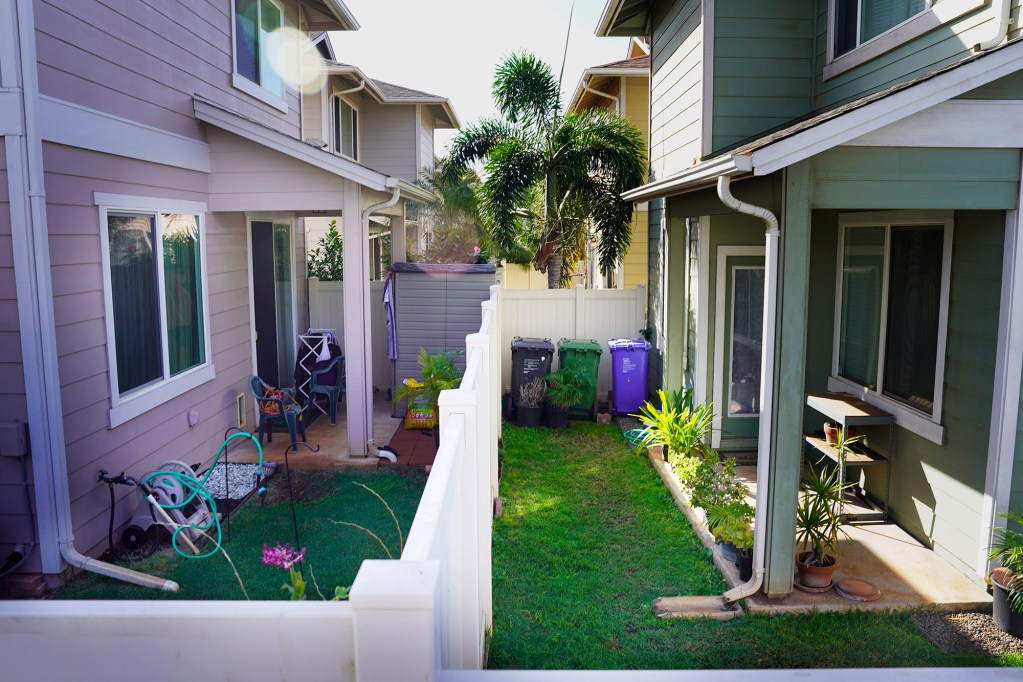
However, we don’t talk much about growing your own food nor do we advocate for houses with bigger yards because we also are bound and determined to squeeze as many people as possible into each square acre of these little islands in the name of affordable housing and keeping developers busy and rich.
Yards in housing developments have been getting smaller for decades. The landscaping in modern housing developments is just that: a strip of grass and a skinny palm of indeterminate origin providing the suggestion of a yard.
There’s no room on a strip of grass to grow your own guava or papaya or plumeria, or, heavens, a big bountiful mango tree. There isn’t even room for a dog, hence dog parks, which were meant for people in the city but have now popped up in suburbs and even rural communities around Hawaiʻi. Kauaʻi has a dog park, which is a bit mind-blowing.
The other thing affecting homegrown fruit and vegetables is the number of short-term rentals. According to a University of Hawaiʻi Economic Research Organization 2023 report, 5.5% or 30,000 of Hawai‘i’s 557,000 total housing units operate as STRs. On Maui and Kauaʻi the short-term rental market represents roughly 15% of the total housing supply
There’s a housing crisis, but there’s also a yard crisis. More than anything, though, Hawaii has an identity crisis. These islands are lush and sunny with some of the best growing conditions on the planet for a multitude of crops, yet we import pineapples, turn fertile fields into lookalike housing units, and have to buy all sorts of food we could easily grow by ourselves.
 Sign up for our FREE morning newsletter and face each day more informed.
Read this next:

Local reporting when you need it most
Support timely, accurate, independent journalism.
Honolulu Civil Beat is a nonprofit organization, and your donation helps us produce local reporting that serves all of Hawaii.
ContributeAbout the Author