The Sunshine Interview: OHA Leaders Kai Kahele And Stacy Kealohalani Ferreira
The new Office of Hawaiian Affairs executives say they are bringing fresh energy to the agency along with specific ideas grounded in OHA’s mission and state law.
February 2, 2025 · 32 min read

About the Authors


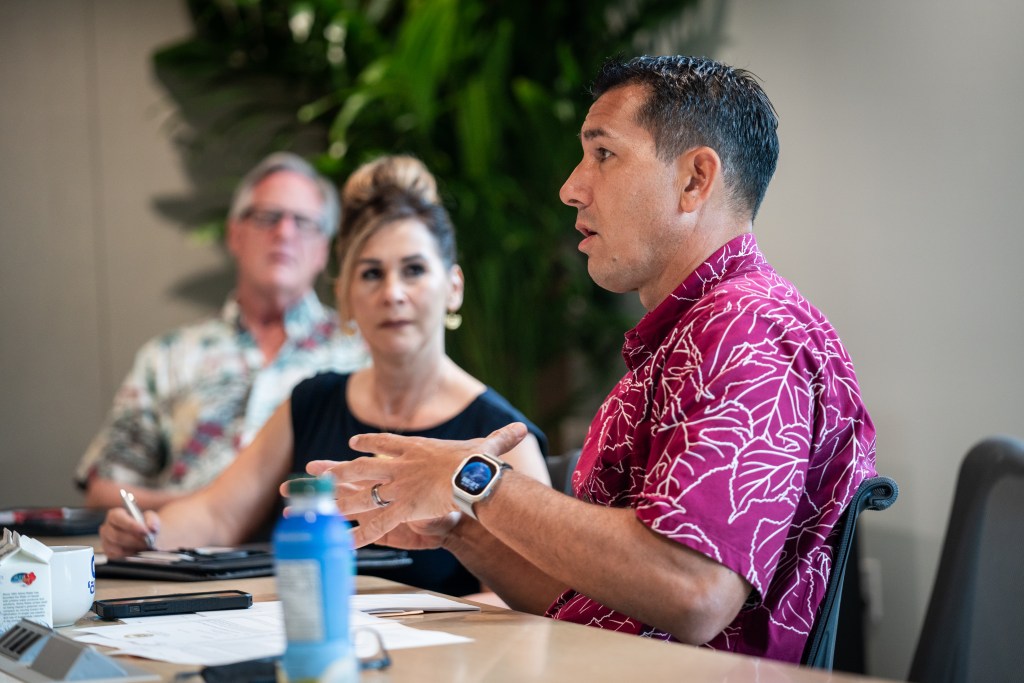
Editor’s note: Civil Beat reporters and editors met Thursday with Kai Kahele, chair of the Office of Hawaiian Affairs Board of Trustees, and OHA CEO Stacy Kealohalani Ferreira to talk about the agency’s legislative agenda and related issues. Kahele, who formerly served in the state Senate and the U.S. Congress and ran for governor in 2022, was elected to OHA last year. This interview has been edited for length and clarity and with an eye toward future reporting. Kahele began by discussing OHA’s current top priorities.
Kahele: I see OHA at the precipice of this inflection point for not just Native Hawaiians, which is at the core of our mission. We serve the entire Native Hawaiian community, but also the state of Hawai‘i. We’ve often heard, “When Native Hawaiians thrive, the state will thrive as well.” And so I think OHA can play a key and pivotal role in that.
We definitely have a new leadership team. For me personally, if you had asked me on Jan. 3, 2023, if I ever thought I’d be coming back to politics this soon, I would have told you absolutely not.
Was that when you left Congress?
Kahele: That was my last day, and it was a liberation day for me, really. And for me, the last two years was a much-needed opportunity to step back from that role that I had played for several years, to reflect on that time spent and things that I had learned, mistakes I had made. It just gave me an opportunity to reconnect with family and purpose and really figure out what I wanted to do with the rest of my life, or at least at that moment In my life. And somehow that led me to OHA. It’s a little different journey. You know, you don’t normally go from being a member of Congress to the Office of Hawaiian Affairs, but I think it’s perfect for me and for OHA and for the state right now.

You have the seat formerly held by Mililani Trask. Did she ask you to run?
Kahele: Eventually, she asked if I would run for her seat. I guess her advisors, people (with) close personal relationships, knowing that there was a possibility that she would not run for reelection due to various personal reasons, started to put the feelers out there of who could run. And this is a Hawai‘i island seat, so you need to be a Hawai‘i island resident. Of course, you don’t have to be Native Hawaiian, but very, very few people who are not Native Hawaiian have served as a trustee. So my name would naturally flow to the top of that list, and people that I admire and respect reached out and then asked if I was interested.
Initially, I was not, because the situation presented to me was she may, in fact, step down from her seat, and would I consider submitting my name to replace her as a trustee? And I didn’t even know how that happened. I knew what happens if you need to be replaced at the Legislature, because I went through that when my dad passed away, but I didn’t know how a trustee is replaced. I would subsequently find out that they are replaced by the trustees who select three finalists that apply to the board, and I didn’t want to go through that process for the very reason that I didn’t want to be beholden to any faction of trustees as a swing vote.
But more importantly, I felt that if I was going to go to OHA, I wanted to go because I was elected by the people to serve on OHA. And coming off of a disappointing gubernatorial race, I really felt offering myself back to the people of Hawai‘i to serve as an OHA trustee, and having them make that decision, was important. And so my answer was, “I’m not interested in replacing a trustee that steps down from her term early. But if the seat was vacant or was going to be vacant as an open seat, that I almost felt it was my kuleana, as a Hawaiʻi island Native Hawaiian with the experiences and skill sets that I have, to put myself forward to be an OHA trustee,” which is exactly what happened. Eventually, she did ask.
Stacy, tell us about your background before you joined OHA in November.
Ferreira: Prior to coming to OHA, I was the budget chief at Senate Ways and Means, working under Chair Donovan Dela Cruz for the last four years, and it was an exciting time working at WAM. We had the single largest budget deficit during Covid, and then the single largest surplus. The budget bill is, after the state Constitution, the single most important policy document we have every legislative session because it funds all the activities of state government. And the role really prepared me, I think, coming over to OHA, knowing how to work with state government, with an elected board.
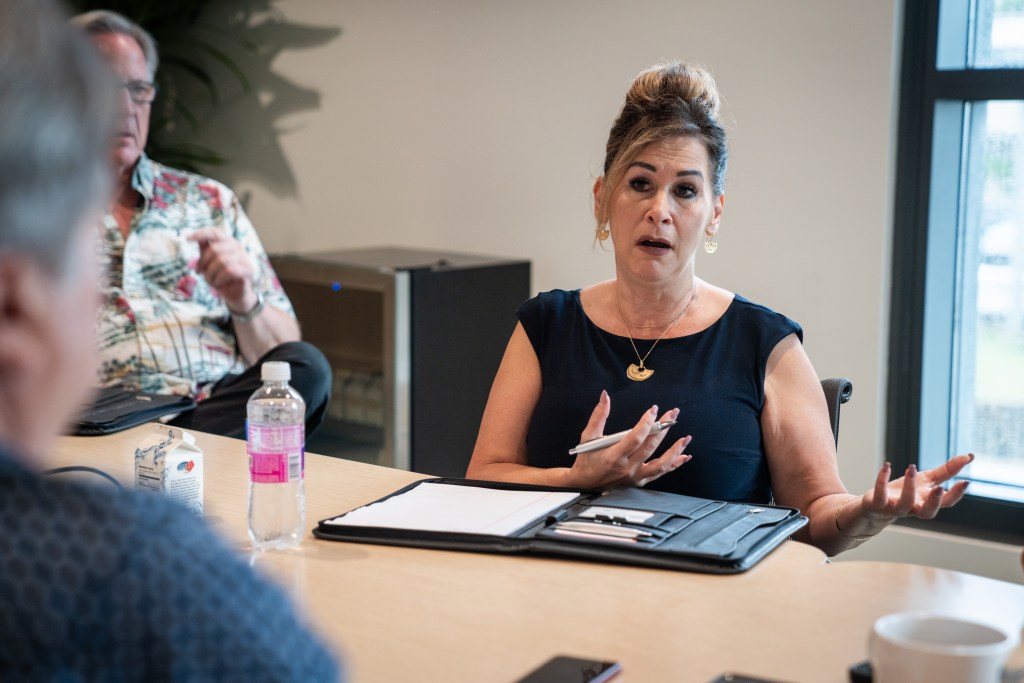
And then prior to that, I was with Kamehameha Schools, having over a decade of work in Hawaiian communities, working in community programs. And then I was also in strategy and implementation. So that provided me another level of skill sets in really thinking about, “How do you look around the corner, how do you forecast, how do you be more strategic about the resources that an organization has?” And really trying to get to whatever that North Star that the organization has put forth for the agency — not just stay on the current course, but also really push to new heights for organizational effectiveness, optimization, and hopefully maximizing the resources for the Native Hawaiian community. I find the melding of the two was a really nice coupling when I went over to OHA, so I felt like I was able to hit the ground running.
You had to do that pretty quickly, because you had to prepare your budget right away and of course preparing your legislative priorities. How has that been in getting the ship in order, especially under a new chair, in only a very short period of time?
Ferreira: I wanted to share some of the words that I’m hearing out in the community: People are excited. There’s a new energy. They’re really appreciating the action-oriented leadership that chair and I both bring. And so when we looked at the budget, one of the things that chair and I both bring is our understanding of Hawai‘i Revised Statutes, the Constitution, and so we have done a really good job of articulating to our teams. “What is that line of sight between, what is our state mandate? How does the budget reflect what we’re supposed to do statutorily? What does that look like in terms of our strategic plan? And then, how do we resource that right?”
“The success of OHA directly affects the lives of everyone in Hawai‘i, and there needs to be more education.”
Kai Kahele
And so when we went in front of Ways and Means and (House) Finance, I think we did an excellent job of really articulating what is it that the state is requiring of OHA. And I think that’s the first time that OHA has ever been able to clearly tell that story of what is our purpose, what are we intending to do based off of that mandate, how that is reflected in our strategic plan, in education and health outcomes, housing and economic resilience, and then what are the resources that we’re going to need to effectuate that.
Coming from Ways and Means, I know what Finance and WAM are needing to understand the state budget requests. So I’m really hopeful that we’re going to get our requests.
What was that like for both of you to be on the other side of Sen. Donovan Dela Cruz — a colleague of yours, Kai, for a number of years, and of course Stacy served on WAM. What was that like to be on the other side of the microphone?
Kahele: It was interesting for me. Dela Cruz and I go back a long ways, and you were there when Sen. (Jill) Tokuda was removed as the Ways and Means chair and Sen. Dela Cruz was named the Ways and Means chair. That was my first session at the state Senate, and to be in the middle of that … I feel like I know Sen. Dela Cruz pretty well, and we have a good relationship, especially when I went to Congress. I maintained that relationship with him as well, and some of the priorities that he had, like the First Responder Tech Park that we were working on together. What I did sense was there’s that mutual respect, but he’s also going to ask you the tough questions, and we would expect no less.
Stacy, could you talk a bit about these new positions that you’re asking for (from the Legislature) related to the OHA strategic plan and just how that kind of fits together?
Ferreira: Mahalo. So one of the first things when I came on as a new CEO, the board had asked, one of their major priorities, was to implement our strategic plan. Mana i Mauli Ola is a 15-year plan, and it is based off of HRS Chapter 10 and Chapter 10-H. We didn’t have a functional team or a department that was able to effectuate the plan. So one of the first things I did was created a Department of Strategy and Implementation, which was critical, because we needed to get individuals that could hit the ground running.

And what that looked like for me was looking at those four strategic directions (health, education, housing, economic stability) and getting individuals who had expertise in those areas.
Hawai‘i is unique. You need leadership that can come in and understand the ecosystems that housing has to operate in, and education and health care. And we needed folks that had the experience, had the understanding of the ecosystems but also the network. Because we know in Hawai‘i it’s the relationships and how we can be able to move things pretty quickly, being able to formulate that tactic, be able to resource it, and then to be able to execute.
The tactics that we have are very big lifts, and we cannot do it alone. So a lot of this work that we’re going to be doing going forward with this strategy and implementation team is to do this in collaboration and in coordination. Now the strategic ask, the compelling request that I think that chair and I and the board put before the money committees, was that the ROI (return on investment) that you would get with the $1.2 million (budget) ask for the 13 individuals was that, by state mandate, OHA is the only agency that has the authority to go into the state department to look at programs, services, policies, processes, and really assess whether or not they’re being effective.
And so when I was talking to them about the $20 billion that they appropriate each year (for the state budget), that is really the biggest leverage point that the Legislature has — their $20 billion appropriation versus our $60 million budget. We’re never going to change the trajectory as much as we could if we were working in consort with the executive branch.
I’ll give you an example: The Department of Human Services budget is $4 billion. That’s a huge chunk of that $20 billion budget, right? But if you look at the Department of Human Services and their programs, Native Hawaiians are overrepresented in many of them — child welfare, TANF (Temporary Assistance for Needy Families ), so on and so forth.
So if OHA, who has the authority to actually go in and work very collaboratively with them, coordinate around their programs and services and really dig into their data, see how they’re using their appropriations, is it changing the trajectory? How can we work better to identify shared tactics so that we can start working more effectively and efficiently together to see some change, some real transformational change happen?
It’s never been done before, but I think that’s the beauty of the relationship that both the chair and I bring because of the folks that we already know in the executive branch, the relationships we have in the Legislature. It’s going to be much quicker work than if you had folks that came in new and didn’t really understand how state government works and understand the statutes. There’s a different level of confidence if you walk into a room when you know what your power and authority is.
You talked about Native Hawaiians being overrepresented on some of these different programs. What services are not happening?
Ferreira: We are dealing with deep-seated, historical and generational trauma, and so to get to that root cause, I think there’s going to have to be a lot more work done in coordination with the Office of Wellness and Resilience that’s currently in the governor’s office, to start looking at the behavioral, the emotional, the social-economic (factors). There’s so many things that are intertwined that we’re going to have to dig into the data.
Again, this is the beauty of the work that’s before us — if we get that appropriation, how do we start looking at what the data telling us and what programs are in place? Where are the gaps happening, and how do we pivot or course-correct or do more of something? But without that level of assessment and coordination between the executive branch and OHA, I think we’re going to continue to have gaps in true understanding on what the solutions can be.
Do you think it’s additional services, or is it figuring out the root cause so that people don’t end up in those systems?
Ferreira: It’s both, because we have the everyday that we have to address. But then we also have to take the long view as well, right? So it’s sort of this parallel effort. We have to do the stop-gap solutions, and weʻve got to figure out what are those root cause issues (such as) dispossession of land. Solving for that doesn’t happen overnight. That’s going to be something that’s going to be years in the making and very entrenched in policy and leadership to change some of those things. There’s other things that we might be able to do more quickly, like housing, because it is a priority for the administration. So I don’t think it’s an either-or.
Kahele: I think that is a question that OHA has struggled with for some time. OHA is not a direct-services agency branch of government. We basically provide grants to nonprofits that do those services, and sponsorships for events in terms of the financial impact that we can make in the lives of our beneficiaries. We’ve tried to align those grants and sponsorships around our strategic objectives.
We appropriate about $18-20 million in grants every year. Compare that, let’s say, with the Hawai‘i Community Foundation that does $200 million in grants, right? We’re a very small operation.
“There’s a different level of confidence if you walk into a room when you know what your power and authority is.”
Stacy Kealohalani Ferreira
But I also think that there is a disconnect between our beneficiaries and the Office of Hawaiian Affairs in terms of understanding why OHA exists — not just our beneficiaries, but the broader state of Hawai‘i — what its mission is and how it’s doing the best job it can to improve the lives of Native Hawaiians, which is at its core. I hope to be able to steer not just our trustees but OHA into a more grassroots, connected-with-our-communities type of focus.
I really believe that we need to get out into community. We need to get out to where people are, to understand and talk to them and educate them and truly understand what they’re going through in their lives and how OHA can best help them. I think we’ve strayed away from that. And it’s not just unique to OHA. In my personal opinion, I think it’s why the Democratic Party lost the election at a national level, because it failed to connect with people’s everyday lives and challenges that they’re having. And I think OHA, in a smaller way, needs to do that in our communities.
It’s going out into homestead communities, and going house to house and meeting with people, talking to them, understanding what they need. “How can OHA make the biggest impact in their lives right now? How can we tailor our funding streams to help people do that?” Everything from a universal basic income modeled after Native Alaskans and their indigenous model of how they support Native Alaskans, to other other types of things that we could be doing. I think that’s super-important.
And I think trustees have to be out in front. I don’t want to just hire contractors to go out and get data with clipboards and iPads. I want trustees out in communities, touching, feeling, connecting with our beneficiaries. I don’t think we’re doing it right now, and I hope to start to do that as soon as possible.
Data is very important, because data allows us to orient our goals, objectives, our resources, to data-driven results. If not, then we’re just kind of shooting in a barrel with different nonprofit organizations that hope we meet these certain strategic objectives and goals and measuring performance. If you ask the average Native Hawaiian out on the street, “Hey, what is OHA? And how does OHA impact your life? Has it impacted your life?” The majority of the people that I’ve run into, they have no idea.
I’m fortunate to be on this side of the economic spectrum, the educational spectrum, the life experiences, but I don’t represent the majority. The majority of Native Hawaiians are struggling. They’re hurting. They need help, and that’s where OHA can’t do it alone. We have to do it with a whole of government effort. We have to partner with our Ali‘i Trusts (Kamehameha Schools, Queen Lili‘uokalani Trust, King William Charles Lunalilo Trust, Queen Emma Trust) and other organizations.
It would help if we got the fair amount of public land trust revenues so we could do those things, then maybe we don’t have to ask for more money and more positions every year at the Legislature. But right now that’s not the case.
With housing being a primary issue for every cost driver in Hawai‘i, what’s OHA’s relationship with the Department of Hawaiian Home Lands, and especially given the length of the waiting list for the homelands?
Kahele: First and foremost, OHA pays $3 million a year to pay the debt service on a $30 million infrastructure commitment that DHHL made 20-something years ago, 30 years ago. To put that into perspective, we have about a $600 million Native Hawaiian trust fund. Our budget is about $57 million a year.
So to directly answer your question on how we how we help them with their infrastructure, there’s a lot of behind-the-scenes collaboration, at least most recently, with DHHL and with OHA, specifically within Kakaʻako Makai and in other projects that they want to partner with us on. New leadership at DHHL under Kali Watson — this is his second time around, right? He’s smarter. He is more nimble. He knows how to develop, especially low-income housing developments. He has experience doing that on the private sector financing, the financing piece. So he’s a great person to lead DHHL and that relationship that we have, at least in the last few months I’ve been there, has been something that people are really excited about.
But it’s an informal relationship, is it not? You’re not on the commission, right? So you don’t have any say in those decisions.
Ferreira: One of the things that DHHL has reached out to us is asking for administrative support on the (Native Hawaiian) ancestry verification and some of the birth certificate verification steps. We’re going to be supporting them with that. They want to operate on their core competence, which is getting housing. If there are other ways that OHA can support them on the administrative side, we want to be able to do that. And then the other thing is they have special powers in their statutes, and OHA has some special powers. And coming together we have opportunity to look at some of the more entrepreneurial efforts.
So although housing is big for OHA and for DHHL, we have opportunities to partner on revenue generation, because we cannot always depend on other sources. We have to get creative. And I think there’s an opportunity in in the near future to really think about some exciting projects.
Specifically regarding the ceded land revenues, your predecessors have repeatedly gone back to the Legislature saying their reading of the Constitution is that OHA should be getting a bigger slice of ceded land revenue. I don’t remember what the exact figure is …
Ferreira: $21.5 million.
But you believe it should actually be closer to something like what?
Ferreira: $80 million.
With the need for revenue and the need for housing, how come you decided not to bring that up, at least initially this session, as part of your legislative package?
Ferreira: We have a bill.
Is it actually within the OHA budget bill?
Ferreira: No, it’s a separate standalone bill. It’s from Sen. Lorraine Inouye and Rep. Kanani Souza. It’s the Public Land Trust Working Group bill. It was actually a deliverable from the Act 226 in 2022. It raised (payments) from $15 million to $21.5 million. They did (a) $65 million payout. And then they created the Public Land Trust Working Group. OHA has been the lead.
So that is a change from years past.
Kahele: I think the historical context is important. We start with the 1978 Con Con (constitutional convention) that created OHA, and it was a watershed moment for Native Hawaiians, right around self determination, self governance, the reawakening of the Native Hawaiian consciousness that was happening in the late-1970s. And when OHA was created, the specific language in the state’s Constitution is that the Office of Hawaiian Affairs would be funded through a pro rata share of the public trust revenues. There’s this pot of land that is not ceded land. It is part of the ceded land corpus, but it does not include all of the ceded lands.
“We need to get out to where people are, to understand and talk to them and educate them and truly understand what they’re going through in their lives and how OHA can best help them.”
Kai Kahele
In 1979 and 1980 when this constitutional amendment was ratified by the people of Hawai‘i and brought to the state Legislature, of which very few state legislators participated — it was made up of mostly community, when the people of Hawai‘i ratified the Constitutional Convention, it went to the Legislature to then enshrine it into statute, which is Chapter 10 Hawai‘i Revised Statutes.
From inception, it was being watered down. And that’s how it has been for the last 40-something years, where this mandate by the people of Hawai‘i to address a long-standing issue through this newly created fourth branch of government, Office of Hawaiian Affairs, was being watered down, watered down, watered down. And the one thing that they were having a hard time figuring out was what that pro rata share meant.
Well, in 1980 they did decide what it meant. It meant 20% of the revenues generated from the public lands corpus, right? There had never been an accurate inventory of where those lands are, what departments have them, what revenues are generated from them, what counts, what doesn’t count. The initial amount that was going to OHA in 1980 was $1.5 million, and sometimes it went to zero. And so it has fluctuated over time. Today it stands at $22 million but by our calculation, it should be $80 million
My remembrance when covering previous hearings is that the Legislature has been reluctant to give that to you, in part because you do have the $600 million in assets and that you can generate your own revenue.
Kahele: But that’s not their choice, right? The state’s constitution says pro rata. HRS says 20%. But 20% off what? If we don’t have a public land trust inventory and accurate inventory, how are we determining where those revenues come from?
And that inventory is something that you’re still pushing for in terms of getting more of that seated public trust land revenue share. Do you think that is going to change this year?
Kahele: It should, yes, because we take those resources and we help Native Hawaiians. The state’s trying to help keep them out of prison, to keep them from being homeless, to help them provide educational opportunities. We provide $18-20 million in grants. Right now, we could be providing $70 million in grants to nonprofits to address all the things, the social determinant issues that we’re trying to address.
But then what you need is, you need a universal baseline of how that number is calculated, how that number is reported. You need enforcement measures if departments are not accurately reporting their revenue. Right now, there is no standard and verification, and there’s the two biggest state agencies that have lands within their inventory — and that pay the most money — the Department of Transportation, Harbors Division that generates the most, about $15 million bucks a year out of the $21.5 million.
DLNR is the second-biggest state agency, and then everyone kind of falls off after that. So having an accurate inventory, putting a universal standard in place about how that’s calculated and actually collecting the revenue that OHA is due is critically important right now. Agencies pay what they pay, and that’s it. They don’t report anything else.
Should this result in the goal that you have, how dramatically will it impact your mission and your beneficiaries?
Kahele: Oh, tremendously. A good example was yesterday. We had a pretty spirited conversation with one of the senators that wanted to ensure that OHA would not be coming back to ask for infrastructure dollars. And I’m like, “If we got our $80 million a year, we would never have to come back to you,” right? I mean, we’re trying to do a good thing here in Kaka‘ako Makai, and you’re telling us we better not come ask you for sewer and water and infrastructure money? If we got the revenues that we were due, that is mandated in the state’s constitution, then we wouldn’t be able to be here.
Ferreira: To clarify, that’s $80 million back in 2016.
Okay, all right. I did want to bring up the burial councils and iwi kūpuna (ancestral remains). I believe your bill wants to change the quorum, or the number of people that are on the councils. My understanding is it’s been a struggle to get enough people on the various councils and then for them to be able to act expeditiously when iwi are discovered.
Ferreira: Quorum has been a persistent issue. At OHA we are trying to help facilitate getting names, vetting individuals, having our trustees approve, and getting it over to the governor so that we can fill long-overdue spots. But DLNR is another avenue in which names are put forth.
The councils work with SHPD directly, correct? State Historic Preservation in DLNR.
Ferreira: Yes. The quorum is one issue. But I think what the bigger issue is is that the whole intent of the burial council was to give lineal descendants, cultural practitioners a forum, a place where they can put forth their expertise on how to deal with iwi kūpuna issues (and) land owners. They have to go through the permitting processes. They have their bank of attorneys and people who are informing their side. And this is the one opportunity, the one area where our cultural practitioners and those family members of the iwi from that area get to weigh in. And when you now have to take into consideration the landowners’ perspectives in that conversation, you change the intent and the dynamic of that. And then if they don’t show up, then that throws it off and then decisions just linger. And it can be used as a strategy, really, to put a hold on a project.
What would the bill then specifically do?
Ferreira: We are hoping to bring down the number of required members and then to take the landowner seats off. On Kaua‘i in Wainiha there is a current private land owner (involved) in septic tank conversion. Part of our authority is that we can be the convener of state departments when it comes to these types of cultural issues. And so in this particular case, we were able to convene the County of Kaua‘i, Dr. Kenneth Fink from the Department of Health, Chair Dawn Chang from DLNR, Jessica Puff from SHPD and OHA and basically we put together a panel that had to be accountable to the public and answer to what is the current process.
“People are excited. There’s a new energy. They’re really appreciating the action-oriented leadership that chair and I both bring.”
Stacy Kealohalani Ferreira
And as a result of that community meeting, the County of Kaua‘i has changed their permitting process in just in a few weeks. They used to look at this septic conversion as remodeling. It wasn’t considered construction. But we know you have to break ground if you’re digging and putting in a septic system. So it was never going through the permitting process.
This convening of the state departments really started to highlight where the holes are in the processes, as well as the lack of communication between the state departments and such an important approval process. Kudos to Kaua‘i County and Mayor Derek Kawakami and his team for moving very quickly to remedy that.
It’s just an imperfect process across the board, and then you have this huge mandate from the state to do this (septic tank) conversion. But if we don’t get this right, we’re going to continue to have kānaka (Native Hawaiians) get arrested, because they’re not going to back down. These are our family members. We cannot condone it and we have to support our communities and making sure the right things are done.

I was looking over the voter turnout again for OHA. By law, non-Native Hawaiians can run for office, non-Native Hawaiians can vote for OHA, and that’s a statewide position. Every single eligible voter in the state can vote for OHA trustees. Why don’t more people turn out to vote? How can you change that?
Kahele: This is just in my experiences in the Legislature and serving in Congress, the thousands of people I’ve met, kids given tours on the floor of the U.S. House, people I’ve talked to, is we have a problem in this country. It is the lack of civic education. That is a core function of our democracy, and it is a failure of the educational system, public and private, that we have where people don’t have this baseline knowledge of democracy, of civics, of why it’s important to engage in community, why it’s important to participate in elections, why it’s important to get fact-based information. That’s a major issue, and I think it is translated to an apathetic electorate that does not want to participate or doesn’t see a value in their right as an American to vote in its free and fair elections.
It’s not just OHA — 32% of this state voted in the August primary election. If you look at the history of voting from the 1990s to now, it’s terrible. Its average is about 40% in the primaries. When we’re typically elected in a Democratic state, the most important races, including the governor’s race, less than 40% of the electorate participate in a general election. It’s a little bit higher, especially in the presidential year, but generally speaking, it’s pretty bad.
But specific to OHA, those races in particular …
Kahele: It goes back to education. If people don’t understand what OHA means and why it’s important to vote in those races. There are some people that say, “Hey, despite the law change or the Supreme Court decision, I’m not Hawaiian, and I don’t think it’s my place to vote in election.” I can respect that. However, the success of OHA directly affects the lives of everyone in Hawai‘i, and there needs to be more education.
I gave this presentation once on this very topic at Kamehameha Schools. And it was to a group of educators that taught middle school and high school. And halfway through the presentation, I gave them a basic civics test. Part of it came from the standard U.S. citizenship test that anyone that is applying for citizenship in this country has to take. I took the test as a member of Congress just to understand. I did fairly well.
So I took about 15 of those questions, which is a lot of American history, American civics, and I created my own Native Hawaiian test about Hawaiian history, about Hawaiian civics, everything down to our flag, our monuments, things that make up a functioning democracy. I put them in a test and I surprised them with a pop quiz, and I had their results shown on the screen. The first group failed the test. The second group passed. It did a little bit better.
Then I asked the next question: “I have a $25 Starbucks gift card here for anyone that can name me your city council member, your state rep, your state senator, who the mayor is, the lieutenant governor, the governor and your member of Congress in the house, and name me one U.S. senator.” Nobody could do it.

That’s bigger than just not voting for OHA. That’s a big issue in this country. It’s something that has existed for 100 years, probably. But I take my little girls, just like my dad took me to the voting booth. I don’t vote via mail. I go to the machine. My daughter sits on one lap. The other daughter’s here, and we’re voting. She’s like, “Oh, I see this person’s banner. Let’s vote for this person.” I wait in line. We vote together. My daughters know how important it is. I want them to remember that.
I think our educational system, both public and private, have this moment in their lives. We have a captive audience, right? Our teachers on the front lines are so important at civic education, and once they move on and they graduate from high school, and they can register to vote, and they can vote. If you don’t capture them, then it’s very difficult to to get them to be participating members of our society.
Ferreira: I just wanted to add another important part that OHA is actually advocating in this current session, is public election funding. I think a reason for (voter apathy) is public election funding. OHA candidates need to have parity, not only on our salaries but also in the election funding, if we want to run quality races where we can educate folks and get folks out to the polls. That’s going to take money.
Kahele: We have to have faith and trust in government. In order to do that, you need clean and fair elections. You need campaign finance reform. You need the 10 things that I proposed when I ran for governor to be implemented. I talked about those things two and a half years ago. It was barely reported on, the things that I would have done and advocated for and tried to lead with. You need a honest, free and open press that people can trust. You need a mainstream media that the electorate can trust.
Because where are they getting their news right now? They’re getting it from Tiktok. They’re getting from YouTube. They’re getting it from NewsNation. That’s a major issue. If you poll the electorate of America, who is the least trusted — Congress, the media. Who is the most trusted — the military. But even that has been waning as well, so that that’s not good for a functioning democracy. And it starts with civics. It starts with education. It starts with campaign finance reform. And I think there’s a lot of different reasons just why people are not voting in the OHA election.
 Sign up for our FREE morning newsletter and face each day more informed.

Local reporting when you need it most
Support timely, accurate, independent journalism.
Honolulu Civil Beat is a nonprofit organization, and your donation helps us produce local reporting that serves all of Hawaii.
ContributeAbout the Authors