Alyssa Salcedo: Don't Regulate How Journalism Is Practiced — Or Taught
When a senator introduced a bill that smelled like censorship, it brought back a high school newspaper memory.
March 9, 2025 · 7 min read

About the Author

When I first looked at Senate Bill 1618, known as the Journalism Ethics Commission Bill, it took me back to high school and my first experience with what felt like censorship.
It was the fall of 2021. As a student journalist for Waipahu High School’s newspaper, The Cane Tassel, I wanted to write a piece critical of the career academy system and how it limits students’ aspirations. But when my advisor asked the deputy principal whether or not the newspaper should publish such a story, she was told it would depend on the content.
Because of that vague statement, I did not feel that there was any need to continue pursuing this story. It felt extremely discouraging, even when I confirmed that people could talk to me about their experiences with the career academy system.
I pivoted to another topic.
It is not hard to imagine that other journalists in Hawaiʻi have had similar experiences, especially when we have to balance maintaining community relationships with holding those in power accountable.
SB 1618, introduced by Sen. Donna Kim and others, proposed the establishment of a Journalism Ethics Commission and other related policies to supposedly strengthen how local journalists report ethically.
The committees the bill was referred to did not schedule a hearing by the deadline, effectively killing it. We’re kicking a dead dog, but it still provides a reason to contemplate what happens when the government tries to control journalists.
What stood out to me as censorship in the legislation was how reporters’ state media privileges could be revoked if a complaint were filed against them and substantiated.
It made me think back to my high school experience because if you prevent journalists from accessing public officials and going to press events, like how President Trump is choosing which press outlets could cover him, it affects our ability to hold officials accountable.
This bill also directed the University of Hawaiʻi Board of Regents, whose members lack media backgrounds except for journalist-turned-lawyer Laurel Loo, to analyze and recommend whether ethics credit classes sufficiently prepare students to deal with rising ethical challenges in journalism.
Ethical Concerns Are Legitimate
The basis of some of the bill’s concerns were valid: Artificial intelligence, deepfakes and misinformation are rampant in our everyday consumption of information. It’s all over our social media feeds, whether we like it or not. Some news organizations have even taken to experimenting with AI, such as The Garden Isle’s short-lived experimental run of its AI-generated newscasts.
But when read more closely, the bill could easily slide down the slippery slope of censorship.
Censorship occurs when access to public information is prevented and when free thought is suppressed.
Recently, a judge in Mississippi ordered a local newspaper to remove its editorial that criticized a mayor and other city officials. These officials claimed that the editorial was “libelous” and violated the First Amendment. On the federal level, the Associated Press has sued the Trump administration for blocking its journalists’ access to key White House-related events because it continues to use the name Gulf of Mexico instead of the Gulf of America.
If journalists cannot constructively criticize the government, then citizens cannot gain access to vital information on how decisions about their communities are made. Also, if journalists are threatened with having their access to key governmental officials revoked, then they would be forced to play along with the rules. As a result, the news created may be a de facto extension of state-sponsored media.
For this reason, local media organizations including the Honolulu Star-Advertiser’s Editorial Board and the Society of Professional Journalists spoke out against this bill.
Not A Job For The Legislature
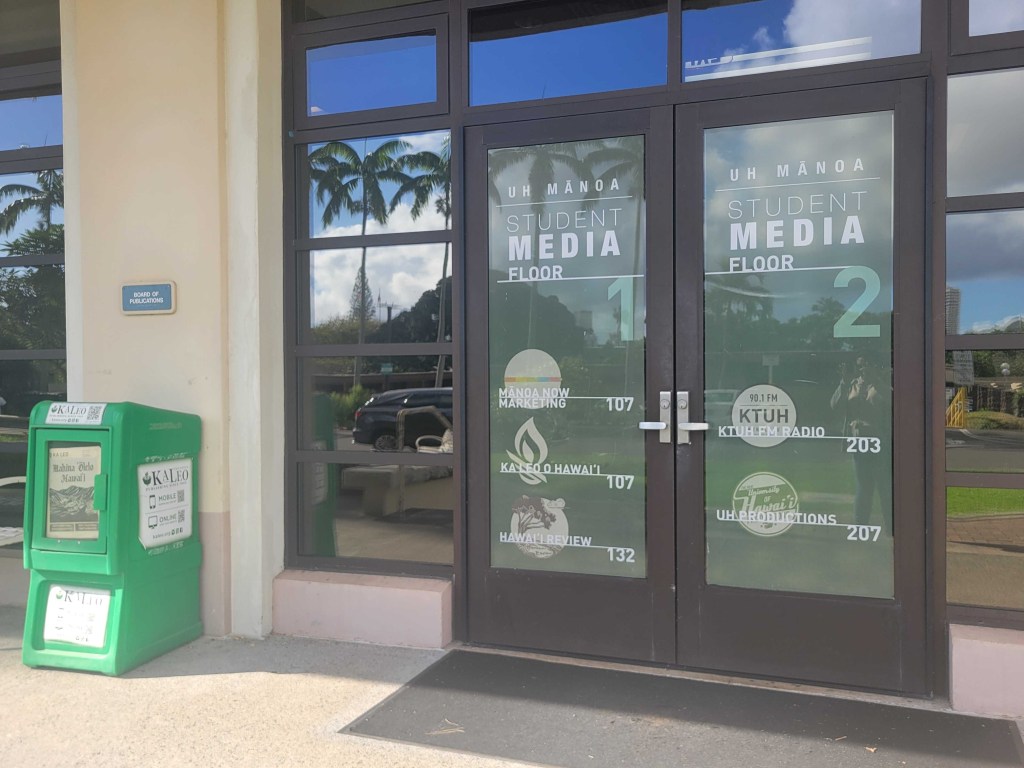
Student journalists – at UH Mānoa and elsewhere – already receive adequate training in journalism ethics.
The journalism program at UH Mānoa offers classes with an ethics designation every semester. These include Media Ethics, Journalism History & Trends, and Communication & Law.
“I don’t think it’s the Legislature’s place to create, assign or restrict curriculum because they’re not experts in the field,” said Brett Oppegaard, a journalism professor and former program director of UH Mānoa’s journalism program.
The bill unfairly targeted journalists from UH Mānoa when over half of all practicing journalists in Hawaiʻi were educated elsewhere. Many of them come from the continental U.S. to work here.
The SPJ Code of Ethics acts as a general guideline for how journalists should operate to produce their day-to-day reports. But it cannot take into account every situation that a journalist may encounter.
For example, the code recommends against using anonymous sources. But consider this example: there’s a whistleblower who intends to speak up about something bad happening. They are restricted by threats of retaliation: lawsuits, harassment or worse. In that case, a journalist might decide to include them as an anonymous source in their piece, provided that their experiences are backed up with hard evidence.
And if a journalist were to do something seriously unethical? Getting fired from their news organization is a likely punishment.
Focus Instead On Media Literacy
Legislators should instead direct their attention to increasing media literacy among all news consumers rather than policing how journalism is practiced or taught.
Media literacy includes online etiquette, understanding persuasion tactics and fact-checking. This knowledge enables news consumers to decide what sources of information they put their trust in – whether it is an article from a local news site, a social media post or unverified hearsay.
It is crucial that this education is not limited to just adults, but also children who are exposed to social media at increasingly younger ages. A recent study by the News Literacy Project found that 94% of surveyed American teens want to require media literacy classes in their education. However, only 39% of teens reported that they received any media literacy education during the 2023-24 school year.
Student journalism classes are another way to receive media literacy education. A recent article by Cassie Ordonio of Hawaiʻi Public Radio showed a decline in the number of Hawaiʻi high school journalism classes. To me, this demonstrated the importance of investing in this kind of education. Sure, it may not be considered Career and Technical Education, but it is important for students to gain exposure to news – through reading or writing it.
Working for my high school newspaper was my entry point into journalism. Before that, I was only exposed to news whenever my Grandpa tuned in to CNN or MSNBC for political news in the morning.
Building cultures of curiosity, openness and civil discussion will push our society forward. We journalists cannot simply tell people what to believe; we provide the information and it is the public’s responsibility to decide how to act on it. But I think that it is our responsibility to encourage these practices, especially in this time where the line between information and entertainment may become blurry for those of us seeking an adrenaline rush.
Democracy relies on a well-informed, civically engaged populace. It is more than just a vote; it is keeping up to date with current events and exercising our rights.
My brief encounter with what felt like censorship inspired me to submit written testimony for the student press shield law, which was signed into law that same year. The Legislature can use its power to advance journalism in Hawaiʻi, but not by attempting to regulate it.
 Sign up for our FREE morning newsletter and face each day more informed.
Read this next:

Local reporting when you need it most
Support timely, accurate, independent journalism.
Honolulu Civil Beat is a nonprofit organization, and your donation helps us produce local reporting that serves all of Hawaii.
ContributeAbout the Author