Tension And Turmoil At The Hawaiʻi Elections Commission
Is the commission still able to do its job amid unceasing questions about election fairness, continued calls to fire top officials and hours-long meetings plagued by infighting?
March 2, 2025 · 14 min read

About the Author

The Jan. 15 public meeting of the Hawaiʻi Elections Commission was typical of the meetings the commission has held for well over a year now: lengthy, byzantine, contentious, exhausting.
Only a few minutes after it began, Commissioner Ralph Cushnie made a motion to amend the minutes from the Dec. 18 meeting. He complained that the minutes did not accurately reflect what had happened in the December meeting — a meeting where Chair Michael Curtis evicted Cushnie for obstructing the agenda.
What followed at the January meeting, the most recent for the commission, was nearly four hours of back and forth between Cushnie, Curtis, other commissioners and a Zoom audience of more than 100 people. The proceedings included lots of testimony on an obsession to remove Scott Nago as chief election officer, even though the matter has already been debated at length and Nago remains at his post.
To be clear, it is precisely the job of the commission to hold such public hearings, to investigate complaints and to advise and evaluate the chief election officer. In that sense, the nine-member volunteer commission is doing as it is required by law.
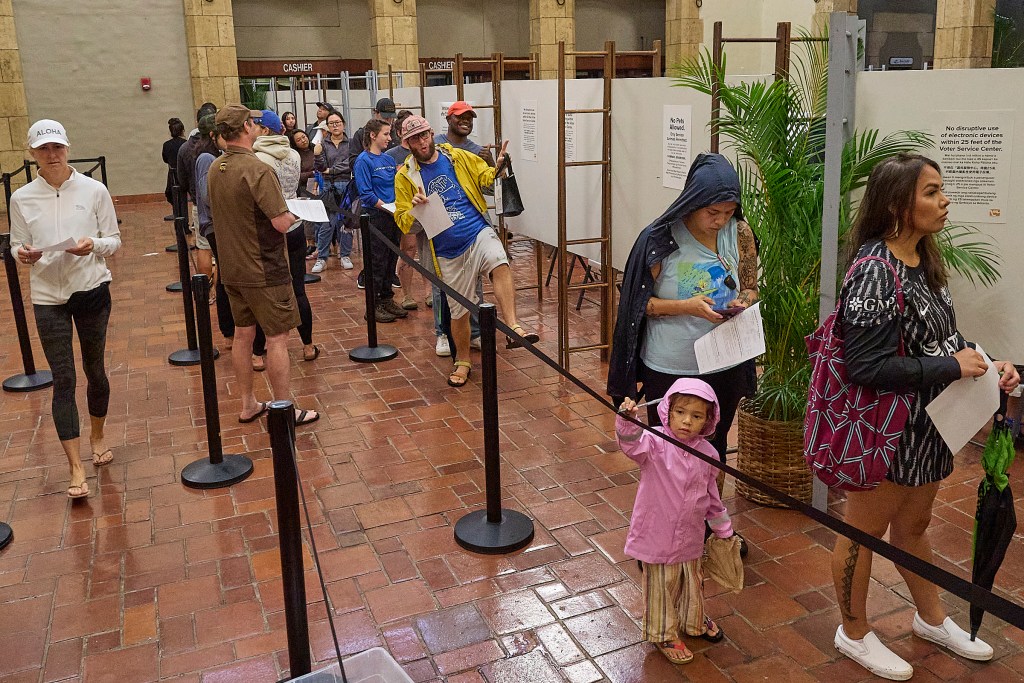
But the meetings also illustrate that the commission’s work can be sidetracked by dozens of sometimes angry, politically ideological and occasionally ill-informed testifiers who do not believe Hawaiʻi’s elections are run with integrity — even though there has been little to no evidence found of voter fraud, locally or nationwide.

While Curtis and Cushnie reject notions that politics clouds the commission’s work, the contentious meetings have not gone unnoticed. House Bill 141, which passed the House on Thursday, would make the members of the commission subject to Senate confirmation. The idea is to vet potential commissioners to ensure that they will serve the state’s elections process fairly.
Whether the bill will be enough to take the rage and partisanship out of elections commission meetings is an open question. While election denial conspiracies that followed the 2020 presidential election have largely disappeared nationally following Donald Trump’s convincing reelection in November, they continue in Hawaiʻi, one of the bluest of states.

There are still concerns about whether Hawaiʻi’s mail-in balloting system is working as intended. Commissioners are now asking the Legislature to form a task force to examine whether there are conflicts in “the letter of the law,” as Curtis explained, that are “inconsistent” with how the voting is actually conducted.
Curtis did not elaborate on what he meant by inconsistencies, but he pointed out that the mail-in system, launched in 2020, was initially intended to be a pilot project in Kauaʻi County only.
“I know the Kauaʻi clerk and elections people, I know that they got their stuff together,” he said. “It would have been a lot better to experiment on Kauaʻi before doing a carte blanche across the state.”
The Nago Attacks
A majority of those who have testified before the elections commission over the past several years very much want a new chief election officer. That was on full display at the January meeting.
Dozens of citizens signed up to speak over Zoom. Andy Crossland accused Nago of insubordination, Nolan Chang alleged multiple violations of election rules under Nago’s watch, Jennifer Hunt said the election process lacked transparency and Gary Cordery testified that Nago had been ineffective regarding the state’s mail-in voting system. Rhy Thornton accused some elections commissioners of stonewalling and even treason.
The battle over Nago has continued since Cushnie was appointed commissioner in January 2024. Prior to that, he’d spent months testifying and submitting letters and emails to Nago, his staff and the commission. Those meetings were often disruptive, too, under former Chair Scotty Anderson, who stood by Nago.
There is often a clear political divide on the commission, judging from many of the votes on the many motions. Commissioners Dylan Andrion, Anita Aquino and Kahiolani Papalimu generally tend to side with Cushnie. All were appointed by Republican legislators.
Commissioners Jeffrey Kuwada, Clare McAdam, Jeffrey Osterkamp and Peter Young usually side with Curtis. All four were selected by Democratic legislators while Curtis, who like Cushnie is from Kauaʻi, was appointed twice to the commission by Chief Justice Mark Recktenwald.
(The chief justice fills vacancies, in this case ones that occurred when the House minority leader did not make appointments in time.)
In an interview, Curtis declined to reveal his political leanings, although he described himself as a fiscal conservative. He declined to comment on perceptions of the political ideology of testifiers, too, although he allowed that some may be “Trumpists.”
At least one commissioner has been identified nationally as an election denier. The nonprofit, nonpartisan States United Democracy Center says on its website that Papalimu, on Jan. 6, 2021, reposted a letter from the state Republican Party chair asking Vice President Mike Pence to reject electors from six states carried by Joe Biden.
Some testifiers have advocated for removing Curtis as chair. He’s characterized by critics as heavy-handed and even dictatorial. So far they have been unsuccessful.
Curtis, who as a commissioner was himself sometimes critical during meetings of the former chair, Anderson, defends his running of the commission.
“I’m a soccer ref and a baseball ref, and like a referee, you got to call it,” he said. “Some people are out of order and you got to limit them. And some people need encouragement, and the discussion happens, and whether it’s for three, four or five hours … I’ll leave it at that.”
Not all who testify are election deniers.
Janet Mason, a member of the League of Women Voters, often watches the meetings and comments publicly. In her view, Curtis is doing a good job keeping the meetings as focused as he can. She said Cushnie takes his work seriously and that all commissioners in general “are performing their duties.”
Still, Mason said “there is no question that the conduct of meetings has been difficult.” She described some as disruptive and frustrating to watch, making it challenging for commissioners and staff.
“It’s not usually about substantive questions. It’s usually about procedural matters and objections to procedural matters — you know, ‘objections to my objection.’ They’re very intent on trying to say what they want to say, regardless of whether it corresponds with the agenda.”

Another problem, she said, is that some testifiers and commissioners blame Nago and Curtis for things beyond their control. Mason said voter service centers, which were backed up for hours on Oʻahu on Election Day, are neither the purview of the commission nor the state Office of Elections but rather the county clerks. Nor are they responsible for establishing mail-in balloting, which was created by the Legislature.
What the Office of Elections is responsible for is candidate filing, printing and counting of ballots, and voter education.
“It’s misdirected criticism,” Mason said.
Sometimes the commissioners themselves do not fully appreciate that their role is advisory.
Mason pointed to the elections office’s plan to join the Electronic Registration Information Center, a nonprofit, nonpartisan organization “created by and comprised of” state election officials from across the U.S. ERIC is used by 24 states to ensure voter rolls are accurate and to help detect illegal voting.
Some testifiers and commissioners raised objections to joining ERIC, which the far right has accused of being biased when it comes to voter fraud. But the opposition was not successful, and Hawaiʻi is now in the process of joining ERIC.
There is little the commission can do to limit testimony. Curtis said each person is allowed 3 minutes to speak, and the chair can allow for an additional 3 minutes. When dozens of testifiers sign up, as is the case with elections commission meetings, meetings naturally run long.
Curtis is fine with that.
“There’s a lot of people venting when they comment, but there’s some substance behind it and and everybody’s concerned. Some of this has come from the Trumpsters. And that’s okay. We should deal with it, and don’t be afraid of it. And that’s where my meetings have been.”
The Cushnie Complaints
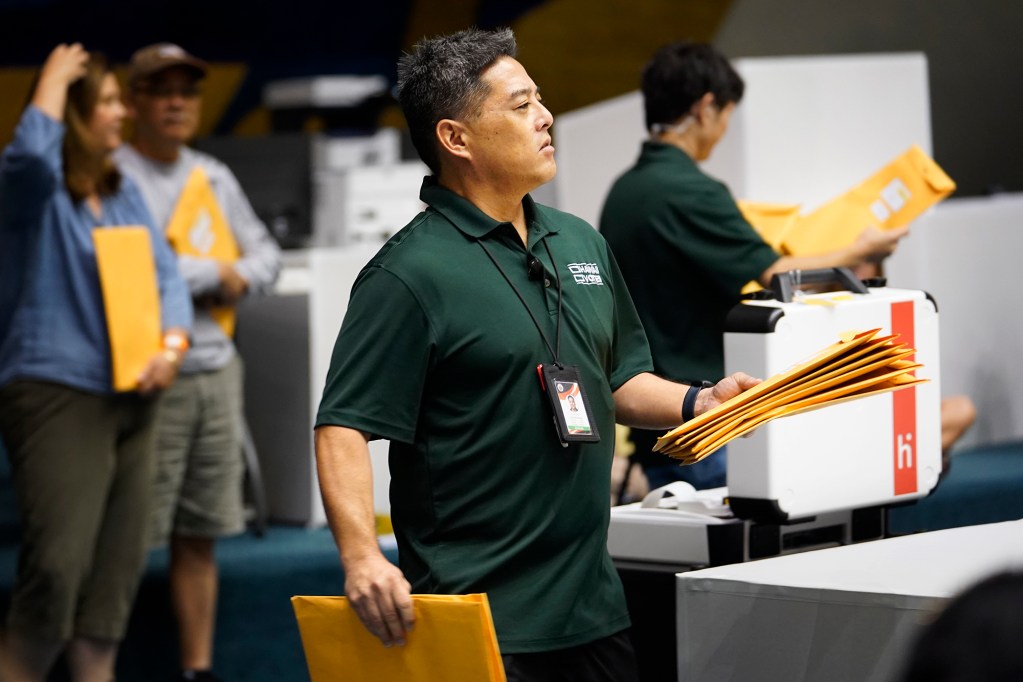
Hawaiʻi’s elections are conducted by the county clerks, who submit the ballot tabulations to the state, which officially reports the results. In the 2024 general election, only 4.5% of ballots were cast in person.
Cushnie has complained to the commission that he has examined the ballots and worries there is a difference in the number generated in Kauaʻi County compared to the final count reported by the Office of Elections. The difference, he argues, could alter the outcome of close races, especially in his home county of Kauaʻi, and he wonders whether there are similar discrepancies in the other counties.
That’s why Cushnie wants to subpoena documents focused on the 2024 Hawaiʻi general election, including ones transmitted on Dropbox and through U.S. Postal Service collections.
“I want to know that the elections are run fairly,” Cushnie told Civil Beat, adding that he has “zero confidence” at this point.
He compared the elections system to a financial institution, arguing that “people would be going to jail” if they kept records the way the elections office does.
But Cushnie has thus far not been able to persuade the elections commission, the County of Kauaʻi clerk’s office, the Office of Elections and state courts, despite submitting the reams of documentation he has painstakingly compiled on his own.

Jamie Detwiler, president of Hawaiian Islands Republican Women, said she too has wondered whether ballots are being collected and counted accurately. But a bigger concern for Detwiler, who testifies frequently before the elections commission, is what she says is a difficulty in getting state and county election officials to adequately respond to public inquiries.
She said it’s frustrating to reach a county official only to be told her inquiry has to do with the state, or vice versa. That can only be improved with better communication, and Detwiler has her doubts whether that’s a shared objective.
As for elections commissioners, she said, “I think their intentions are good, and they appear to do the right thing.” She also does not believe that most testifiers are testifying merely through a political lens.
“Elections are not even a partisan issue,” she said. “It’s a citizen’s issue about accountability and integrity.”
One of Detwiler’s concerns was resolved only last week. An audit was done of her race for state House District 37 on Oʻahu, which she lost to Democrat Ryan Yamane. There was no change in the voting outcome, and Detwiler said she accepts the results of the audit.
She also opposes House Bill 141. As stated in her testimony, “This would give the power and authority to the Democrat-majority Senate therefore creating an imbalance on the EC. An imbalance will also diminish the voices and opinions of the minority party on the EC … the public will not trust the elections process.”
More Work Ahead
The workload of the elections commission extends beyond complaints about Scott Nago and complaints from Ralph Cushnie.
At the January meeting, Curtis remarked that there are concerns about the declining service of the U.S. Postal Service, noting the closure of the Keālia Post Office on Kauaʻi.
He also raised concerns about unique identifying numbers on ballots and envelopes that could possibly be tracked inappropriately by outsiders, emphasized that voting machines and software should not dictate voting behavior, and advocated for in-person, same-day voting, which is allowed under the mail-in system.

The meeting concluded with a victory of sorts for bipartisanship. A motion from commissioner Young asked the Legislature to create the bipartisan task force to examine questions about mail-in balloting. And Cushnie made a motion to ask the counties for their chain of custody documentation.
Both were adopted with only one dissenter, Osterkamp. Papalimu was absent. Curtis then asked commissioners if there was anything else to discuss. There was not.
“In that case I’ll adjourn the meeting,” he said. “That’s the end of my agenda. Thanks for coming, thanks for your time, and thanks for the testimony — positive and negative.”
Bills And Politics
The elections commission’s way of operating stands in sharp contrast to the public meetings of the Hawaiʻi Campaign Spending Commission and the Hawaiʻi State Ethics Commission. Those agencies rarely meet for more than an hour or so, relationships among commissioners and staff are friendly and productive, and only a handful of people tune in remotely.
That politics hovers over the elections commission is perhaps no surprise. The 2004 law that established the commission’s current composition pitted the Democrat-controlled Legislature against a Republican governor. Gov. Linda Lingle vetoed the bill, complaining that it took away the governor’s power to appoint one of the commissioners and blurred the separation of powers between the executive and judiciary branches.
She also argued that the commission’s composition would favor the three neighbor island counties over the heavily populated City and County of Honolulu, as each county would have two representatives.
The Legislature easily overrode Lingle’s veto. Oʻahu Rep. Scott Saiki, who would be a future House speaker, said at the time that having four commission members selected by Democratic lawmakers and four by Republicans, with a ninth member selected by the commission to be chair, allowed for “equal representation.”

House Bill 141 would not change the Democrat-Republican split nor the neighbor island representation. But it would require members to be confirmed by the state Senate.
Senate confirmation is not required for ethics or campaign spending commissioners, but those nominees are selected by the independent Judicial Council and sent to the governor for consideration.
The author of HB 141, Oʻahu Rep. Adrian Tam, a Democrat, said the elections commission meetings did not play a major factor in introducing the bill, although he said he is aware of their disruptive nature. The main purpose of his bill is to let the public weigh in on filling important positions.
“The reason for the bill is that I felt anyone who is going to be on this commission and managing decisions of our elections should have a public hearing and be subject to accountability and public testimony,” said Tam, a former chair of the Democratic Party of Hawaiʻi.

But in an indication of just how political the bill is viewed, six of the nine House Republicans voted against it Thursday. Two of the other three GOP members were absent, and the third often votes with Democrats.
Republicans object to the fact that confirmation of commissioners would be subject to the dominant Democratic Party. Indeed, the Democratic Party of Hawaiʻi itself supports the bill, saying it will “significantly enhance the transparency and accountability” of the elections commission.
Cushnie, appointed by the House minority leader, testified against HB 141. He said issues before the commission are procedural rather than political.
“This bill is designed to silence the minorities concerns regarding our elections process,” he wrote in testimony.
 Sign up for our FREE morning newsletter and face each day more informed.

Local reporting when you need it most
Support timely, accurate, independent journalism.
Honolulu Civil Beat is a nonprofit organization, and your donation helps us produce local reporting that serves all of Hawaii.
ContributeAbout the Author