The Sunshine Blog: Covering Up Pay-To-Play Politics
Short takes, outtakes, our takes and other stuff you should know about public information, government accountability and ethical leadership in Hawai‘i.
March 23, 2025 · 9 min read


About the Author

Where did this one come from?: The most anticipated political accountability bill of the session passed out of the Senate Judiciary Committee this past week. That would be House Bill 371, the measure that would ban the owners, officers and close family members of government contractors and organizations that receive state grants in aid from donating to political campaigns.
But a disturbing provision was slipped in by Judiciary Chair Karl Rhoads with no public discussion. And it is wording that would make key information submitted to the state Campaign Spending Commission off-limits to the public.
In the bill passed by the House, state and county agencies would be required to send a list of contractors, grantees and the people connected to them to the state Campaign Spending Commission. Not only would the commission then be able to easily check those names against the names of donors but the public could do the same, and alert the commission to potential violators.
“The commission shall periodically publish the names of the state and county contractors and grantees, and their officers and adult immediate family members, on its website, as reported by the state and county agencies,” according to the House version.
The new version, as passed by the Senate committee on Tuesday: “The state or county office shall make the reported information available electronically to the commission, which shall then make the information available to candidate and noncandidate committees on a password-protected section of the commission’s website; provided that the state or county office shall not be required to make the reported information available for procurements of less than $100,000 for goods or services or $250,000 for construction. (That’s The Blog’s emphasis in bold.)

If you listen to the hearing, you will hear no discussion of password-protecting the names or of making them available only to candidate committees and PACs. And yet there it is in the new Senate draft that was voted on. More troubling, when Rhoads hurried through a public reading of the amendments he had drafted right before the committee vote he said nothing about it.
Most of the discussion during the hearing centered around how burdensome it would be for the state procurement office to have to collect information on all contractors. Many state contracts are too small to worry about from a political perspective, so the committee decided to limit the disclosure requirement and the ban on contributions to contractors on work that meets certain thresholds — $100,000 for professional services contracts and $250,000 for construction.
Kristin Izumi-Nitao, the commission’s executive director, said that contractors should be required to report their ownership information themselves. She suggested that the agencies include a form as part of the contract documents where businesses would report the names of owners, officers and their family members.
“This is an important bill, a very important bill for us,” Izumi-Nitao told the committee. “It’s our attempt to address the pay-to-play problem that we hear a lot of public sentiment (about).”
She noted the public outrage over the bribery trials of Honolulu businessman Dennis Mitsunaga and former Honolulu prosecutor Keith Kaneshiro (a jury found them not guilty) and the pay-to-play implications that surfaced during those.
Izumi-Nitao urged the committee to move the bill forward — it still needs to make it through the Senate Ways and Committee — and said her office is working with the attorney general and the procurement office to work out the logistics.
“We can close the gap on pay-to-play,” she said.
The Blog is hopeful that when the dust settles on this legislative session the names of state contractors and grantees, their owners, officers and family members will be readily available for public scrutiny. It’s so important.
Just to remind everyone, this is a measure that has been introduced and killed year after year. It came up again in 2023 as part of the Commission to Improve Standards of Conduct’s recommendations and again a year later in 2024. It still failed.
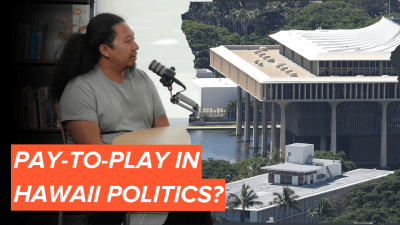
After the last session ended, Civil Beat reporter Blaze Lovell, working on a fellowship with The New York Times, exposed the extent of pay-to-play politics in Hawaiʻi by painstakingly digging into the state contractor database and comparing it to donors in the campaign spending database.
Lovell’s story, “Inside the Late-Night Parties Where Hawaii Politicians Raked In Money,” finally got the attention of lawmakers who vowed to close the loopholes in the campaign finance system. It’s critical that members of the public, including journalists like Lovell, be allowed access to information so they can review the flow of money into the political system.
Getting the green light: Could this be the session that Hawaiʻi lawmakers enact some sort of visitor-impact fee to help pay for the costs of climate change on our precious ʻāina? On Thursday, two House committees approved bills to do exactly that. But session is far from over, and “green fees” died the past two sessions.
Senate Bill 1396, which is one of the green fee bills proposed by Gov. Josh Green’s Climate Advisory Team, would assess the transient accommodations tax on cruise ship cabins. It would be based on the total time the cruise ship is docked at any port in the state.
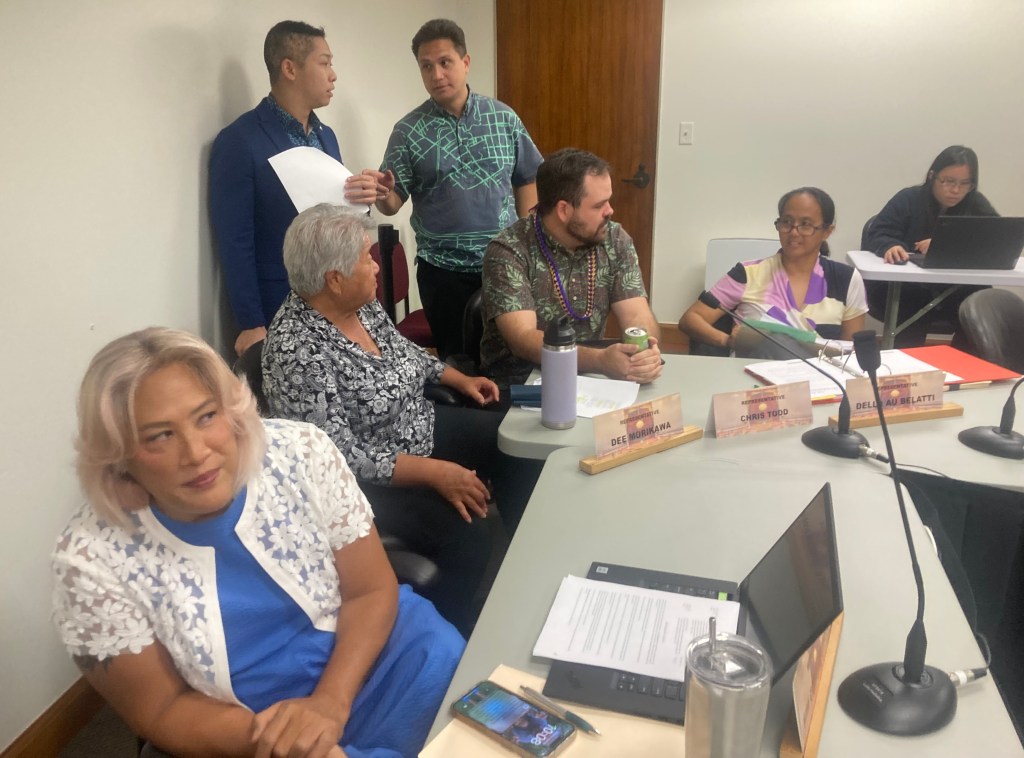
The Department of Land and Natural Resources would then use the funds for protection, management and restoration of Hawaiʻi’s natural resources and for environmental stewardship, climate and hazard mitigation and sustainable tourism.
But SB 1396 still awaits a hearing in the House Finance Committee, where bills often die. The bill has also dramatically morphed from its original intent to raise the TAT on hotels and other accommodations, and then to levying a $20 per night hotel fee in exchange for visitor mileage or reward programs.
There have been eight drafts of the bill so far, and we’re not even to conference committee.
The other green measure, Senate Bill 439, would have the Board of Land and Natural Resources adopt rules to impose user fees on nonresidents who visit state parks and trails. The BLNR would come up with a list. SB 439 also awaits a FIN hearing.
Down the tube, again: For the second year in a row the Big Island Press Club is giving its Lava Tube dishonor to the Hawaiʻi Emergency Management Agency. That’s because the state’s civil defense organization and its leadership supported a state law that allowed governors and county mayors to suspend electronic media transmission during emergencies.

The press club described the law, which has since been amended to be more favorable to the media, as “constitutionally questionable” and possibly interpreted by some leaders as a “kill switch” to prevent journalists from reporting during an emergency, the press club said in a press release last week.
Bills in 2023 and 2024 sought to remove the emergency power, but HI-EMA Administrator James Barros lobbied against them. One of those measures, House Bill 2581, ultimately passed last year, but Gov. Josh Green indicated at the time he might veto it at the urging of Barros.
Green eventually let HB 2581 become law without comment, but Barros was dinged by the press club last year with its 2023 Lava Tube dishonor for failing to support the bill. This year the press club specifically dishonors HI-EMA, which is still run by Barros.
“In times of emergency, government and media — both electronic and print — have historically partnered to provide essential information in a timely manner to a public that wants, and has a right, to know what is going on,” the press club stated in awarding the Lava Tube this year.
I hear the train a-comin’: A recent audit confirmed what The Blog had long assumed: that Skyline, the Honolulu rail line, has not been able to draw even modest ridership since it opened in 2023. Blame bad marketing and clunky payment systems for the desolate train, which doesn’t even serve the airport or downtown — yet — let alone Ala Moana Center.
That didn’t stop a House committee from approving resolutions Thursday to urge the Honolulu Authority for Rapid Transportation to extend Skyline to Ko ʻOlina, Nānākuli, Māʻili and Waiʻanae. The resos, which are nonbinding, come at the behest of West Side Rep. Darius Kila.

He’s got a point: Residents in his part of town “face significant commuting challenges, including length of travel times, heavy traffic congestion, and limited public transportation options,” as the reso explains. If there was a train, it might well improve access to jobs and essential services, contribute to economic development in underserved communities and “increase the possibility” of moving large groups of people in an emergency.
Indeed, there is but one way in and out of the region, Farrington Highway, unless the U.S. military opens Kolekole Pass.
In related resolution news, Kila is also the author of two other resolutions that request the owners and management of Ko ʻOlina Golf Club to implement measures to prevent golf balls from reaching nearby Farrington Highway.
The resos explain that there’s been a rise in balls hitting homes and cars and threatening pedestrians.
The golf club did not comment on the idea, but state Department of Transportation Director Ed Sniffen supports it and testified that the DOT will talk to the club to see how all parties involved might improve public safety in the area.
 Sign up for our FREE morning newsletter and face each day more informed.
Read this next:

Local reporting when you need it most
Support timely, accurate, independent journalism.
Honolulu Civil Beat is a nonprofit organization, and your donation helps us produce local reporting that serves all of Hawaii.
ContributeAbout the Author