Audit Confirms Honolulu Rail Woes: Poor Marketing, Clunky Payment System
Skyline’s usefulness is still below par 14 years after ground was broken and more than a year and a half after its first segment opened, new audit says.
UPDATE: This story has been updated to correct the Honolulu City Auditor’s estimated decline in ridership. The actual decline was much less steep than what the office originally published.
Short hours, inadequate marketing and a clunky payment system limit the Skyline rail line’s usefulness and therefore ridership, according to a report last week from the Honolulu City Auditor, validating residents’ complaints about the $10-billion-and-counting project.
The audit also says accessibility for people with disabilities is good inside the stations but less so outside. Federal language accessibility requirements also are not being met, it says.

The Honolulu Department of Transportation Services – which is in charge of operating Skyline, while Honolulu Area Rapid Transit is in charge of building it – provided written responses at the bottom of the audit addressing most of the concerns raised.
City officials have pointed out that Skyline is still a fledgling system, yet to reach key destinations such as the airport and downtown. As more of the guideway is built, they say, hours will expand and usefulness will improve.
Here’s a rundown of some of the key criticisms in the audit with responses from the city in writing and from a Civil Beat interview with Transportation Department Deputy Director Jon Nouchi.
How Useful Is Skyline, Honolulu’s Rail Service?
The rail line doesn’t reach key destinations, its hours are too limited and it is slower than car travel —especially in the stretch between the University of Hawaiʻi Mānoa and the University of Hawaiʻi West Oʻahu.
Skyline opened its first segment in June 2023 between East Kapolei and the former Aloha Stadium, with its next leg scheduled to open at the end of this year. It operates between 5 a.m. and 7 p.m. on weekdays, opening at 8 a.m. on weekends. (The city extends its hours for special events such as the Waipahu Street Festival, during which Saturday service operated until 10 p.m.)
Nouchi doesn’t think the lack of destinations is a fair critique, saying it inherited the line in its current form from the Honolulu Authority for Rapid Transportation.
“It was not an operational decision of ours to not service the airport,” he told Civil Beat, “or to not service Downtown Honolulu, or to not service Waikīkī.”

Nouchi defends the decision to limit hours while only the first segment is open, citing studies that predict a sharp decrease in ridership if the system operated past 7 p.m.
“If we provided more hours for less utilization,” he said, “then that could be another comment against our operations.”
How Well Is The City Marketing Its Rail System?
Seattle’s light rail system offers users rewards through a mobile app. That’s an example of innovation that Skyline lacks.
Social media promoting the rail line also pales by comparison with that of other cities. Portland’s MAX Light Rail has 60,000 followers on Instagram; Seattle Link Light Rail’s has 36,000 followers; the account for New York City’s behemoth system is followed by 182,000 people.
Honolulu’s Department of Transportation Services had 2,400 followers at the time of the audit, a missed opportunity to reach working-age commuters.

“This limited digital reach hinders its ability to effectively promote Skyline, connect with potential riders, and build a strong community of regular users,” the audit says.
The city recognizes this as a shortcoming. In its written response, it says it could investigate breaking off Skyline as its own social media account separate from the rest of the department, which is an approach taken in some of the other cities.
Partnerships to promote rail travel to venues also could improve, the audit says, pointing to five missed opportunities to partner to promote Skyline for events between July 2023 and December 2023. Skyline saw a 44% decrease in ridership during that time period.
The department wrote that’s an unfair comparison because it does not account for the fact that the four-day free-fare period starting June 30, 2023, to celebrate the system’s opening, attracted many riders. It said a better comparison would be the 18% year-over-year improvement between December 2023 and December 2024.
Payment options are also limited. Unlike other cities – such as New York, which saw an increase in ridership and revenue after allowing riders to use their mobile phones to pay – Skyline requires them to pay with a physical Holo card that needs to be reloaded.

Holo card was a long-awaited innovation when the city started its use in 2018, 15 years after Mayor Jeremy Harris announced it would be coming in his state of the city address. After roadblocks delayed its implementation for years, Holo card was seen as something more seamless than forcing many riders to search for exact change.
It’s an imperfect system – the city almost ran out of blank Holo cards in 2023 because of a global chip shortage, according to the audit.
Now, the city is planning to launch a version of mobile phone payment before the second leg of Skyline opens, Nouchi said. Federal banking requirements complicate that process, he said, which is why the city hasn’t done it sooner.
Is Skyline Accessible To People With Disabilities?
Physical accommodations for those who need them could be better, according to the report. It says the stations comply with the American Disabilities Act, but connections to bus stops and other areas are rife with liabilities.
It points out places where people could trip and where people with disabilities would have trouble navigating.
While the city responded in its written comments that some of these areas are outside its jurisdiction, the report says the city should partner with other agencies to meet the spirit of its mandate as a transportation department.
“While we understand that surrounding area jurisdiction may be in question, we stand by our finding as DTS is responsible for the multimodal movement of people and goods on roadways which includes riders getting to and from key access areas including bus stops, pickup areas, and crosswalks,” the report says.
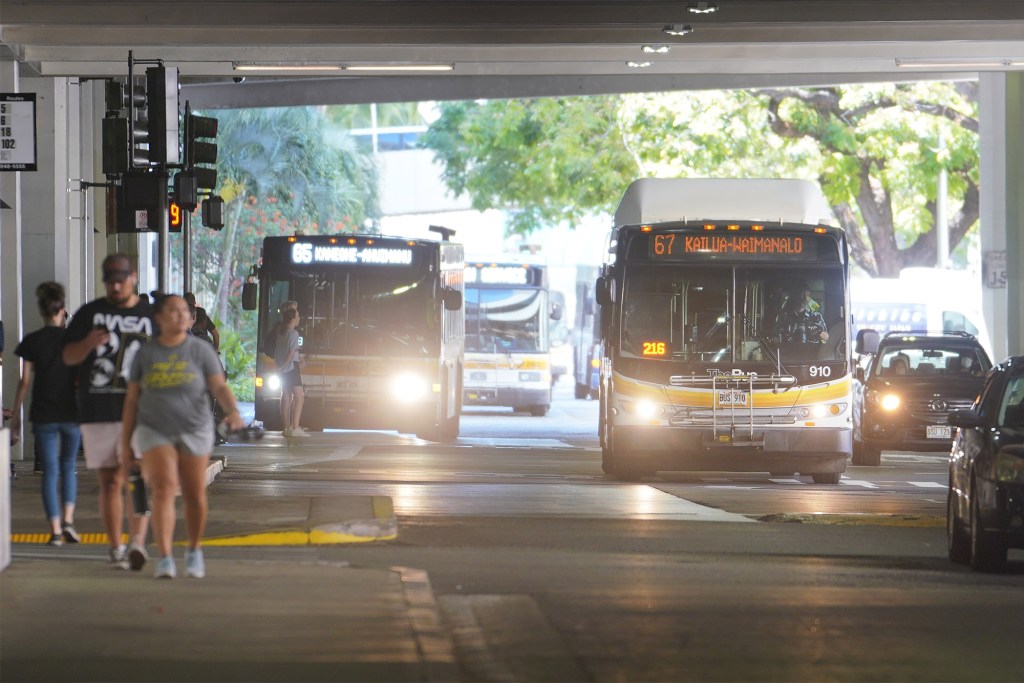
Language access also was cited as inadequate.
“Unlike TheBus and TheHandi-van, DTS did not include multi-language information on Skyline when changes were made to existing bus routes, which were used significantly by limited English proficiency individuals,” the report says. “As a result of not having multi-language information and resources, barriers to riding Skyline increased and those individuals may have difficulty utilizing Skyline.”
This is a federal requirement stemming from an executive order signed by former President Bill Clinton in 2000.
“We’re pressed to find a reasonable solution,” Nouchi said, adding that Honolulu has some of the most stringent federal language requirements of any U.S. transit agency, and that they would need to provide about 11 or 12 languages on printed signs to comply.
Read the full audit here:
CORRECTION: This story has been updated to correct who was president in 2000 when the executive order was signed.