In Last-Minute Drama, Legislature Shelves Bill To Ban Assault Weapons
The legislation was opposed by gun-rights advocates who warned that hunters and Native Hawaiians would be harmed by the restrictions.
April 30, 2025 · 9 min read


About the Authors


Just five days ago Hawaiʻi legislative conference committees approved a bill that would ban high-powered semiautomatic rifles and shotguns with military features that can fire multiple rounds rapidly.
Gun-control groups praised the initial approval late Friday of Senate Bill 401, which would have closed a loophole in state law that prohibits assault pistols but not assault rifles such as AR-15s.
“Today we are one step closer to protecting our islands from weapons that have turned far too many communities into war zones,” Erica Yamauchi, a volunteer with the Hawai’i chapter of Moms Demand Action, said in a statement shortly after that vote.
But on Wednesday during spirited floor debate in the Senate, SB 401 was recommitted, meaning it was sent back to legislative committees for more work. With the 2025 session set to wrap Friday, that means the bill is dead.
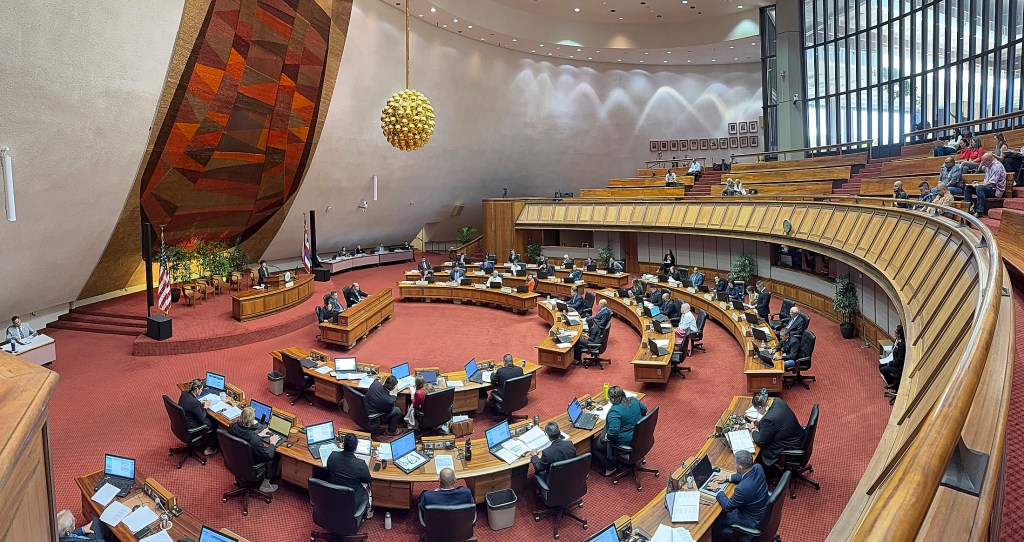
Lawmakers also cast final votes Wednesday on a package of bills to provide hundreds of millions of dollars in negotiated raises for public employees, and approved a new two-year state budget that totals nearly $20 billion per year.
Other measures approved Wednesday would make school lunch subsidies available to more students, increase the state cigarette tax and finance law enforcement sting operations in support of fireworks bans.
Fierce Senate Debate
The collapse of a plan to ban new sales of assault rifles involved some confusion and contention. It took several Senate votes, including one that was counted in error, and a couple of recesses so lawmakers could figure out where they stood. In the end, senators split 12-12 and Senate President Ron Kouchi cast the tie-breaking vote that ended up killing the bill.
The opposition to SB 401 came in the form of a floor amendment from Sen. Lynn DeCoite. It would have allowed licensed firearms dealers statewide to continue to service, repair and transfer weapons for lineal descendants, who under the proposed legislation would be able to pass along assault weapons before a Jan. 1 deadline
DeCoite, who represents rural parts of the state including Molokaʻi, said the amendment would also preserve “the rights of subsistent hunters and conservation workers, especially Native Hawaiians, whose rights are protected under the Hawaiʻi Constitution.”
Another section of the amendment targeted invasive species.
“On Molokaʻi and Maui axis deer have caused devastation and wreaked havoc, stripping our pasture lands, collapsing our native systems, destroying irrigation systems and driving ranchers into crisis,” she said. “On Hawaiʻi island, feral pigs are tearing through farms and forests, spreading disease and disrupting watershed protections.”

Sen. Tim Richards, a rancher who represents a rural part of the Big Island, backed DeCoite’s amendment. He explained at a Senate media briefing after the floor session, “One of the tipping points was the magazine size and whether or not we’re going to keep the legacy magazines in place. And I received a tremendous amount of communication on this matter, because the concern was, ‘Okay, fine, I have the weapon, but I don’t have the magazine.’”
Richards and Sen. Brandon Elefante said at the briefing that they would work on the assault weapons bill over the interim. Technically, SB 401 remains alive for the 2026 session or if a special session is held later this year, as seems likely.
Yamauchi of Moms Demand Action said the Senate had caved to the gun lobby.
“Whenever tragedy strikes next, we’ll ask ourselves what could have we done to prevent it. That moment of reckoning? It was right now. The answer was passing SB 401,” she said in a statement issued after the vote.
House lawmakers also recommitted the assault weapon bill, shelving it for the year it since it could not pass without the support of the Senate.

Money Worries
Some House lawmakers praised the new state budget, but Finance Committee Chairman Kyle Yamashita warned these are uncertain times because of cuts imposed or proposed by the Trump administration.
Yamashita said “headwinds have grown” since the start of the legislative session, with about $30 million in federal grants to government in Hawaiʻi already frozen or terminated. That includes programs and research dealing with invasive species, agricultural technology and energy resilience, he said.
“These grants support local businesses, provide nonprofits with the ability to deliver valuable services to those most in need, (and) enhance government services for safety net programs throughout the state,” he said.
Lawmakers have made tentative plans to return to the State Capitol later this year for a possible special session to try to use state money to fill funding gaps caused by additional federal cuts, but “we simply do not have all the resources necessary to provide all things to all people,” Yamashita said.
Kouchi said he expected the Legislature to respond to budget negotiations by Congress that must happen by Oct. 1.
Kouchi said after the session he gave the Legislature a grade of “I” for incomplete, as the uncertainty over the Trump administration’s policies — for example, tariffs, Medicaid cuts and the Department of Government Efficiency — may mean that Hawaiʻi will have to change its own finances.
“We’re waiting to see what they’re negotiating, and in the meantime, we adopted a (state) budget that doesn’t lay off any of our employees,” he said at the briefing. “And by not having the layoffs, we are continuing to provide the services to our community that you know people need.”

Still, lawmakers found money in the budget for a variety of initiatives, including $6 million to increase the pay for child welfare workers, and $30 million for loan repayment for health care workers who commit to working in Hawaiʻi.
They also approved Senate Bill 1300 to significantly expand access to free school lunches.
Under that measure, starting this fall students who qualify for reduced-price meals under the National School Lunch Program will receive free lunches.
The following school year the bill requires that any student whose family income is 300% of the federal poverty level or less will also qualify for free school meals.
“Because of this bill, fewer kids will sit in the classroom distracted by hunger,” said Rep. Trish La Chica. “More families, especially those who make just a little too much to qualify under outdated rules, will no longer have to worry, knowing their children will eat at school free of charge.”
Questioning Priorities
Lawmakers approved several bills to try to control illegal fireworks following six deaths in a New Year’s Eve fireworks explosion, but one measure to enforce fireworks bans drew scathing criticism Wednesday.
Republican Rep. Chris Muraoka, who represents Waiʻanae, said he opposes illegal fireworks, but he questioned House Bill 806. That measure would finance a new explosives lab and commit $1 million over the next two years for sting operations by the state Department of Law Enforcement to combat illegal fireworks.
“I cannot — let me repeat — I cannot ignore the larger crisis that surrounds us every single day, a crisis that this bill does not address,” Muraoka said. “We are facing an epidemic of drug addiction, violent crime and an ever-worsening crisis of homelessness in nearly every community across our state.”
“These are not seasonal issues like fireworks, these are daily emergencies, and our constituents are living in fear, frustration and desperation,” he said. Lawmakers are providing money for fireworks enforcement, “yet we cannot find the same dollars to expand drug treatment and prevention programs.”
The fireworks measure passed the House easily, with only Muraoka and fellow Republicans Diamond Garcia and David Alcos voting against it.
The Senate floor session was dominated by the assault weapons bills and the passage of Senate Bill 897, a controversial measure that supporters say helps preserve the state’s dominant utility, Hawaiian Electric Co., but critics say amounts to selling out to the company’s shareholders and possibly putting the state at risk should another disaster like the 2023 Maui wildfires occur.
Kouchi said he welcomed the discussion.
“This is my 10th full session that I’ve presided (over), and I think today is probably the most vigorously floor-debated day that I have had to preside over in in my 10-year tenure,” he said.
Other than the gun and HECO bills, there was little discussion of dozens of other measures approved Wednesday. The House and Senate will reconvene Friday for final votes on the last day of the session.
Their work includes tweaks to a bill increasing penalties for criminal offenses involving fireworks. Under a proposed amendment, film crews and other commercial enterprises would be allowed to import fireworks to the islands.
Another priority is the green fee bill, which would increase the hotel tax as well as levy it on cruise ship passengers to help pay for taking care of the state’s natural resources.
Kouchi said Senate Bill 1396 needed to be amended to correct errors that had been discovered by the state Department of Taxation.
 Sign up for our FREE morning newsletter and face each day more informed.

Local reporting when you need it most
Support timely, accurate, independent journalism.
Honolulu Civil Beat is a nonprofit organization, and your donation helps us produce local reporting that serves all of Hawaii.
ContributeAbout the Authors