Kirstin Downey: Caring For The ʻĀina From Thousands Of Miles Away
A new book shows how one Hawaiian family has upheld its responsibility to care for an important cultural site in the face of rising taxes and encroaching development.
May 23, 2025 · 8 min read

About the Author

A provocative new book by journalist Sara Kehaulani Goo raises the same heart-rending and perplexing land-use issues that made the novel and movie “The Descendants” a smash hit.
But unlike the fictitious account in “The Descendants,” this story is completely real. It’s a winding tale that stretches back 500 years.

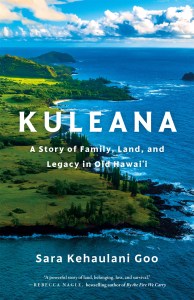
In the book, “Kuleana: A Story of Family, Land, and Legacy in Old Hawaiʻi,” Goo describes her family’s decadeslong calling to protect an ancient Hawaiian heiau on ancestral lands on Maui, weighing their sense of responsibility for preserving the past against the imperatives of economic survival in the modern world.
Unlike “The Descendants,” however, where the primary threat to ancestral lands comes from marital infidelity, Goo’s endearing narrative highlights the loving links in her multi-generational, multi-ethnic ʻohana as they come together to face a series of challenges. The external threats come from taxes, bureaucrats, the high cost of living in the islands and the parade of oligarchs — Mark Zuckerberg, Larry Ellison and Oprah Winfrey — paying top dollar to snap up vast tracts of Hawaiʻi’s land.
The book, which will be released next month, is already attracting a lot of attention, both on the mainland and in Hawaiʻi. Goo will present talks at the elite Washington, D.C., bookseller Politics and Prose, and in August she will appear at Bishop Museum with former President Barack Obama’s sister, Maya Soetoro-Ng. I interviewed her in Washington as she was getting ready to head out on the book tour.
In her earliest years, Goo knew little about her complex family heritage. Born in Orange County, California, her father a tech executive, Goo’s earliest longings were simply to fit in with the other kids, who were mostly white or the children of recent immigrants to the United States, each of whose families represented a single nationality. Like many families from the islands, Goo’s family had a much more diverse pedigree that combined their Hawaiian, Chinese, Okinawan and European heritages.
But at a young age, Goo’s family made a trip to Maui that ended up as more of a pilgrimage, where Goo for the first time visited an ancient heiau that had been entrusted to her family’s care hundreds of years ago. The temple, known as Piʻilanihale Heiau, the largest such temple in all Polynesia and one of the best preserved, and 990 acres of land had been given to Goo’s ancestors, the Kahanu family, by King Kamehameha III as a royal grant in 1848.
Kahanu is an old and storied aliʻi name in Hawaiʻi. Goo is believed to be distantly related to Princess Elizabeth Kahanu, the wife of Prince Jonah Kūhiō Kalanianaʻole, the last heir to the Hawaiian throne and a 10-term U.S. congressman who represented Hawaiʻi in the House of Representatives.
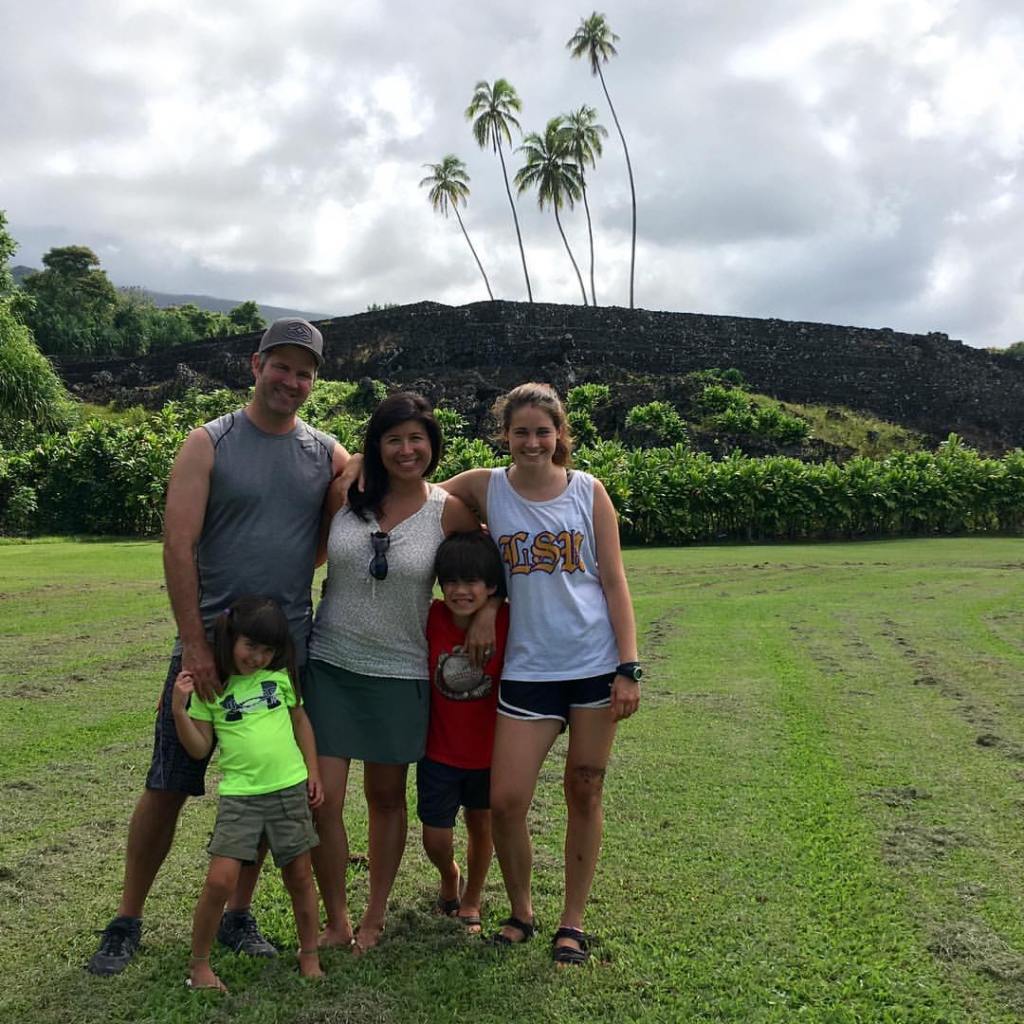
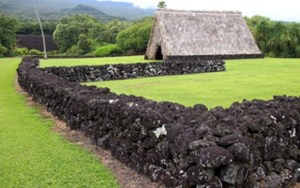
On a hot day in 1984, Goo’s family trekked into the forest near Hāna, and it was there that she caught her first glimpses of an awe-inspiring sight. It was a massive edifice made of stones, some 341 feet by 415 feet in dimension, hidden in the jungle, badly overgrown, with terraced steps. One side rose 50 feet in the air. The structure is associated, though no one knows exactly how, with the great Maui chief Piʻilani, who lived in the 1500s, and it has been carbon-dated farther back to the 1200s. It may have been a sacrificial or agricultural temple or perhaps a monumental home overlooking the sea.
The Kahanu family had preserved the heiau, leaving it intact and undisturbed, and, for many years kept its existence a secret. The uncle guiding his young relatives to visit its location laid down the law, Goo recalls: Kuli kuli, which means hush-hush.
But something so monumental is hard to entirely conceal. In 1962, the federal government named the temple a national historic landmark, which imposed on the family a new set of obligations for preserving it.
In 1974, the Kahanu clan deeded it and some the surrounding property to the nonprofit Pacific Tropical Botanical Garden, now the National Tropical Botanical Garden, which pledged to restore and maintain the structure. But for years the group stalled and delayed, and by the time Goo and her family toured the site, it was eerie and desolate, but also haunting, other-worldly and evocative.
In the late 1990s, the Kahanu clan had had enough, and they pressured the botanical garden to do the work it had promised to do, and the restoration was at last completed in 1999. Members of the extended Kahanu clan ended up doing much of the actual work themselves, supervised by state archaeologists.
Over the years, the family’s land holdings in Hāna had shriveled, sold off piece by piece, mostly to sugar plantations, as Goo has learned through land research and family records. The surviving estate had been whittled down to 66 acres, a land holding shared by a tangled web of uncles, aunties, cousins and siblings. Any family action related to the property had to be done by consensus, a complicated process made even trickier because of the logistical challenges of connecting far-flung relatives now scattered across the United States, driven out of the island by high housing costs and limited employment opportunities in Hawaiʻi.
Goo’s book opens with the family getting word that the taxes were skyrocketing on their surviving land parcel, which was prized by the family but unoccupied. The land had been farmed in the past and had long been zoned for agricultural use but Maui County had begun using drone photography to ferret out irregular property uses and officials told them they no longer qualified for the lower agricultural tax rate. The family had set up a fund of some $20,000 to pay for taxes and other expenses, but with annual taxes jumping to $2,000 from $300 one year earlier, that reservoir would soon be sucked dry.
They were at risk of losing the property altogether. The family got together to look for help but were thwarted at every step. They were told they didn’t qualify for a kuleana land tax exemption because their land had previously been owned by their ancestor, a chief, not a commoner, as the law required. Next, they decided to try their hand at actually farming, a challenge for a family that hadn’t grown crops in anyone’s living memory.
They worried.
They watched as other families related to them succumbed to financial pressures and sold their ancestral homes. Goo came to realize that some people felt a sense of responsibility, or kuleana, for preserving the land, while others considered selling it to be the obvious pragmatic choice. She realized she cared about it more than her sister. Another relative just wanted to walk; “he doesn’t care,” they were told.
One family who had moved to Las Vegas casually sold some land that fell into their hands when a childless uncle died. Callers who begged them to reconsider were told to share their concerns with the real estate agent listing the property.
More corporate titans moved to Maui and expanded their land holdings, pushing up land prices and taxes even higher.
As this debate unfolded, Goo found herself examining her own choices in life, surfacing the internal conflicts she faced in the search for her own identity as a woman born on the mainland, but with a deep pull to Hawaiʻi. Goo rose to the pinnacles of American journalism, as managing editor of National Public Radio and executive editor of the national news organization Axios. That meant that in her personal life she straddled two different worlds — upper crust life in Washington, D.C., but also her grandmother’s cozy house on Hawaiian homelands in Nānākuli. Goo’s pursuit of an ambitious Washington career often felt in conflict with the call of Hawaiian culture and traditions.
Which path would have the stronger pull on her, she wonders in the book’s pages.
Ultimately, the property’s rescue came from an unexpected corner, as the book relates, but in the meantime, the family has hung on for yet another generation.
“Mālama i ka ʻāina, Grandma,” she said in ending the book. “Take care of the land, and the land takes care of you.”
 Sign up for our FREE morning newsletter and face each day more informed.
Read this next:

Local reporting when you need it most
Support timely, accurate, independent journalism.
Honolulu Civil Beat is a nonprofit organization, and your donation helps us produce local reporting that serves all of Hawaii.
ContributeAbout the Author