Lee Cataluna: Honoring Pidgin In Hawaiʻi Public Schools
For the first time, the state Department of Education is recognizing Hawaiʻi Creole as a language worthy of biliteracy.
May 24, 2025 · 7 min read

About the Author

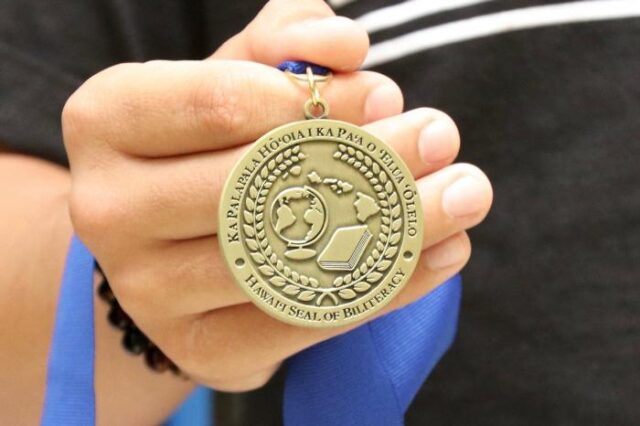
When the Waipahu High School class of 2025 gathered for their graduation ceremony at the Stan Sheriff Center this week, 10 of the students wore medals among their academic regalia indicating their proficiency in what is commonly referred to in Hawaiʻi as Pidgin English.
The Seal of Biliteracy for Hawaiʻi Creole, as it is properly termed, was offered for the first time this year to students in Hawaiʻi public schools. To qualify for a Seal of Biliteracy, a student must demonstrate proficiency in either English or Hawaiian and one other language.
In January, Waipahu Multi-Lingual Program Coordinator Jeremiah Brown put out the word about Hawaii Creole being included in the languages for which students could earn a Seal of Biliteracy. First, though, Brown consulted school Registrar Steve Miyashiro and registrar clerk Lani Bayudan for help in writing the school announcement in Pidgin for the daily bulletin:
“Sup Seniors! Pidgin stay one reckanized language fo’ Da Seal of Biliteracy now, li’dat.
Howz dat? Pretty mean, ah? Da Seal of Biliteracy is one mayjah honor fo’ high school grads who can talk and write English and Pidgin read shmood, you know da kine?
But eh, make shua you meet one of da English requirements fo’ take da test in Pidgin, Rajah dat? If you do killahz on da test, you gon get one cherreh medal fo’ wear at graduation! Yo’ maddah and faddah, and choke oddah people gon’ be shmall kine proud, ah!?!
Yessuh, show dem you one hammah!”

Student Cara Jurison heard the announcement in school that morning. “I didn’t think it was real, actually,” she said.
Jurison, who will attend the University of Oregon in the fall, found out it was indeed a real thing, and signed up to take the test. She was already planning to take the biliteracy test for Korean, which is taught at Waipahu High School.
Pidgin English, or Hawaii Creole, is described by the University of Hawaiʻi Sato Center for Pidgin, Creole, and Dialect Studies as the common language that arose out of the need for immigrants from different countries to communicate in Hawaii’s sugar industry starting in the late 1800s:
“Children learned their parents’ languages and picked up English at school. But the kind of English they spoke on the playground was influenced by the Pidgin English earlier brought to Hawai’i, by the Hawaiian spoken by their parents, and by their own first languages, especially Portuguese. By the turn of the century a new Hawai‘i Pidgin English began to emerge with features from all of these sources. This pidgin became the primary language of many of those who grew up in Hawai’i, and children began to acquire it as their first language. This was the beginning of Hawai’i Creole English. By the 1920s it was the language of the majority of Hawai’i’s population.”
These days, though, there are so many other influences on the way Hawaiʻi students speak.
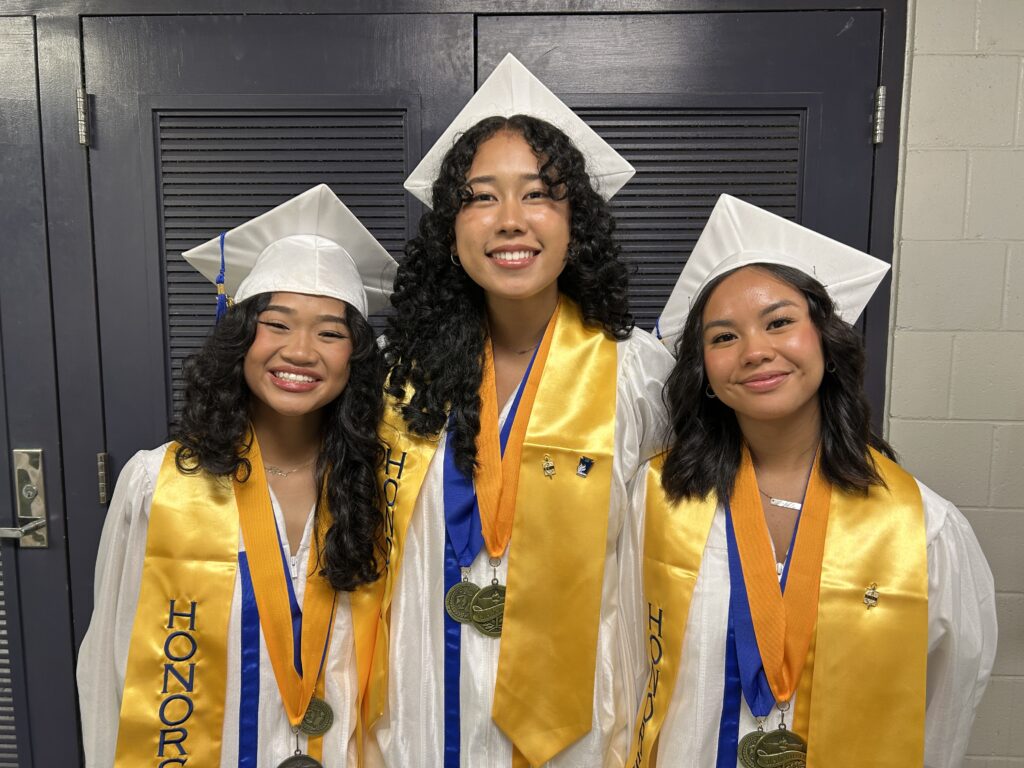
“We grew up around it, but we don’t really use it that much,” said Amore Laney, who will be attending UH Mānoa in the fall with a plan to major in business.
“I listen to my dad speak,” said Jyliann Teocson, who will attend the University of San Francisco to major in biology with a focus on pre-med. She also plans to study business because her goal is to open a medical clinic.
Several of the Waipahu students who signed up to take the Hawaiʻi Creole test formed a study group to prepare.
“Sometimes we looked up words on Google. And my Dad had an old Pidgin book,” Laney said.
The test was administered by Avant Assessment, part of a number of proficiency tests available for languages not commonly taught in high schools. The exam involves writing and speaking, and was taken on computers in the school library.
“It was basically all of us in the library whispering into mics,” Laney said.
One part of the test involved prompts in English that the students had to respond to in Hawaiʻi Creole. Examples of prompts they had to write about were “a memorable event in childhood” or “what is something that you cherish?”
Some students wrote their responses in English first and then translated it into Pidgin, for example, substituting “da” for “the” and “dakine” if they didn’t know a specific word.
“While I took the test, I would ask myself, ‘What would my uncle say?’” Jurison said.
The total number of graduating students who were awarded the Seal of Biliteracy in Hawaiʻi Creole this year is not yet available. Last year, the Department of Education awarded Seals of Biliteracy to graduating seniors in Hawaiʻi high schools in 28 different languages: American Sign Language, Arabic, Bisaya/Visayan, Cantonese, Cebuano, Chuukese, Dutch, English, French, German, ʻŌlelo Hawaiʻi, Ilocano, Japanese, Korean, Kosraean, Mandarin, Marshallese, Pangasinan, Pohnpeian, Portuguese, Russian, Samoan, Spanish, Tagalog, Thai, Turkish, Vietnamese, Yapese.
In years past, Waipahu has successfully lobbied to add several more languages, including Pangasinan, Tongan and Itawis, a language spoken in a small area of the Northern Philippines.
In order to qualify to take the biliteracy test, a student must have a GPA of 3.0 or better in English classes or score an 18 or higher on the English section of the ACT. At Waipahu this year, 125 students will graduate with a Seal of Biliteracy representing 13 different languages. Many of the languages are home languages for the students.
A Seal of Biliteracy is more than another honor to wear during graduation. Some colleges give credit for knowing a world language or will allow the student to start language classes at a higher level. The Seal is a note to future employers that the student can communicate in more than one language.
“And it’s a source of pride for the families,” Brown said.
Laney and Teocson described traveling to Japan on an exchange program and teaching basic Pidgin terms to Japanese students, which delighted their hosts.
“We taught them to say ‘Howzit’ for hello,” Laney said.
“And told them to loosen their shaka,” Teocson added.
“We taught them ‘shoots’ for goodbye. And also k-dens,” Laney said.
This term is new to my ears. In my day, it was ‘kay den’, as in “OK, then.” I ask if k-dens is always spelled with an s. The girls laugh and correct my Pidgin. “It’s spelled with a z.”
k-denz.
“You see?” Brown said. “Pidgin is evolving.”
In generations past, Hawaiʻi Creole speakers fought against the stigma of speaking non-standard English and the assumptions about the intelligence of Pidgin speakers. It seems Pidgin is evolving in many ways.
The Seals of Biliteracy were among many other marks of academic honor the students wore at their graduation. All three were valedictorians.
Civil Beat’s education reporting is supported by a grant from Chamberlin Family Philanthropy.
 Sign up for our FREE morning newsletter and face each day more informed.
Read this next:

Local reporting when you need it most
Support timely, accurate, independent journalism.
Honolulu Civil Beat is a nonprofit organization, and your donation helps us produce local reporting that serves all of Hawaii.
ContributeAbout the Author