Kirstin Downey: Taking Stock Of Hawaiʻi's Historic Feathered Capes
Most of them remain off-island, and aficionados seek what glimpses of them they can find.
May 14, 2025 · 8 min read

About the Author

Hawaiʻi’s magnificent feathered capes, which have been called the “crown jewels” of the islands, are in the news again.

At one time, there were as many as 400 capes, known in Hawaiian as ‘ahu ‘ula, but today there are only about 150 still existing, mostly in Europe or in the continental United States. About a quarter remain in Hawaiʻi, including about three dozen held by Bishop Museum.
In other places, emblems of royalty and divine authority have been molded from precious metals and gems. But in Hawaiʻi, these symbols of power were prayerfully and painstakingly fashioned from the brightly colored feathers of exquisite native birds, many of which have gone extinct. From 1779 to the 1840s, scores were given away as gifts or as trade goods from Hawaiian rulers to visitors; some were sold.
For people in Hawaiʻi, these gifts have been a much-lamented loss, and aficionados seek what glimpses of them they can find.
One such beautiful cape, with a striking red, black and yellow design, is on display in England now at Oxford University, through next year, as part of a broader exhibit on Hawaiian culture.
In 1841, it was given as a token of appreciation by an imposing and regal chiefess, Kekāuluohi, the wife first of King Kamehameha and then his son Liholiho, and later mother to Hawaiian King Lunalilo. She presented it to Sir George Simpson, the Scottish-born governor of the Hudson Bay Company. Simpson was a friend and trading partner to the Hawaiians, who helped the kingdom restore its independence from Great Britain.
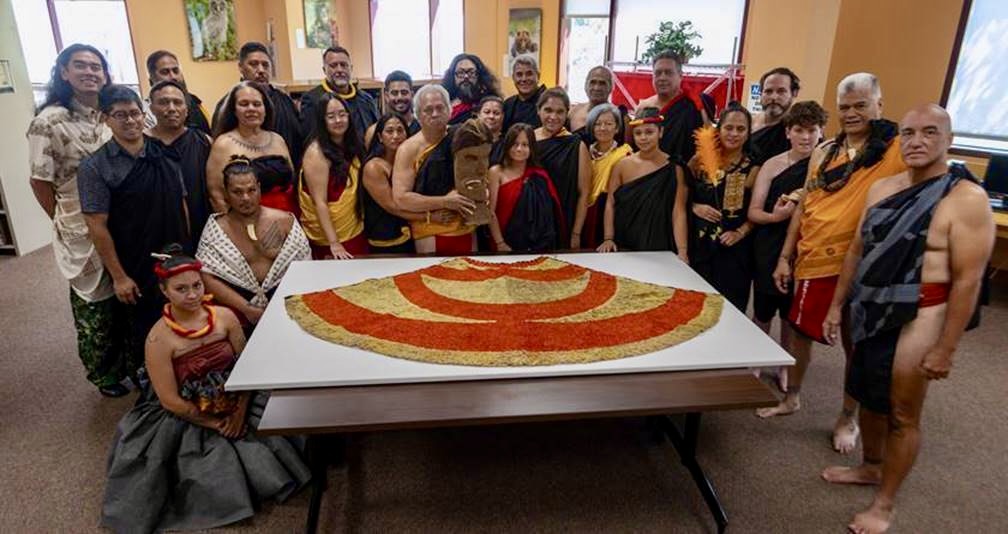
Another cape is being returned from Washington, D.C., to Hawai‘i as a loan from the Smithsonian Institution to the National Park Service as part of a repatriation claim. It will not be made available for public viewing but instead for what officials have called “community consultation.”
Enticing But Far-Away Exhibits
It’s a source of great frustration in Hawaiʻi that so many of its treasures are held far afield, where they are seldom displayed and normally attract very little attention. People in Hawaiʻi can only see them from time to time, and only if they can afford the long-distance travel.
Some capes are periodically put on display in special exhibitions. A number of events, for example, were held in 2018, in commemoration of the 250th anniversary of Captain James Cook’s embarkation on his first voyage of discovery. A cape that was once owned by King Kamehameha II, but is now held by the British Museum, was made available for viewing at the Royal Academy of Arts. That same year, a museum in Stuttgart, Germany, displayed four capes held in European museums.
People who attended the Stuttgart exhibit were thrilled with what they saw. About 30,000 to 40,000 attended the exhibit, but only a few of them, mostly people associated with Hawaiʻi’s museum community, were able to make the trip from the islands.
The Smithsonian Institution has more than 800 cultural objects from Hawaiʻi and owns at least five capes.
Hawaiʻi’s own failures have contributed to the sense of injustice. In the early 2010s, museum curators in Hawaiʻi and elsewhere spent years organizing an unprecedented exhibit of Hawaiian featherwork called Na Hulu Aliʻi. It was said to be the best collection of Hawaiian featherwork ever assembled, some 75 items, bringing together objects from the United Kingdom, Austria, New Zealand and the United States. Harvard University, the Smithsonian Institution and the National Museum of Natural History all contributed items of featherwork.
The display was expected to be put on view at Bishop Museum in March 2016, in what would have been a blockbuster show, and the exhibit’s first stop on a traveling tour to museums in the United States. Museum curators around the world had allowed these delicate and disintegrating objects to travel, some in the belief that the objects would be exhibited in the place where they had been created — Hawaiʻi —centuries ago.
But at the last minute, Blair Collis, Bishop Museum’s chief executive officer, said the cash-strapped institution did not have the money to stage the exhibit in Hawai‘i, causing widespread dismay. The museum had real money problems: its federal funding had cratered after the 2012 death of Sen. Daniel Inouye, who had steered significant funding to Bishop Museum over the years.
In April 2016, Collis resigned under pressure from the museum’s board of directors. People were furious about the exhibit debacle. Collis himself visited the exhibit when it was displayed in San Francisco. He has since returned home to Australia.
Many Were Gifts To Explorers
There is a large cache of Hawaiian antiquities at the British Museum in London because so many British explorers came to the islands in the late 18th century and Hawaiʻi island chiefs in particular honored them with gifts of capes.
Capes and feather standards “were the natural mediums for ceremonial gifting because they indicated the elevated political strata upon which these transactions took place: between Hawaiian chiefs and representatives of foreign nobility,” said Hawaiian scholar Noelle M. K. Kahanu, in a book on the 2016 exhibit called Royal Hawaiian Featherwork.
The aliʻi knew they were valuable, of course, but it would have been unimaginable to them that the birds whose feathers were used would go extinct and that the capes would become irreplaceable.
Sometimes Hawaiian chiefs also traded capes for armaments. In 1810, for example, King Kamehameha sent the British King George III a feathered cape and asked him for “a small vessel” and brass guns in exchange.
The Smithsonian Institution has more than 800 cultural objects from Hawaiʻi and owns at least five capes. Four of them were bequests from Princess Abigail Kawānanakoa, including one believed to have belonged to Chiefess Po‘omaikelani-Nui of Maui; one from Chiefess Apikaila from Kauaʻi and one associated with King David Kalākaua. The fourth is known as the Kamakahelei cape and may have belonged to the Paramount Chiefess of Kaua‘i at the time Captain Cook first landed on Kaua‘i in 1778.
In his journal, Cook noted seeing such capes on Kaua‘i but was frustrated that he could not obtain one. On Hawai‘i island, however, Chief Kalaniʻōpuʻu lavished Cook with gifts in a ceremonial presentation in 1779.
“The King got up & threw in a graceful manner over the Captns Shoulders the Cloak he himself wore & put a featherd Cap upon his head & a very handsome fly flap in his hand; besides which he laid down at the Captains feet 5 or 6 Cloaks more, all very beautiful & to them of the greatest Value,” wrote a British eyewitness to the exchange.

Latest Acquisition Is Not On Display
Another cloak held by the Smithsonian belonged to a warrior chief named Kekuaokalani. He famously fought to preserve the traditional religion after the kapu system was abolished by the family of King Kamehameha after the king’s death in 1819. Kekuaokalani, his wife Manono and their allies went to war against the Kamehameha dynasty and were killed. The cape fell into the hands of King Liholiho (Kamehameha II) and was then passed to his brother, Kauikeaouli, known as Kamehameha III.
Kamehameha III gave the cape to a visiting US Navy Commodore John Henry Aulick, around the same time that Kekauluohi gave the one held at Oxford University to Sir George Simpson. The Aulick family gave it to the Smithsonian, according to Smithsonian spokesman Ryan Lavery.
Lavery said the cape has been loaned to the National Park Service for two years while it is being considered for repatriation. He said it would not be on display in Hawaiʻi but is available for what he called “community consultation.”
The cape will be held at Hawai‘i Volcanoes National Park, which is a unit of the National Park Service.
A presentation ceremony was held at the Smithsonian’s Museum Support Center in Suitland, Maryland, on May 1.
Sen. Brian Schatz’s spokesman, Mike Inacay, put out a press release on May 5 about the event, which included pictures provided by a Hawai‘i island group called Hui Iwi Kuamoʻo. In the press release, he said the cape will be held at Hawai‘i Volcanoes National Park, which is a unit of the National Park Service.
The biggest single repatriation coup of the decade came in 2016, when the cape of Chief Kalani‘ōpu‘u came back to Hawai‘i as a loan of unlimited duration from the Museum of New Zealand Te Papa Tongarewa.
That has fueled the hopes of many who love Hawaiian antiquities that it will not be the last to return to the islands’ shores.
 Sign up for our FREE morning newsletter and face each day more informed.
Local reporting when you need it most
Support timely, accurate, independent journalism.
Honolulu Civil Beat is a nonprofit organization, and your donation helps us produce local reporting that serves all of Hawaii.
ContributeAbout the Author