Beth Fukumoto: Holding Billions Of Dollars, These State Funds Need Scrutiny
If lawmakers want to ensure public money is used wisely, they ought to pay closer attention.
June 8, 2025 · 8 min read


About the Author

When lawmakers debated Hawaiʻi’s new “green fee” this year, they faced a choice: create a new special fund as a dedicated account for climate projects or route the money into the general fund, where the Legislature would have greater oversight and flexibility.
They chose the latter.
It was a small shift, but it raised a bigger question: With billions of dollars already parked in special and revolving funds across state government, do we really know how those funds are working or whether they’re still serving their original purpose?
Big Pieces Of Hawaiʻi’s Budget
Special and revolving funds are common tools in state budgeting.
Special funds are created by law and earmarked for specific purposes. The Emergency and Budget Reserve Fund or Rainy Day Fund is the state’s largest special fund. At the close of its most recent audit in fiscal year 2023, the fund had approximately $974 million. Today, that number is closer to $1.5 billion.
The Rainy Day Fund, which is administered by the Department of Budget and Finance, is intended to provide emergency funding for the state in a crisis and receives funds from legislative appropriations, interest income and 15% of tobacco settlement revenues.
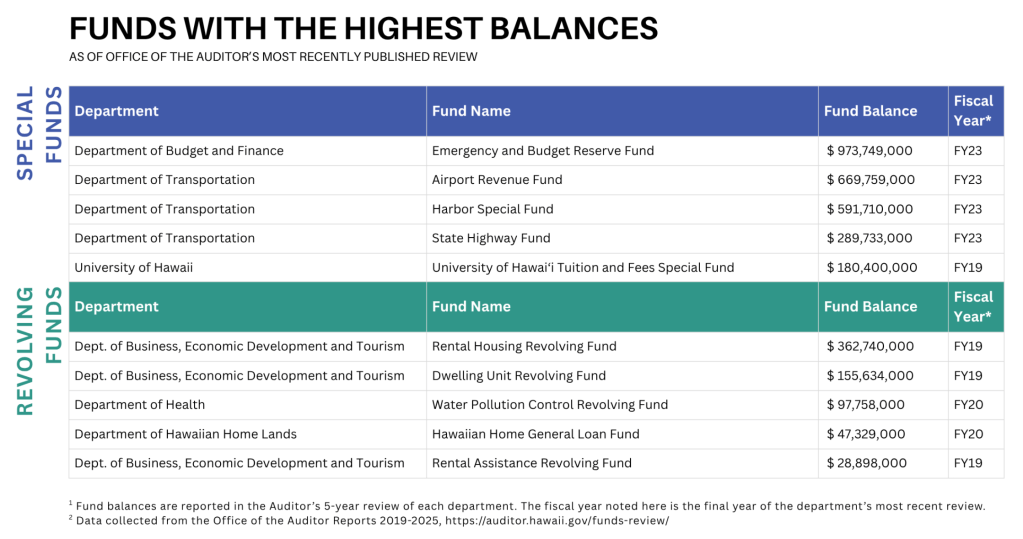
Like special funds, revolving funds are earmarked for specific purposes, but they are typically replenished by loan repayments or service charges. For example, the Rental Housing Revolving Fund provides money for the development of affordable rental housing and receives its revenues from loan repayments, conveyance taxes, fees, investment and interest income.
Administered by the Department of Business, Economic Development and Tourism, it’s the state’s largest revolving fund and had an ending balance of approximately $363 million when it was last audited in fiscal year 2019. According to the department’s estimates, the fund will be approximately $776 million at the end of fiscal year 2025.
Together, special and revolving funds make up a substantial portion of Hawaiʻi’s budget. In fiscal year 2026, special funds account for 22% of the operating budget. In fiscal year 2027, that number is 21%. Revolving funds make up another 3% each year. That amounts to more than $4.5 billion allocated outside the general fund.
As federal spending becomes increasingly uncertain, that matters more. If Congress continues to reduce domestic support for programs like Medicaid, housing and education, states will have to fill the gaps on their own. That makes it even more important to understand how these non-general funds are structured, where the money sits and whether lawmakers have the information they need to put it to good use.

A Look At The Audits
To get a clearer picture, I reviewed the most recent reports from the Office of the Auditor for every state department funded through the executive budget, published since 2019 and focused only on special and revolving funds. These reports are published on a rolling five-year basis, so while some numbers may be a few years old, the trends are still meaningful.
According to my review, the departments held about $3.7 billion in special funds at the end of their last audit. Roughly one-third of that total was held by the Department of Commerce and Consumer Affairs, which manages 20 separate special funds. Another 30% was in the Department of Budget and Finance, which includes the Emergency and Budget Reserve Fund and the Mass Transit Special Fund.
On the revolving fund side, the departments held about $972 million. More than 60% of that was in the Department of Business, Economic Development and Tourism. The Rental Housing Revolving Fund alone had over $360 million at the time of its last review.
Transparency And Oversight Fall Short
State law requires departments to submit annual reports on every non-general fund. Under Section 37-47 of the Hawaiʻi Revised Statues each report must include the fund’s purpose, the program it supports and key financial data. These reports are meant to help lawmakers understand how funds are being used and whether they still serve their intended purpose.
But compliance has been inconsistent. According to the most recent auditor’s reports since 2019, at least 12 special funds and three revolving funds — holding a combined total of more than $763 million — were not properly reported.
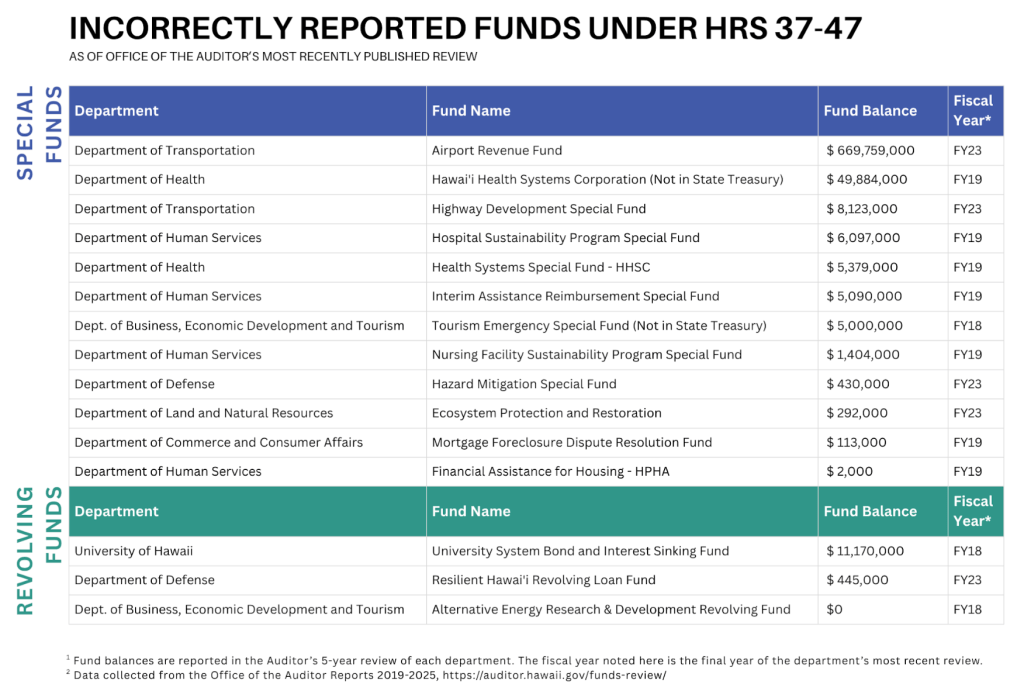
In some cases, departments submitted reports using incorrect forms. In others, they assumed that submitting information through a different channel was enough to meet the requirement. It wasn’t.
And while these may seem like administrative errors, the result is more serious: Lawmakers and the public do not always have a full and accurate picture of how much money is available or whether the funds are still aligned with their original goals.
That does not mean departments are mismanaging funds. Most are using them for the purposes they were designed to support. But with hundreds of funds spread across dozens of agencies and an inconsistent centralized system for ensuring uniform compliance, it becomes difficult to track what is being spent, what is being saved, and what could potentially be repurposed in a budget crisis.
Lessons From Budget Crises
Hawaiʻi has been here before. In 2011, during the aftermath of the global economic downturn, lawmakers faced a projected $1.3 billion budget shortfall. They were able to reduce the gap to about $500 million through budget cuts and restrictions but still needed to find new revenue to balance the budget.
That led to a closer examination of the state’s non-general funds. Lawmakers reviewed special and revolving funds to determine whether excess balances could be used to help close the budget gap. Their reasoning was straightforward. As they put it at the time, the recession had created “extraordinary fiscal circumstances,” and the state needed to “review and scrutinize” these accounts to identify funds that were no longer active or held more money than needed. Some were repealed entirely. Others were partially drained to support urgent spending needs.
Legislators also turned to the state’s reserves. Money was pulled from the Hurricane Relief Fund and the Emergency and Budget Reserve Fund to maintain programs considered essential for public health, education and welfare. Lawmakers emphasized that these actions were necessary to ensure that core services could continue at sustainable levels.

A decade later, when the Covid-19 pandemic brought the economy to a halt and the federal government had not yet stepped in, the State Auditor’s Office applied a similar lens. Staff reviewed prior reports to identify funds with consistently high balances that could be repurposed without undermining the programs they supported.
According to State Auditor Les Kondo, they found “hundreds of millions of dollars that are sitting in these funds that are not going to be used. And in often cases, the funds continue, the balances continue to grow, but at that moment, and maybe at every moment, the state probably could use some of that money for other programs.”
Looking Ahead
There is no question that special and revolving funds offer stability, continuity and, in some cases, financial independence for programs that serve the public. But unlike general fund programs, these programs often receive less scrutiny because they’re not competing for the state’s limited general fund appropriations. When a quarter of the state’s operating budget is managed outside the general fund, it becomes essential that lawmakers and the public have tools to evaluate how that money is being used and whether it still serves its intended purpose.
The Auditor’s Office provides those tools, at least in part. Every five years, it reviews each special and revolving fund held by each department. But the auditor doesn’t have enforcement authority. If a fund no longer meets legal criteria, the only way to eliminate or repurpose it is through legislation. And that rarely happens.
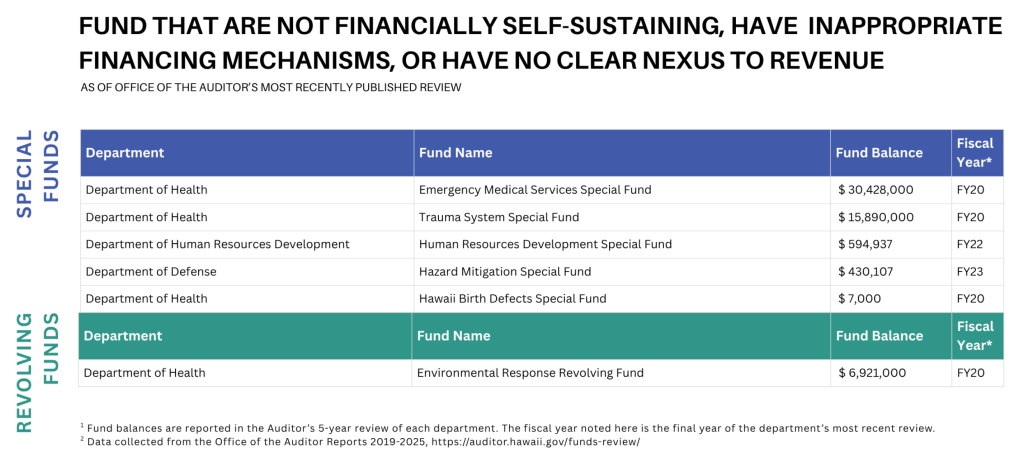
From 2019 to 2025, the auditor found more than $250 million sitting in special and revolving funds that did not meet statutory requirements. Some funds had lost their purpose. Others were no longer financially self-sustaining or had no clear link between the source of revenue and the program they supported. But in 2025, lawmakers repealed just two of them. At the same time, the Legislature continues to pass new special and revolving funds, even when the auditor finds they don’t meet the criteria.
If lawmakers want to ensure public money is used wisely, they need to pay closer attention to these funds. That could mean creating a centralized public database of fund balances, clarifying reporting requirements and taking a more deliberate approach to fund repeal. It could also mean considering a more structural change. As Kondo pointed out, special funds don’t need to go through the general fund appropriation process — but “if the Legislature wanted to make all programs come to them and go through the regular appropriation process, they could.”
That would make the system more transparent. It would also be more time-consuming. But whether or not lawmakers choose that path, it is clear that better tracking, consistent reporting and more regular legislative engagement with these funds should all be on the table. Hawaiʻi can’t afford to treat a quarter of its budget as an afterthought.
 Sign up for our FREE morning newsletter and face each day more informed.
Read this next:

Local reporting when you need it most
Support timely, accurate, independent journalism.
Honolulu Civil Beat is a nonprofit organization, and your donation helps us produce local reporting that serves all of Hawaii.
ContributeAbout the Author