Hawaiʻi's Ombudsman: 'We Don’t Have Teeth, But We Can Gum Them To Death'
For decades, one of the state’s main agencies to help the public has been understaffed and lacking in authority.
June 22, 2025 · 9 min read


About the Author

Editor’s note: This commentary, which has been lightly edited from its original form, is reprinted with the permission of the author. Read the original columns on iLind.net.
As we were nearing the end of a recent week-long visit to Portland, Oregon, something brought Hawaiʻi’s Office of the Ombudsman to mind.
Back in the early 1990s when I was publishing a monthly newsletter about politics and money, and later while an investigative reporter for the Honolulu Star-Bulletin, I regularly browsed the Ombudsman’s annual reports for story ideas. It always included a table showing the number of complaints along with the number and/or percent of sustained complaints, helping to zero in on those departments with the most problems.
But I got out of the habit of checking those annual reports a number of years ago, and realized that I haven’t seen or heard much of anything about the ombudsman in a long time.

With time on my hands during the long travel day heading back to Honolulu, I took another look.
In case you’re not familiar with Hawaiʻi’s Office of the Ombudsman, it is an independent legislative agency created to investigate complaints about executive branch departments and agencies. Hawaiʻi was the first state in the country to establish an ombudsman via a bill passed by the Legislature in 1967. The first ombudsman, Herman Doi, was appointed two years later.
The kinds of things the ombudsman is able to investigate are defined by state law (Chapter 96 Hawaii Revised Statutes):
§96-8 Appropriate subjects for investigation. An appropriate subject for investigation is an administrative act of an agency which might be:
(1) Contrary to law;
(2) Unreasonable, unfair, oppressive, or unnecessarily discriminatory, even though in accordance with law;
(3) Based on a mistake of fact;
(4) Based on improper or irrelevant grounds;
(5) Unaccompanied by an adequate statement of reasons;
(6) Performed in an inefficient manner; or
(7) Otherwise erroneous.
The ombudsman may investigate to find an appropriate remedy. [L 1967, c 306, §9; HRS §96-8]
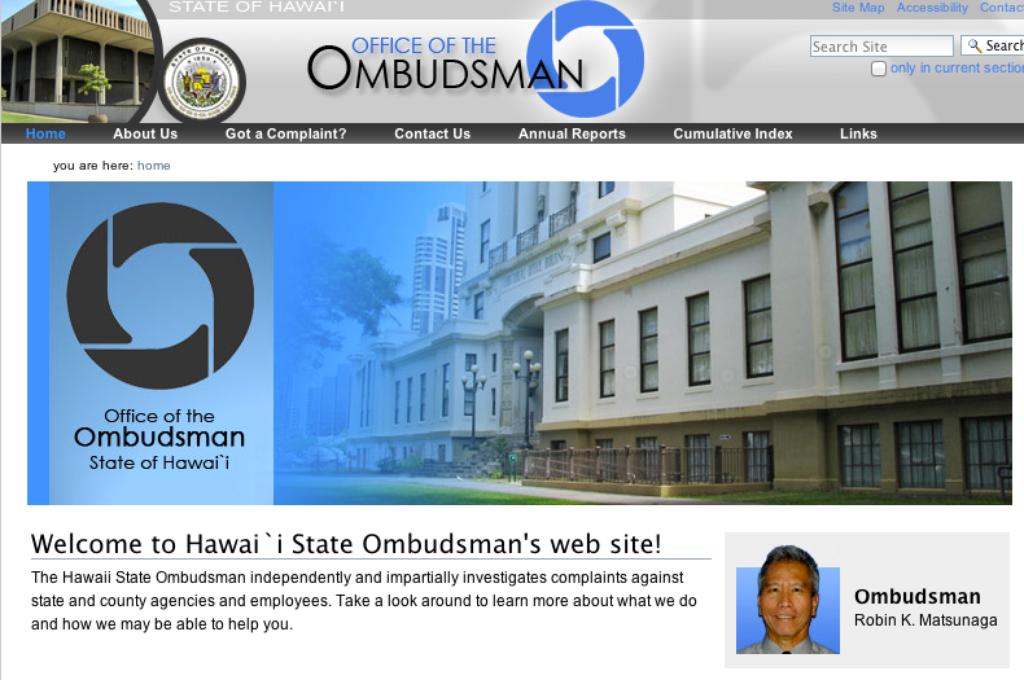
During this year’s legislative session, Ombudsman Robin Matsunaga submitted written testimony briefly describing the office and its mission.
“The Office of the Ombudsman was created to investigate the administrative acts of state executive branch and county government agencies of the State of Hawaii. We learn of possible erroneous administrative actions and decisions primarily through complaints that are filed with our office by residents and visitors who are impacted by these agencies. We conduct our investigations independently and impartially, and not as an advocate of either the complainant or the agency. We do not have authority to overturn an agency’s decision or to compel an agency to take corrective action, but if we find that an agency has acted erroneously, unfairly, or unreasonably, we can make recommendations for corrective action to the agency. Although we do not substantiate every complaint that we investigate, by independently and impartially investigating, we level the playing field for citizens who have complaints about their government and ensure that they are being treated lawfully, fairly, and reasonably. We believe that in doing so, we improve the level of trust that citizens have in their government.“
While most issues come as complaints or requests for information from the public, the ombudsman is also authorized to pursue investigations on its own initiative if the ombudsman “reasonably believes that an appropriate subject for investigation” exists.
My first stop was newspapers.com, where I did a quick search of for Hawaiʻi news stories containing the word “ombudsman.” I went back a dozen years, and found almost nothing substantive about the office or any of its investigations. That confirmed my impression that the office has been essentially invisible for years, whether by design or not. It makes me wonder where people learn that the ombudsman’s office is a resource for their complaints about public employees or services..
The idea of an ombudsman is simply to provide someone with authority who can intervene on behalf of regular people who run into a public agency or employee acting like a petty tyrant, being rude, unreasonable, or unfair. It’s very appealing, and a lifesaver if you’re locked in one of those crazy disputes when you are exhausted and ready to concede that no matter how right you are, “you can’t fight city hall.”
But it’s not a perfect world. The ombudsman’s jurisdiction is limited by law, so there are issues that they can’t touch. And things happen. Communication issues. Heavy workloads. Particularly obstinate agencies.
So how is the ombudsman doing in Hawaiʻi after more than a half-century?
Back at the beginning of 2013, I wrote a column about the Office of the Ombudsman for Civil Beat.
Not much has changed over the intervening years.
Problem: Who Da Guy?
At that time, Ombudsman Robin Matsunaga acknowledged that many people had never heard of his agency.
“Much of the public doesn’t know about what we do, they don’t know we exist, and don’t know how to use us,” he told me in an interview at that time.
The agency’s limited budget isn’t sufficient to support a vigorous outreach program.
Problem: All Bark, Little Bite
And even when the office investigates and sustains a complaint, it lacks the “teeth” to force state and county departments to admit the error and follow the ombudsman’s recommendations to correct the situation.
While the ombudsman does not have the power to compel agencies to follow its advice or overturn agency decisions, Matsunaga said his office has been very successful at gaining agency compliance, although at times it can be a long process.
“We don’t have teeth, but we can gum them to death,” he said. “My staff are real tenacious. When we’re sure of our position, we will continue to try and persuade them.”
That situation appears unchanged today.
It can’t be a comfortable position to be in.

Problem: Secret Or Not?
The ombudsman’s office is required to navigate a precarious boundary between legally required secrecy, and its ultimate sanction, the power to embarrass an agency by going public with critical findings.
The obligation to keep matters secret is spelled out in statute (Chapter 96 Hawaii Revised Statutes).
§96-9 Investigation procedures
(a) In an investigation, the ombudsman may make inquiries and obtain information as the ombudsman thinks fit, enter without notice to inspect the premises of an agency, and hold private hearings.
(b) The ombudsman is required to maintain secrecy in respect to all matters and the identities of the complainants or witnesses coming before the ombudsman except so far as disclosures may be necessary to enable the ombudsman to carry out the ombudsman’s duties and to support the ombudsman’s recommendations.
But elsewhere in the same statute is a broad but ill-defined exception to this statutory secrecy.
§96-13 Publication of recommendations. After a reasonable time has elapsed, the ombudsman may present the ombudsman’s opinion and recommendations to the governor, the legislature, the public, or any of these. The ombudsman shall include with this opinion any reply made by the agency.
The ombudsman has generally said that it’s goal is to get agencies to comply with its recommendations, no matter how long or how fiercely they might have resisted. As long as the agencies eventually give in, it’s chalked up as a “win” for the ombudsman.
The ombudsman is also authorized to seek legislation to correct problems that it identifies, but it isn’t clear whether it has ever proposed such legislation.
Problem: Staffing
In September 1983, the Office of the Ombudsman had a staff of 11, including Ombudsman Herman Doi, six analysts who investigate complaints, and four secretaries. An additional authorized position for Doi’s first assistant was authorized but vacant due to a retirement.
Two decades later, the ombudsman’s annual report for the 2003-2004 fiscal year noted a staff of 15, including Ombudsman Robin Matsunaga, his first assistant, eight analysts, and five support staff.
Another 20 years later, at the end of the 2024 fiscal year, the position count was down to 13, consisting of Ombudsman Matsunaga, his first assistant, seven analysts, and four support staff. One additional position was unfilled.
The budget passed by the Legislature this year maintains the ombudsman’s staff at 14 authorized positions.
During testimony on the ombudsman’s budget earlier this year, Matsunaga described ongoing staffing issues.
“…it has become more difficult to retain qualified, trained employees over the past few years. While there is no way to prevent employees from retiring, I am concerned about the number of employees who have left the office to work at another State or County agency, or in the private sector, based in large part to the higher salaries they would receive. My office expends a significant amount of time and other resources to train staff to perform their duties, especially in conducting impartial investigations in a thorough and sound manner. It is clear to me that other agencies and private companies recognize the investigative and analytical skills that my staff have, and how much they can contribute to the mission and purpose of their agency or company. I believe that in order to stop this trend, I need to be able to pay my staff salaries that are competitive with the salaries paid by other agencies and companies to their employees who have similar skills and knowledge.“
The turnover has been documented in recent annual reports. During the 2023-2024 fiscal year ending June 30, 2024, three of the agencies seven analysts resigned, two after less than four months on the job. The other had been with the ombudsman’s office for four years, but left for job with another department.
There was similar turnover the prior year, FY 2022-2023, with three analysts resigning. Two of them had been hired just a year earlier.
 Sign up for our FREE morning newsletter and face each day more informed.
Read this next:

Local reporting when you need it most
Support timely, accurate, independent journalism.
Honolulu Civil Beat is a nonprofit organization, and your donation helps us produce local reporting that serves all of Hawaii.
ContributeAbout the Author