Kirstin Downey: A Navy Plan To Develop Barbers Point Will Erase History
Historians are hoping to keep the military from destroying historic buildings and other artifacts from the World War II battle site.
June 13, 2025 · 7 min read


About the Author

A scrubby, forlorn-looking coastal area once known as Naval Air Station Barbers Point, and now as ʻEwa Plain or Kalaeloa, is rapidly becoming one of the most contested pieces of land on Oahu.
It is packed with spots that are historically significant, something that in the past won the site national recognition. ʻEwa Plain Battlefield was listed on the national register in 2016 for its role in World War II. Once the largest naval air stations in the region, it was known as the Crossroads of the Pacific.

The U.S. Navy itself has long acknowledged that the place deserves special attention and supported the original historic nomination. American battlefields on the mainland, including Civil War and Revolutionary War sites, have generally received extraordinary levels of protection and preservation.
But now, Navy officials want to brush aside some of that important military history to make way for development.
Last month, William Manley, an environmental director for the U.S. Navy Command, formally petitioned Joy Beasley, the Keeper of the National Register of Historic Places, to remove 19 individual Barbers Point structures from the register, including 12 World War II sites, six properties from the Cold War era and an ancient rock wall that may have archaeological importance.
In an email to Civil Beat Thursday, Manley said these are are sites are only potentially eligible for inclusion.
Historic preservationists who had fought for the Barbers Point area to be listed on the register are deeply disturbed by the effort.
“The Navy is pushing hard to put development of up to seven stories on the battlefield site,” said historian Ross Stephenson, former keeper of the Hawaiʻi Register of Historic Places. “We’re very, very concerned about that.”
In his petition to Beasley, Manley said that although the Navy had participated in previous studies of the area’s significance, military officials who have reviewed the site now believe that the “potential World War II and pre-military era historic districts (have been) rendered discontinuous by decades of approved demolition.”
In other words, because so much has already been torn down there, there is little reason to persist in preserving much of what’s left.
And in truth, a number of buildings there have been destroyed over the years, by design or by neglect. Ironically, in fact, a historic airline hangar was purposely blown up to enhance the cinematographic effects in filming the 1970 movie “Tora! Tora! Tora!” about the attack on Pearl Harbor.

The Historic Hawaiʻi Foundation is protesting the Navy’s action, stressing that these surviving buildings are components of four phases of Barbers Point history, including the World War II district, a Quonset hut area, the ʻEwa Field warehouse district and structures connected to the Cold War era.
“Historic Hawaiʻi Foundation does not agree with the Navy’s updated assessments and reversal of 10 years of prior research and believe it is unsupported by any meaningful new information,” Kiersten Faulker, the group’s executive director, said. In a letter to the Navy in February, Faulkner noted that the Navy is essentially reversing its previous opinions of historic merit, conducted in 2018 and 2021.
The State Historic Preservation Division, meanwhile, is on record from 2021 in asking the Navy to do a more thorough analysis of the surviving properties that represent the specialized districts within the former base area.
At that time, the National Trust for Historic Preservation asked military officials to maintain their original commitment to the site, asking them not to “attempt to reverse or back away from a number of prior determinations of prior determinations of National Register eligibility.”
The ʻEwa Plain Battlefield’s boundary covers about 180 acres, according to the national register listing, and includes portions of ʻEwa Field “that retain physical features and characteristics dating back to 1941, including intact portions of landscape, such as airfield/runways, the swimming pool, foundations, open fields and transportation arteries that were present during the attack.”
In question now is a cluster of scattered properties that together add to that landscape, many of which are located on the makai side of Roosevelt Avenue, but are not central features such as the bullet-scarred airfield itself.
Many eras of Hawaiian history are also represented throughout Kalaeloa, including early Polynesian sites and Native Hawaiian antiquities.
The Oʻahu Historic Preservation Commission has been working to draw attention and resources to a unique geographic feature called Ordy Pond, a 1.2-acre sinkhole that is believed to contain archaeological evidence that would let scientists study how the island’s environment has evolved since human beings first arrived in the islands. The commissioners want the land preserved, protected and studied, and they are seeking the support of the U.S. Navy in moving the effort forward.
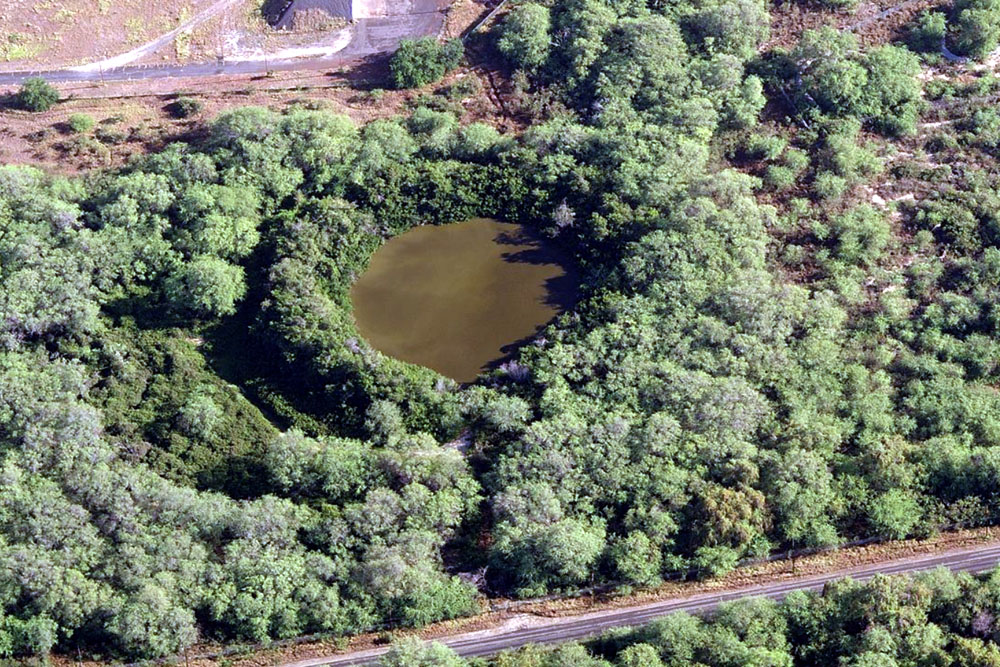
But the site has been a toxic waste ground for the Navy, which spawned the name Ordy Pond because of ordinance dumped there in past decades. Before it can be analyzed, it needs to be cleaned up.
ʻEwa Plain is most famous for the role the area played in World War II, when Japanese fighters attacked ʻEwa Field shortly before they struck Pearl Harbor. At least four Marines were killed. More than 50 civilians who worked at nearby ʻEwa Plantation were injured, and a child who was wounded later died.
The base was a hub for aviation training, the place where military pilots learned to fight and fly.
One group that had trained at the base was working at Wake Island on Dec. 8, 1941, another scene of the simultaneous Japanese attacks. There were about 500 servicemen and 1,200 civilian contractors at Wake. They fought off the Japanese forces for about three weeks but were eventually forced to surrender. The survivors were sent to harsh prisoner of war camps in Asia. Dozens were summarily executed and only some ever returned home.
Others who learned to fly at ʻEwa Field headed off to fight the Battle of Midway, an important turning point in the war.
“In the early months of the war, marines from ʻEwa formed the very spearhead of America’s air effort against Japan,” according to historian Ben Resnick, in a National Park Service presentation in 2019.
Barbers Point, which is southeast of Pearl Harbor, got its name from a shipwreck back in 1796. A sailing ship under the command of a British ship captain named Henry Barber ran aground there during a tropical storm. About a quarter of Barber’s crew drowned in the high waves off the coast.
The area later became a sisal plantation that grew fibers used in rope and rugs.
By the early 1930s, the land was owned by industrialist James Campbell. The U.S. Navy leased it as a mooring location for a dirigible, Akron. Later the Navy built additional facilities there to support a mooring mast for the use of U.S. Navy airships, although it was never used for this purpose. But it meant that the land was available for use as the United States began to make preparations for what would become World War II. It became Marine Corps Air Station ʻEwa and later, Barbers Point.
The Navy decommissioned Barbers Point in 1999 as part of a federal budget-cutting initiative, Base Realignment and Closure. The Navy began transferring the land, covering some 3,700 acres, to residential developers, including the Hunt Cos., a Texas-based defense contractor.
The area, which includes several new residential subdivisions built by Hunt, is now a master-planned community called Kalaeloa.
Stephenson said that the keeper of the historic register would need to reverse an earlier decision if the National Park Service went along with the Navy’s request.
“I hope the keeper will stand firm on the significance of the sites that have already been identified,” he said. “I hope the Navy will realize its responsibility and negotiate development with the Hunt Cos. elsewhere, in recognition of the significance of this sacred site, and keep it intact.”
 Sign up for our FREE morning newsletter and face each day more informed.
Read this next:
Local reporting when you need it most
Support timely, accurate, independent journalism.
Honolulu Civil Beat is a nonprofit organization, and your donation helps us produce local reporting that serves all of Hawaii.
ContributeAbout the Author