Denby Fawcett: This 60-Year-Old Classic Opens The Door To Hawaiʻiʻs History
“Place Names of Hawaiʻi” provides an introductory grasp of the islands’ culture and mythology.
July 8, 2025 · 6 min read


About the Author

Recommended reading lists abound in the summer as ubiquitous as teriyaki steak on the hibachi or sodas chilling in a cooler at the beach. Since it is already July, I want to offer my own list.

I keep hearing that people seldom read books today, preferring instead to scroll the internet or play with chatbots, leaving them with increasingly short attention spans. Keeping that in mind, my summer reading list has only one entry.
The book is “Place Names of Hawaii” by Mary Kawena Pukui. Samuel H. Elbert and Esther T. Mookini.
This nearly 60-year-old classic offers a fun first step for anyone who wants to start exploring Hawaiian history and get an introductory grasp of Hawaiian culture and mythology.
Friends visiting from the mainland often ask me to recommend one book — just one book — to help them understand our state. There is no such single volume to make sense of all that has happened here, never mind to reveal the deeper meaning behind events of the past. That requires years of reading dozens of books. But “Place Names” offers a straightforward way to begin.
I love this book and find it endlessly entertaining and enlightening. A reader can pop it open and look at any page for just two minutes before closing it and walking away with a better understanding of a place or a street they might have passed through the day before. My paperback edition is so well used the front cover has separated from the book’s spine.
It is a reference book that gives the meaning and history and sometimes the mythology of 4,000 place names of all kinds of locations from residential streets to surf breaks to famous rocks, religious shrines and buildings — even the names of dormitories on some school campuses.
Hawaiian language scholar and author Puakea Nogelmeier calls “Place Names” a “port of entry.” By that he means, a book to inspire a reader to take a deeper dive into the multilayered, poetic world of Hawaiian language and stories.
‘Just The Right Amount Of Information’
Why should anyone care about this? Nogelmeier says it is about enriching your perspective.
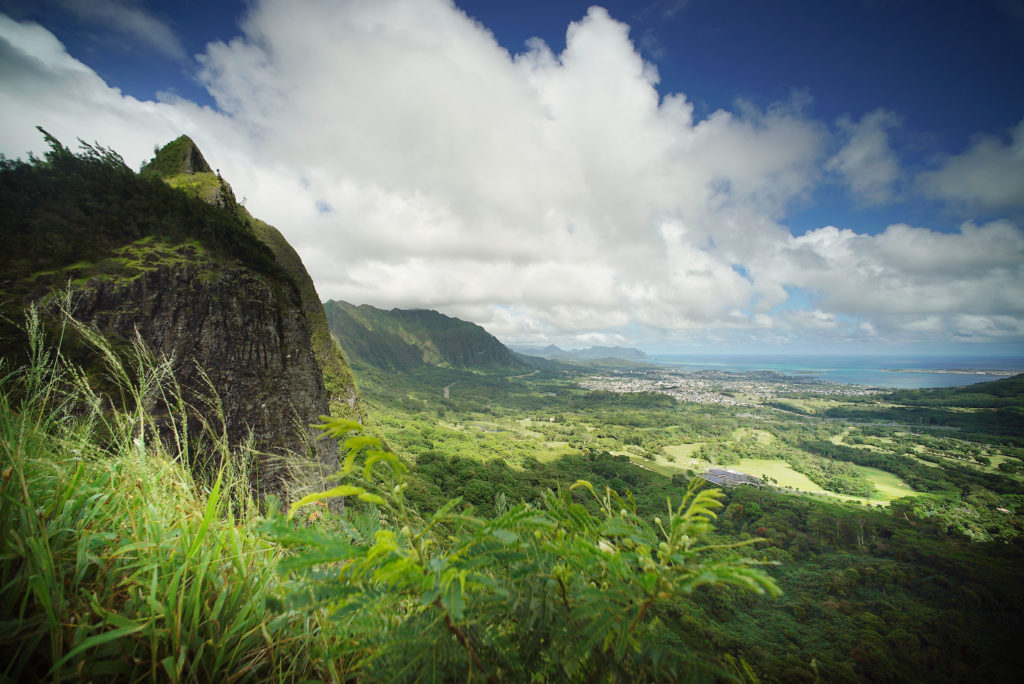
“Some may look from the Pali Lookout over to Kāneʻohe and see only a vast expanse of green. I look out and see myths and creatures and famous people and historic events all told in the names Hawaiians gave to their places. I have been doing this for 50 years and it is still engaging.”
Nogelmeier is a professor emeritus at the University of Hawaiʻi Mānoaʻs Kawaihuelani Center for Hawaiian Language. He is also a kumu hula and composer of Hawaiian songs and is heard daily by bus commuters as the taped voice on TheBus calling out in perfectly pronounced ‘ōlelo Hawaiʻi the names of each bus stop.
Kailua bookseller Pat Banning says “Place Names of Hawaii” is a fast-paced way to pick up facts, much like the TV quiz show “Jeopardy.”
“It is painless,” she said. “It gives just the right amount of information.”
We laughingly agreed it is perfect bathroom reading. Take it into the bathroom, read a little and you come out smarter.
Banning said “Place Names” has always been a steady seller at BookEnds, the store in the Kailua Shopping Center she has owned for 27 years.
Hawaiians often created their names for places by stringing together a few words or a phrase to tell about a historic event or a myth associated with the place.
Take the entry in “Place Names” for Kāneʻohe:
“Kāneʻohe. Quadrangle, land section, playground, village, bay, beach, harbor, ranch, school, stream, county park, Marine Air Corps station, and golf course. Oʻahu. Lit., bamboo husband (according to one account, a woman compared her husbandʻs cruelty to the cutting edge of a bamboo knife).”
You will never look at the streets and places around you in the same way as they come alive with context and meaning.
Or the story behind the name for the Nuʻuanu swimming hole and ti leaf slide once frequented by Honolulu teenagers, including myself, called Jackass Ginger:
“Pool and mudslide. Judd Trail. Upper Nuuanu, named by local youths in early 1900 for a donkey that was tethered nearby and for the yellow ginger growing by the pool. See Kahua-i-lana-wai.”
Kahua-i-lana-wai, the more beautiful Hawaiian name for Jackass Ginger, is translated in the book as “pool of tranquil water.”
Interestingly, Jackass Ginger almost didnʻt make it into the book when the three authors were unsure of what its name meant. In an article in the Honolulu Advertiser on Oct. 9, 1973, they solicited help from the public.
University of Hawaiʻi Press promotion director Carol Abe said the article generated six handwritten letters sent to the UH Press by readers giving their own Jackass Ginger definitions — enough to persuade the authors to include the name of the popular swimming hole in “Place Names.”
Essential Research Tools
Native Hawaiian author John Clark says “Place Names of Hawaii” is what inspired him to write 11 of his own place name books; most recently, “Niʻihau Place Names.”
Clark said he admired the way Pukui, Elbert and Mookini’s book used simple, short explanations to help readers understand the deep respect Hawaiians had for their lands.
He said “Place Names of Hawaii” and Pukui and Elbertʻs “Hawaiian Dictionary” are the two books he considers essential for researching Hawaiian history.
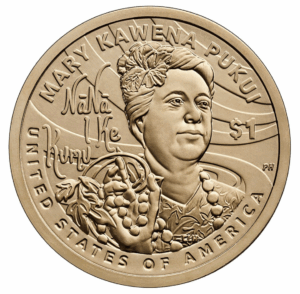
Mary Kawena Pukui was a respected language scholar, composer, author, hula expert and educator. On Jan. 20, the U.S. Mint released a silver dollar coin with her image on it.
Her collaborator, Samuel Elbert, was a professor of Pacific Languages and Linguistics at the University of Hawaʻi Mānoa.
Pukui and Elbert released the original “Place Names of Hawaii” in 1966 as a 64-page separate paperback supplement to their already popular “Hawaiian Dictionary” published by University of Hawaiʻi Press.
They enlisted Hawaiian language scholar Esther Mookini as a co-author to help research the historical background of the names for the subsequent 1974 hardbound edition and the 1976 paperback, which is the current edition now in its 19th printing, with more than 50,000 copies sold.
The book is also available for free online on Ulukau, the Hawaiian Electronic Library.
If you read “Place Names” carefully, you will never look at the streets and places around you in the same way as they come alive with context and meaning.
And maybe, if you are deep in Nuʻuanu Valley, you might think of the image of a donkey surrounded by yellow ginger beside a refreshing mountain pool.
 Sign up for our FREE morning newsletter and face each day more informed.
Local reporting when you need it most
Support timely, accurate, independent journalism.
Honolulu Civil Beat is a nonprofit organization, and your donation helps us produce local reporting that serves all of Hawaii.
ContributeAbout the Author