Here’s How The Legislature Is Slow-Walking A Reform Hawaiʻi Needed Years Ago
Many lawmakers keep saying they support longer sessions. But it never happens.
July 27, 2025 · 9 min read


About the Author

Even as they extol the commonsense wisdom of lengthening Hawaiʻi’s ridiculously short legislative sessions, some key state lawmakers seem complicit in preventing that from happening.
Or at least slow-walking it to the point where they’ll all be safely retired before it happens.
They’ve beaten back all but the most modest of proposals to even study the idea, for God’s sake.
Proposed constitutional amendments for longer sessions die every year in a Legislature that has no affinity for letting the voters decide such things. Last session House Speaker Nadine Nakamura pushed for a high-powered working group to fast-track deliberations. Same result.
Oh well, the speaker said, there’s always that report already requested of the Legislative Reference Bureau.
The one with no deadline and in fact no requirement that the LRB even deliver its findings to the Legislature.
Don’t hold your breath.

The terms “12-month Legislature” or “full-time Legislature” may be off-putting to folks who think more government is never a good thing. But this isn’t about lawmakers holing up in the State Capitol all year long. It’s about ripping away the excuses for why we can’t have nice things such as an open and transparent budgeting process.
A glance at Civil Beat’s candidate Q&As finds widespread support — at least during election season — for lengthening legislative sessions.
There are holdouts, including some Republicans who campaign on cutting government resources and some Democrats from neighbor islands who simply want to spend as little time on Oʻahu as possible.
What really stymies this reform from gaining any momentum, however, are legislators who wave the flag for it but don’t follow through.
Speaker Abandons Her Own Proposal
It’s become an annual tradition. Every session, measures are introduced proposing a constitutional amendment that would let voters decide on the question of a full-time Legislature where lawmakers would be prohibited from having other jobs.
And every session, they die in committee, sometimes without hearings and other times advancing past one committee only to be killed by the money chairs.
Almost as if there’s a concerted effort to avoid making the majority of legislators go on the record in a floor vote.
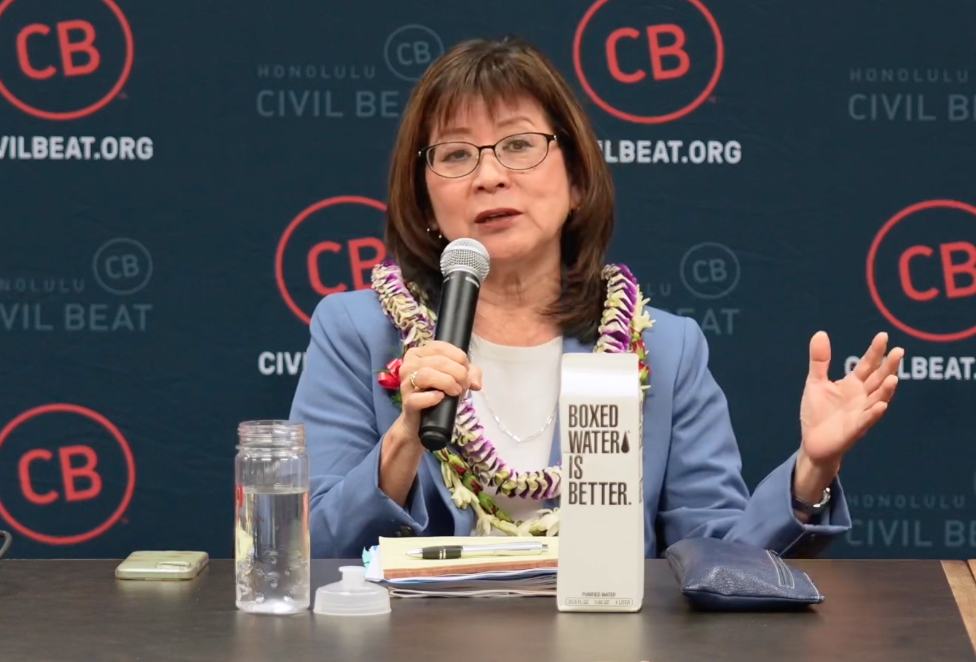
This year brought a twist as Nakamura, the new House speaker, spoke out forcefully in favor of figuring out how to lengthen legislative sessions.
“We currently have a 60-day session from the middle of January to the first week of May and we have these self-imposed deadlines that require us to not hear a lot of bills,” Nakamura said in January. “It requires us to write very complex bills in a very short period of time.”
She introduced House Bill 1425 to create a high-level working group to “study the feasibility of transitioning” to a 12-month Legislature.
Only a task force, true. But one that would have included two legislators and members selected by the governor, the attorney general and the Senate and House clerks, among others, with its report due before the start of the 2026 session.
The new speaker seemed to be breathing new life into the idea, and she even persuaded Senate President Ron Kouchi to introduce a companion measure in his chamber.
Both bills cleared their initial committees but then, thud. They were shot down with no explanation by, you guessed it, the money chairs.
Why would the speaker of the House let that happen to her own proposal? That’s what Civil Beat wanted to ask, but Nakamura did not respond to a request for comment this week.
Update: In an email response received Sunday afternoon, Nakamura said she abandoned the bill “because the LRB study was not going to be ready for a working group to use as a basis for discussion.”
She added the study “is expected to be completed later this year” — something the LRB director did not commit to Thursday.
“I remain very interested in pursuing the option of a year-round legislative session,” Nakamura said in the email. But she added, “I’m keenly aware that many legislators and staff are reluctant to change” the session length.
Shortly after her measure was snuffed, the speaker had alluded to the fact that lawmakers already have asked the LRB to study the issue.
But let’s look closer at that 2024 request.
Working ‘Diligently’ With No Deadline
Last year, before she became speaker, Nakamura and Rep. Chris Todd proposed House Concurrent Resolution 138 to ask for the LRB study. It didn’t propose a high-profile working group, but it did require that a report be submitted to the Legislature no later than 20 days before the start of the 2025 session.
When LRB Director Charlotte Carter-Yamauchi submitted written testimony asking for more specifics about what should be studied, Nakamura amended the resolution to ask the LRB to look at four states that already had full-time legislatures.
She also gave the LRB a tighter deadline, asking for its report no later than 45 days before the 2025 session.
Then, wonder of wonders, the resolution sailed through two committees and the full House before landing in the Senate Government Operations Committee.
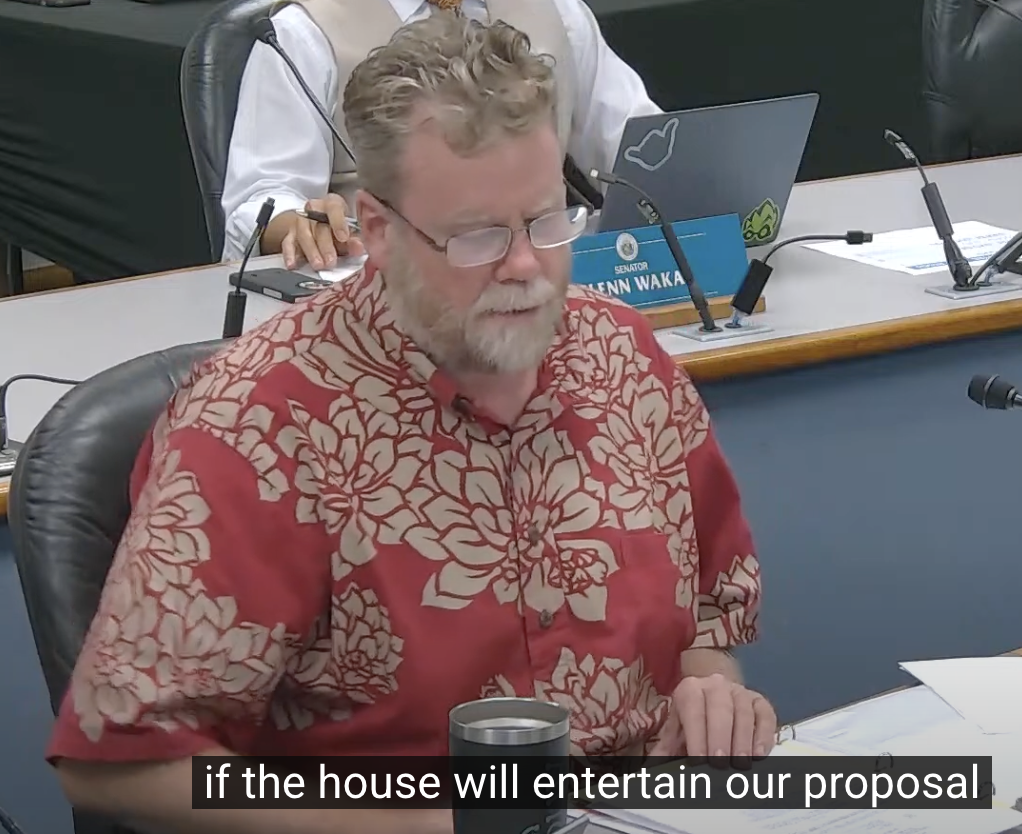
That panel’s chair, Sen. Angus McKelvey, pulled a switcheroo, saying at the time, “We’d like to see if the House will entertain our proposal insofar as studying a year-round Legislature.”
Then he replaced the House proposal with language from a Senate resolution that contained no deadline for the LRB to produce a report, or even a requirement that the report had to be submitted to the Legislature at all.
So that’s what the Senate passed, and the House silently acquiesced and approved it as well.
McKelvey said Thursday that when he Senatized the resolution he wasn’t aware that the new version didn’t impose a deadline on the LRB. He added that he didn’t think the LRB could have met the deadline anyway, based on its written testimony.
But here’s what Carter-Yamauchi said in that testimony: “If a specific model of a full-time legislature is provided and the noted issues are clarified, the Bureau believes that it could complete such a study in the stated time period.”
She was referring to the need for clarification on what states with 12-month legislatures the LRB should study. Nakamura had provided those details in her amendment, but that too was lost when the House language was stripped from the resolution.
Any journalist can tell you that work tends to proceed more slowly without a deadline, and it turns out the LRB is no exception.
It didn’t produce the report in time for the 2025 session and when asked this week if it would be done in time for the 2026 session, Carter-Yamauchi offered no guarantees, saying just that the LRB is working on it “diligently.”
With Friends Like These
McKelvey is actually one of the guys who keeps proposing constitutional amendments for a 12-month Legislature, and he says he’ll do it again next session.
“From what I have observed, there seems to be growing support — at least for extending the current session by incorporating more recess days,” he said. “The original 60-day framework was developed in a vastly different era, one of far less financial and operational complexity.”
Wow, that’s convincing. But somehow, powerful committee chairs who voice support for this reform aren’t even coming close to pushing it toward the finish line.
Take Karl Rhoads, chair of the Senate Judiciary Committee. In 2023 he joined McKelvey and Sen. Stanley Chang in co-sponsoring a constitutional amendment that would have not only produced a year-round session, but also would have applied the Sunshine Law to the Legislature for the first time.
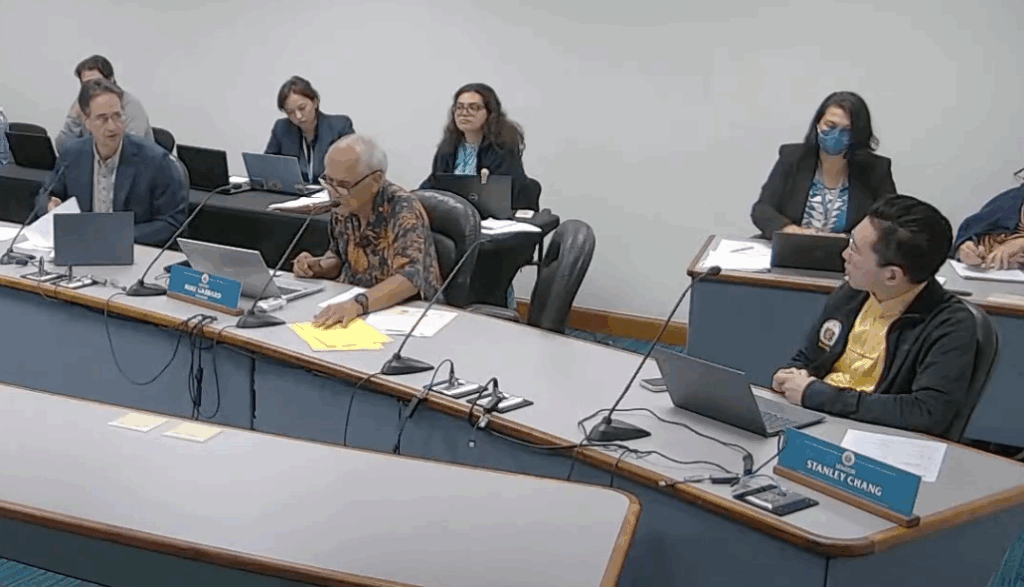
And yet there was Rhoads in late January killing the latest McKelvey-Chang 12-month Legislature bill to come before his committee “with apologies” to Chang, who sat stoically about 10 feet away.
Rhoads offered no real explanation at the time, saying only, “I do think we have gathered a lot of interesting and useful testimony and analysis and we’ll see where it goes from there.”
On Wednesday he explained it this way: “I was deferring to leadership’s approach, which was study first.”
But soon after Rhoads deferred the bill, “leadership’s approach” was also rejected courtesy of the money chairs.
In 2024, a similar McKelvey-Chang bill died in the Governmental Operations Committee that McKelvey himself chaired.
For some reason, it was one of those rare times that committee members didn’t follow the lead of their chair.
“I frankly misjudged the level of support the bill had,” McKelvey said Thursday.
Where does all this leave us? Like with most governmental reforms, so far legislators are going nowhere, slow, on lengthening sessions.
But they’d best remember this: Less than two years from now, they’re getting big pay raises that will put to rest the notion that being a Hawaiʻi legislator is a part-time job.
Civil Beat’s reporting on the Hawaiʻi State Legislature is supported in part by the Donald and Astrid Monson Education Fund.
 Sign up for our FREE morning newsletter and face each day more informed.
Read this next:

Local reporting when you need it most
Support timely, accurate, independent journalism.
Honolulu Civil Beat is a nonprofit organization, and your donation helps us produce local reporting that serves all of Hawaii.
ContributeAbout the Author