No Confidence: We Need To Force Legislative Leaders To Clean Up Their Own Houses
One thing the public can do is petition leadership to investigate the $35,000 given by the FBI to a lawmaker during a federal corruption investigation.
July 20, 2025 · 9 min read


About the Author

It is time that the leadership in both houses of Hawaiʻi’s Legislature be called out for their actions taken in defiance of public opinion.
Several events have coalesced in recent months that call for the legislative leadership to come forward to explain their actions or face scrutiny. This can only be accomplished by pressure from their fellow legislators or us, the voters.
One thing we can do is petition both the Senate and House to formally investigate the $35,000 given by the FBI to a legislator in 2022 as part of a federal corruption investigation. So far, leadership has had little to say about this important matter, which amounts to the FBI’s direct involvement in the legislative process.
Additionally, both chambers should require their respective rules committees to establish a voting procedure to give members a mechanism to express their lack of confidence in legislative leaders. That legislative vehicle currently does not exist.

How We Got Here
First came leadership’s callous gutting, and then killing, of the pay-to-play bill that was set to be enacted at the end of the 2025 legislative session. Three years after the House Commission to Improve Standards of Conduct introduced legislation to tighten campaign finance reform in the aftermath of Rep. Ty Cullen’s and Sen. Kalani English’s convictions — underscored by the 2024 New York Times/Civil Beat article exposing lurid late-night campaign fundraising parties that included politicians, state employees and wealthy donors — it appeared that House Bill 371 (pay-to-play) was finally set to be enacted.
The bill would have prohibited campaign contributions from officers, their executives and family members of businesses that have significant state contracts. Mind you, this was not a new or radical concept, as efforts to make this very same reform go back to the 1990s and have been shut down by legislative leadership every single time. But things, finally, seemed to be looking up.
Both the House and Senate Judiciary Committees unanimously approved the bill. But at the last minute, according to both House Judiciary Chair David Tarnas and Senate Judiciary Chair Karl Rhoads, House Speaker Nadine Nakamura and Senate President Ron Kouchi intervened and watered it down to the point that the amended bill would have had little, if any, significant impact on current campaign finance practices.
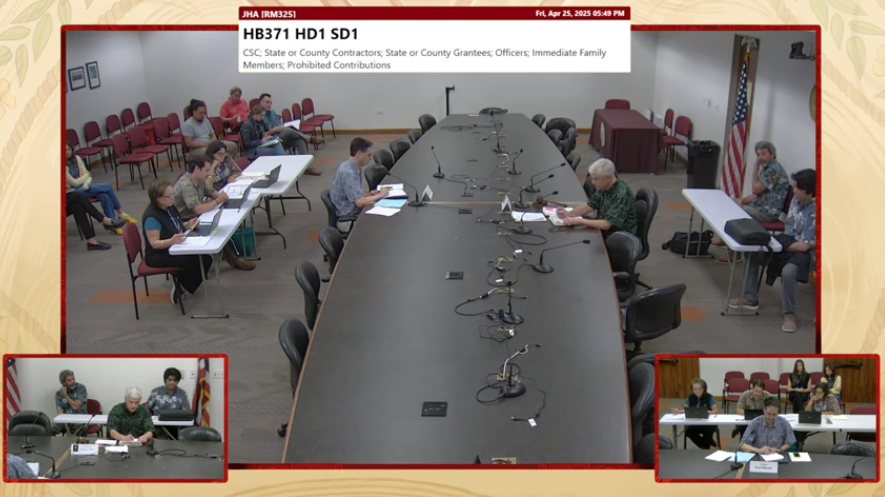
However, even this was not good enough, and this watered-down version of the bill was killed in the House and Senate conference committee.
And while the chair of the House Finance Committee was subsequently sacked, in my opinion that was partly because the leadership wanted the watered-down bill to pass so they could create a false narrative that they’d accomplished something.
Without any bill passing, however, it lays bare that the leadership is more interested in keeping campaign monies, wherever sourced, flowing into their bank accounts rather than curbing corruption or addressing public concerns.
The second set of events concerns the less publicized but equally dubious killing off of House Bill 370 and House Bill 772. HB 370 proposed partial public funding of elections, which would have lessened the corrupting influence of campaign donations from companies or private individuals doing business with the state and help level the playing field for those candidates willing to accept required amounts of small donations from actual people.
HB 772 would have prohibited a legislator from using their campaign funds to buy tickets to another legislator’s fundraiser, thereby transferring monies donated by typically larger and corporate donors to one legislator for use by another, essentially laundering campaign donations and sidestepping contribution limits that are intended to reduce corporate influence.
Together, the passage of these two bills, plus HB 371, would have gone a long way in addressing transparency issues and could have greatly curtailed practices that allow wealthy, corporate donors — some of whom may have contracts with the state — to corruptly influence a legislator through campaign donations.
But our legislative leadership refused to allow these bills to come to a vote, even though they were approved by numerous committees. Despite being given the opportunity by Civil Beat reporters and others to address their actions, they refused to say one word in defense of their actions.
Legislature Should Investigate Its Own
These actions, unfortunately, lead to another, much more serious question: Why have these same legislative leaders done absolutely nothing to investigate the events surrounding a possible member of the Legislature accepting $35,000 from an unknown individual? This transaction, which occurred more than three years ago, was secretly recorded by former Rep. Ty Cullen in his capacity as an undercover informant for the FBI.
While the FBI has not brought criminal charges or provided details of its investigation, that fact does not prevent the Legislature from conducting its own investigation into the matter. Particularly when it directly involves a state legislator, one of their own.
And even if it turns out that whatever occurred was legal under our current laissez-faire campaign finance laws, it certainly is suspicious and requires an explanation. The legitimacy of this $35,000 transaction, however, is called into question because, if it was legal, why hasn’t the legislator who accepted the money come forward, admitted their involvement and simply explained their actions?

Legislative leadership has full authority to empanel an investigatory committee with subpoena powers. But no such steps have been taken. Rather, leadership has taken the position that if it sees no evil and hears no evil, whatever transpired will simply fade away from public memory and they can go on with business as usual.
The concern is that the statute of limitations is running out, meaning it may become impossible under state criminal laws and/or campaign spending and ethical rules to sanction any wrongdoing. The clock is ticking, and the legislative leadership’s inaction is purposely allowing time to run out.
Why? Perhaps there is a connection between the $35,000 transaction and the killing off by the leadership of the three bills that would have made such a transaction clearly illegal, or at the very least, transparent and accountable to the public.
Open Accountability Is Needed
So, what is to be done other than wringing our hands in frustration?
One possible recourse would be a vote of no confidence in the leadership of our Legislature by fellow lawmakers. Such a vote would accomplish two things.
First, it would allow legislators to voice their unhappiness with the direction of leadership in a non-binding resolution without requiring a majority vote that is needed to oust leadership entirely.
Second, and more importantly, such a vote, if taken in an open session, allows the public to see where each legislator stands. The public is then able to lobby their individual legislator or vote them out of office.
In other words, a vote of no confidence results in direct accountability and, if it has enough numbers behind it, may result in leadership changing direction lest they be voted out entirely in a more formal vote.
Unfortunately, no such rule exists within either the House or Senate to conduct such a vote. Rather, as things now stand, everything is done in secret behind closed caucus doors, shielded from public knowledge. This practice not only stifles dissent, but it also allows leadership to punish dissident legislators without public backlash. Voting against leadership, under such circumstances, is political suicide.
A public vote of no confidence, on the other hand, will offer protection to these same dissident legislators, as any retribution would become transparent, allowing the public to hold leadership directly accountable. An open session vote and public accountability is true democracy in action. It is to be embraced, not feared.
There is still an opportunity to convince our legislative leadership to do the right thing. Robert Harris, the executive director of the Hawaiʻi State Ethics Commission, and executive director Kristin Izumi-Nitao of the Campaign Spending Commission plan to actively pursue these bills in the 2026 legislative session.
They will need your support. These bills need to be passed now, with immediate effective dates. Not in 2027. Not in 2028, but now so that we have true transparency and accountability in the 2026 elections.
An open session vote and public accountability is true democracy in action. It is to be embraced, not feared.
It was hoped that when voters ousted former House Speaker Scott Saiki, it would send a clear message to legislative leadership that the public was fed up with business as usual. It appears that neither Nakamura nor Kouchi have gotten the message.
Think of the sheer chutzpah it took to kill off these bills in plain sight with utter indifference to public opinion. Leadership clearly calculated there would be little if any meaningful backlash. They need to be reminded they serve the public’s interest, not their own political ambitions.
It will take our collective action, both from outside the Legislature in the form of public pressure, and from within the Legislature, from dissident legislators, to force leadership to listen and to get meaningful anti-corruption legislation passed. But it can be done if we all work together, voice our opinions, and hold our legislators accountable.
From my understanding, legislative rules allow for any member of the public to petition the Legislature. I intend to petition both houses to formally investigate the $35,000 transaction and for the rules committees to consider creating a no-confidence voting procedure.
You don’t get anywhere if you don’t poke the bear.
 Sign up for our FREE morning newsletter and face each day more informed.
Read this next:

Local reporting when you need it most
Support timely, accurate, independent journalism.
Honolulu Civil Beat is a nonprofit organization, and your donation helps us produce local reporting that serves all of Hawaii.
ContributeAbout the Author