Hawaiʻi Gov. Josh Green Is Walking A Tightrope With The Trump Administration
As Trump’s domestic military moves and threats play out in DC and LA, the need to balance legal challenges and relationship-building isn’t lost on Hawaiʻi.
August 17, 2025 · 8 min read


About the Author

President Donald Trump took over the Washington, D.C., police department and sent the National Guard into the nation’s capital.
He has deployed California National Guard members and U.S. Marines to Los Angeles — against the will of that state’s governor — in the midst of protests against immigration crackdowns there.
He’s threatening to do the same in other cities that are Democratic Party strongholds.
At a recent state House hearing, Hawaiʻi legislators speculated about scenarios where federal actions such as immigration arrests could lead to direct confrontations with state sheriffs if they occurred, say, at a State Capitol protest or in a state courthouse.
We’re living in extraordinary times, and there’s no reason to think the islands are immune to the effects of national unrest.

This leaves Gov. Josh Green with a precarious balancing act. Even as his Attorney General’s Office has joined 27 legal challenges against the federal government since Trump took office in January, the governor has been trying to turn down the heat to avoid state-federal confrontations that he said “could be very destructive to the fabric of our culture.”
‘A Very Slippery Slope’
One of the many Hawaiʻi legal actions was to file an amicus brief in support of California’s suit over Trump’s injection of troops into Los Angeles despite the opposition of its governor, Gavin Newsom. During a three-day trial last week, a judge was deeply skeptical of the need for the federal action, but any ruling in the case will likely be immediately appealed — probably all the way to the U.S. Supreme Court.
“It’s quite distressing to many people in our state that we would have to worry about our National Guard being used by the federal government,” Green said in an interview last week. “I want to be totally clear. I feel strongly that governors have to control their own National Guard troops, and the reason is because we need these excellent officials and military personnel to help us with disaster relief and crises at home.”
That local need included just this past week using the National Guard to support firefighting on the Big Island, including using Blackhawk helicopters to make numerous water drops, he said.
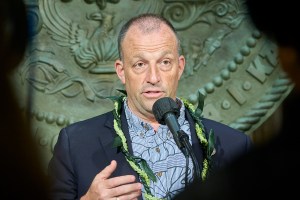
“For our National Guard deployment to be used by anyone other than the governor would be very disruptive.”
Trump’s move into the realm of actual law enforcement in D.C. would be harder to replicate in an entire state — especially without a governor’s approval. In Los Angeles, for example, the troops have been limited to protecting property.
Green emphasized he has no interest in help from the military when it comes to law enforcement.
“It does take us down a very slippery slope where people will not feel that they can trust their own military if they’re being used against them,” he said. “And so I’m really sensitive about this issue, and I would greatly prefer that the president allow us all to do our own law enforcement in our states.”
Bringing In The Marines
Still, Trump has often described illegal immigration as an “invasion.” On the same day he announced his D.C. takeover, he vowed to intervene in other cities to fight crime. And when he went into LA, those California National Guard members were accompanied by 700 U.S. Marines.
About 6,000 Marines were stationed in the islands as of 2023, most of them just around the bend in Kāneʻohe Bay.
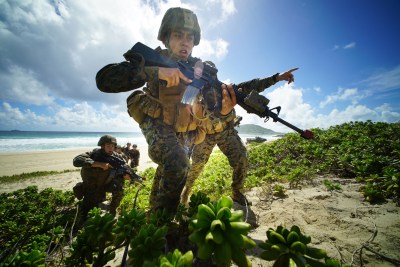
“I’ve had many private discussions, and there seems to be consensus that the active military personnel have a job to do to prepare for what comes in the Indo-Pacific, and that’s their focus,” Green said. “I’m certain that they do not want to be dealing with domestic matters.”
In all, Hawaiʻi had 44,736 active duty military personnel in 2023, along with 9,604 National Guard members and reserves, according to the state.
“I have a great relationship with Admiral (Samuel) Paparo, the head of Indo-PACOM,” Green said. “He follows orders and the chain of command, of course, but our relationship is such that we’re able to have open conversations, so that we never get there, so that we just are able to deal with our problems. I mean the active duty military, they should never be used against American citizens unless there was a truly horrific civil war. That’s not on the horizon for Hawaiʻi or for the country.”
Briefing The Legislature
Concerns about the Trump administration have been the subjects of recent informational briefings before Hawaiʻi legislative committees.
One was held Thursday by Senate Judiciary Chair Karl Rhoads at which members of the state’s legal team updated legislators on lawsuits against the federal government, including cases where more than $1 billion in federal funding for Hawaiʻi is at risk.
Attorney General Anne Lopez, Special Assistant David Day and Solicitor General Kalikoʻonālani Fernandes were praised as “rock stars” by Democratic Rep. Terez Amato, who joined the panel discussion at Rhoads’ invitation.
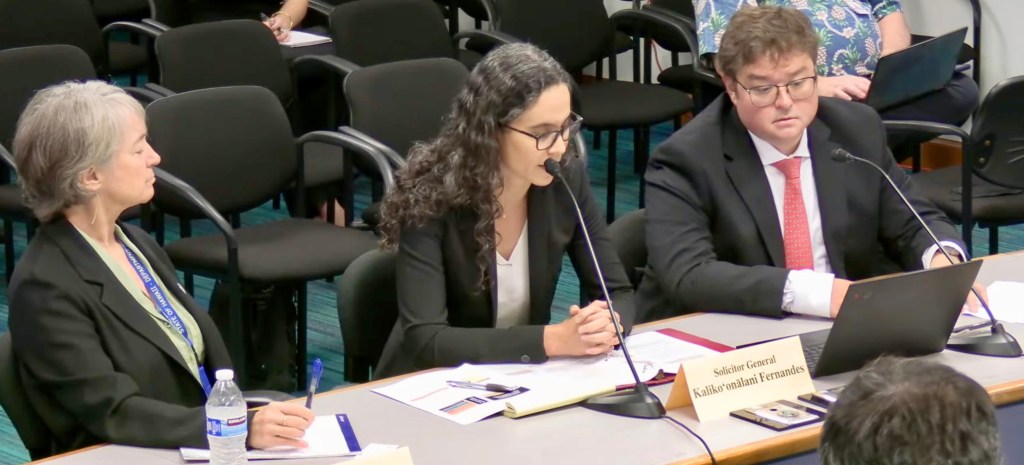
But Republican Sen. Brenton Awa questioned whether Hawaiʻi should be challenging all of the federal attempts to cut spending and suggested the attorneys should instead focus on wasteful spending in state government.
A more intriguing discussion unfolded at a recent hearing of the House Public Safety Committee when Vice Chair Kim Coco Iwamoto asked a deputy director of the state Department of Law Enforcement to speculate about how state sheriffs might respond to conflicts with the federal government.
The department has 350 officers across the state and “we take our direction solely from the governor,” Jared Redulla said. “We do not take our orders from the federal administration.”
Their responsibilities include keeping the peace at the State Capitol and state courthouses, he said.
‘How Much Retaliation Can We Afford?’
How would state sheriffs respond, Redulla was asked, if masked Immigration and Customs Enforcement agents attempted to detain people at one of those venues?
At large events such as a Capitol protest, law enforcement agencies would typically communicate with each other in advance to avoid any conflict, Redulla said.

As for state courthouses, “I’ve not personally seen ICE officers in our courthouses, but we’ve had conversations with the Judiciary to ensure that we’re prepared in case that were to happen,” he said.
“We’d avoid interaction at the courthouse if at all possible,” Redulla said. “What goes on outside the courthouse on the public street is something that we can’t control.”
Committee Chair Della Au Belatti speculated about whether new legislation could be crafted to make the Hawaiʻi National Guard more resistant to a federal takeover.
Attorney General Lopez responded that “there are potential risks associated with laws that are passed. They have made it clear that they will retaliate, and they will threaten loss of funds, they will threaten lawsuits.”
Later Lopez added, “How much retaliation can we afford financially? Where do we draw the line?”
Just Don’t Make It Personal
The governor also questioned the wisdom of potential new bills.
“I’m really not particularly interested in legislative scenarios, in informational briefings — those are meant to catch headlines,” Green said. “The job of the executive is to work out those differences with the administration before they become a problem.”
Despite all the policy disagreements, including his outspoken opposition to the nomination of Robert Kennedy Jr. to be the nation’s top health official, Green said he has maintained a functional relationship with the administration.
“There are a lot of ways to to win a fight like this.”
Gov. Josh Green
“I have spoken with the president, and we spoke very directly about the best way to manage communication and to have a professional relationship, and I did share with him that we have some pretty significant differences, and his feeling was, as long as I didn’t make it personal and directed at him, that our state would do very well, and I could express in any terms I needed to my concerns with his secretaries or other directors. And I do.”
Following that approach, Green said, “will also probably help us to avoid some of the more explosive moments like you saw In California and in Washington, D.C.”
The governor of Hawaiʻi almost sounds optimistic about all this.
“There are a lot of ways to to win a fight like this and I’m going to be very strategic so that we don’t end up in a circumstance where our National Guard is taken and it causes a big legal confrontation. And I’m not going to risk our public health. So I will always push back, but there aren’t too many scenarios that can’t be handled with a thoughtful conversation.”
 Sign up for our FREE morning newsletter and face each day more informed.
Read this next:

Local reporting when you need it most
Support timely, accurate, independent journalism.
Honolulu Civil Beat is a nonprofit organization, and your donation helps us produce local reporting that serves all of Hawaii.
ContributeAbout the Author