Kirstin Downey: For Now, Lahaina Artists Must Live In The Past
Maddeningly slow efforts to rebuild the burned-out downtown area delay the return of an arts district.
August 8, 2025 · 7 min read

About the Author

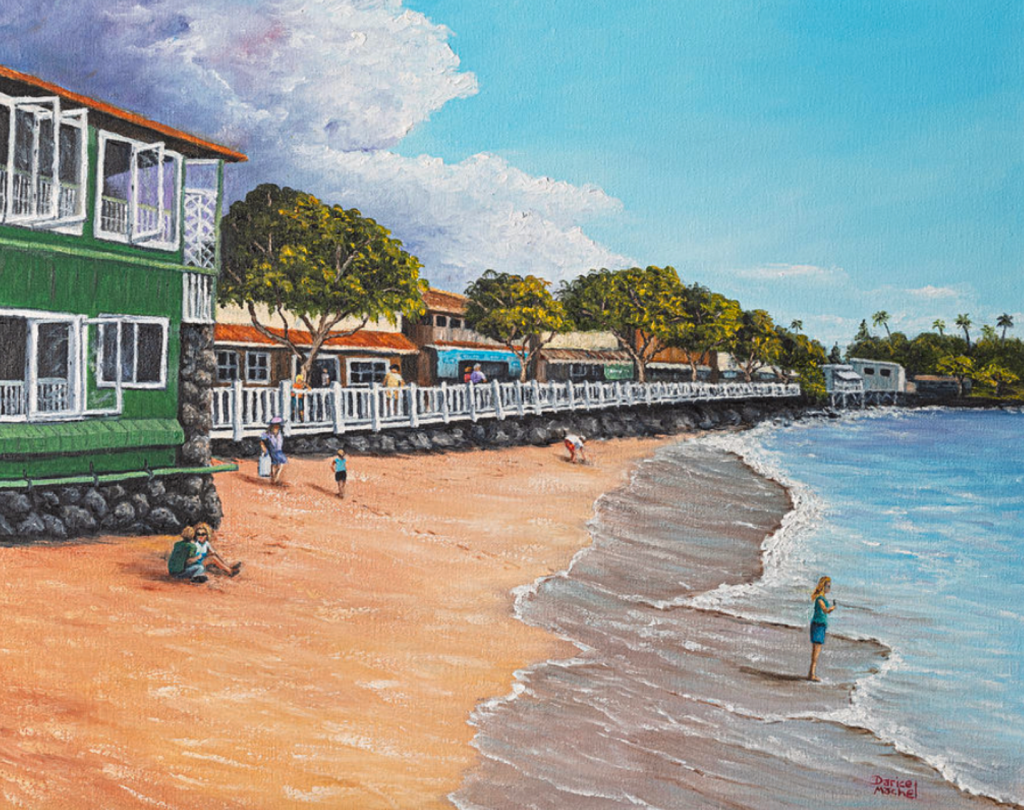
Without many visible signs of progress toward regenerating Lahaina’s core two years after most of the town was destroyed by fire, artists, photographers and writers are still focused on what used to be there, when oceanfront streets housed the top art market in all Hawaiʻi.
Half a year ago, federal workers were finishing up. Lahaina town, a national historic landmark, was cleaned up and ready to go. Most of the historic stone buildings had been stabilized. Many property owners in the historic district said they were eager to restore their buildings.
By now, downtown construction should be well underway. But while construction of individual houses is moving forward, mostly in Lahaina’s fringe areas, little of consequence appears to have occurred in the historic downtown, which has fallen victim to Maui’s glacial pace of government.
“It’s bloody tragic that nothing’s happening,” said Bill Smith, executive director of the 58-year-old Lahaina Arts Society.
While artists continue looking for new sources of inspiration, what’s left often involves looking back.

Ideas showcases stories, opinion and analysis about Hawaiʻi, from the state’s sharpest thinkers, to stretch our collective thinking about a problem or an issue. Email news@civilbeat.org to submit an idea or an essay.
For 2025, the theme of the annual Lahaina poster contest sponsored by the Lahaina Restoration Foundation was, once again, Remembering Lahaina. A new book also came out with that title. And even an exciting and popular new animated audiovisual presentation on Mokuʻula, the royal compound that once existed south of what became downtown, is focused on Lahaina’s more distant past.
The wildfire of 2023 was disastrous for Hawaiʻi’s artists because Lahaina was a cultural hub. It had served as a government and religious center during the kingdom, a whaling capital, an outpost of the global sugar industry and recently a major tourist destination. All these eras generated a rich mix of peoples and enterprises.
More Than A Dozen Galleries Lost
For Hawaiʻi artists, it became a mecca, a place where painters, writers and photographers gravitated. Until a few years before the fire, a regular art show held under the famous downtown banyan tree drew artists and art-lovers, many of them seeking creative expressions of the place they loved. The weekly show has been relocated to a parking lot by the Cannery Mall, which provides a venue for new art but without the cachet of the banyan tree.
In the downtown area, there were more than a dozen art galleries where artists could sell their work. All were wiped out in the fire. Only one, the Village Gallery, has a scheduled reopening date in about one month.
Two years later, the emotional anguish remains, and artistic representations of historic Lahaina continue to elicit dramatic reactions.
“Art is an emotional connection to a memory,” said long-time painter Darice Machel McGuire, known for her scenes of Lahaina, who reluctantly moved to California in the wake of the fire and is still suffering from the loss.

Oʻahu artist Bill Braden, best known for his seascapes called Best Beaches of Hawaii, first went to Lahaina as a teenager and recalls with delight its “human-scale” environment that invited people to walk from place to place, wander into shops and interact with other people.
“There was a fakey kind of Disneyland aspect to it, but I was charmed,” he said.
Later Braden went to Rhode Island School of Design in New England, where he saw old fishing and whaling towns that reminded him of Lahaina.
Braden was horrified by news reports about the fire and felt drawn to do something outside his normal kind of work. Relying on his memories of Lahaina, old photographs and using Google Earth for additional research, he painted a monumental triptych, consisting of three panels, each 4 feet by 4 feet, depicting the intersection of Lahainaluna Road and Front Street.

It was displayed in February at the Punahou Carnival Art Gallery, the state’s largest annual art show, and again at the Haleʻiwa Arts Festival in June. It drew crowds of people, some of whom lingered for long minutes. One young mother, a graduate of Lahainaluna High School who now lives on Oʻahu, began to cry as she looked at it, before buying a print to take home with her.
“Lahaina is like a magnet,” Braden said. “Everybody knows Lahaina and has a story of Lahaina.”
Photographer Charlie Osborn had owned Island Printing and Imaging, a commercial printing and art reproduction business destroyed in the fire. Selling his home on Maui, Osborn moved his business to Grass Valley, California, where he continues to make prints for Lahaina artists who are managing to survive. This gives him a good vantage point to see what sells, which is artistic or fanciful views of old Lahaina.
“They are selling emotions, selling memories,” Osborn said.
Chronicling Ecological Abuse
Writer Anthony Pignataro, who spent more than a decade working as a journalist on Maui, was living on the West Coast when the disaster struck. Like many others, he had fallen in love with Lahaina, partly because it harkened back to a simpler era.
“It was a small town, where you got to know people, your neighbor, the people down the street, the bartender. We were all in the same boat. We shared the community view, that where we are living is home and it feels like home,” Pignataro said.
There was personal loss — he had friends who died in the fire — but he felt extra grief and anger because he believes the fire resulted from decades of poor governance of the land. He found himself inspired to write a book, “Remembering Lahaina: What I Learned About Tourism, the ʻĀina, and Myself During Twelve Years on Maui.”

In its 25 chapters, Pignataro chronicles many ways Hawaiʻi has been abused ecologically and how its people have suffered from waves of different kinds of colonization, including by explorers, by sugar plantation magnates and later by its own incompetent or corrupt government. When the plantations closed, he witnessed what had been lush green fields of sugarcane abandoned and gradually reduced to a tinderbox of dry thatch. He remembered well that a fire in 2018 had offered an explicit warning to Maui leaders that was ignored.
“Maui has been misused,” he said, adding that he has not been able to bring himself to return.
One aspect of Lahaina’s past that is getting much-overdue appreciation involves the widening circulation of a 360-degree animated audiovisual exhibition about Mokuʻula, Lahaina’s island palace, which permits viewers to envision it for themselves. The film project was produced by the Lahaina Restoration Foundation, in collaboration with cultural practitioners, and first shown in November.
The royal site was a scenic 1-acre compound that was home to Queen Keōpūolani and her son, King Kamehameha III. The island was abandoned in the late 1800s and later turned into a trash dump and then a sports park. Most people forgot it had ever been there, but supporters have long dreamed of it being rebuilt. In this respect, at least, the fire is providing a welcome opportunity.
About 1,000 people have attended presentations of the show at The Sphere at the Maui Ocean Center at Māʻalaea. More than 700 Maui schoolchildren, meanwhile, have experienced the presentation through virtual-reality headsets purchased by the Lahaina Restoration Foundation through grant funding.
“Once you tell them it’s virtual reality, they are immediately entranced,” said Theo Morrison, executive director of the Lahaina Restoration Foundation, which is working to rebuild the historic structures in the downtown area. “We are reaching kids where they are.”
Civil Beat’s coverage of Maui County is supported in part by a grant from the Nuestro Futuro Foundation.
 Sign up for our FREE morning newsletter and face each day more informed.
Read this next:
Local reporting when you need it most
Support timely, accurate, independent journalism.
Honolulu Civil Beat is a nonprofit organization, and your donation helps us produce local reporting that serves all of Hawaii.
ContributeAbout the Author