Art Should Be Built With, Not Just For, Kalihi
World Wide Walls at Farrington High School should reflect the values, histories and spirit of the community.
September 3, 2025 · 4 min read

About the Author
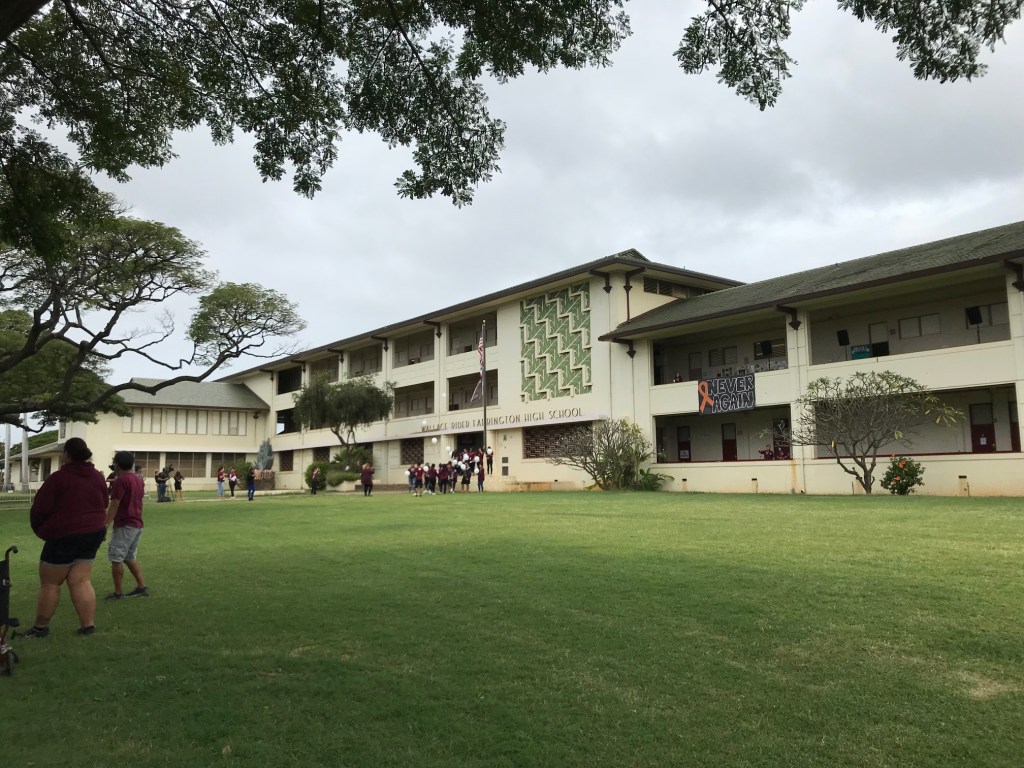
As a proud 2010 Farrington High School alumna, I was excited to learn that World Wide Walls — the same organization that brought local and national artists to Kakaʻako — has chosen Farrington as the site of its Hawaiʻi Walls mural festival from Sept.15-21. More than 50 new murals are planned with the potential to add vibrancy to a school community long known for resilience, pride, and artistry.

Some of the artists are from Kalihi and a few are Farrington alumni. That is worth celebrating because it means voices from our own community are shaping the campus.
Last year, in conversations with FHS students about earlier murals on campus, some admired the art, but others noted errors — like a mural misstating the school motto — and struggled to see how the work reflected Farrington’s story. These reflections highlight the opportunity for deeper collaboration and care in representing our community.
For many of us who carry Farrington Gov Nation in our hearts, it is important that the artwork not only beautify campus, but also reflect the values, histories, and spirit of the Farrington High School community — a legacy built across generations of students, teachers, staff, alumni, and families in Kalihi.
For me, being a Governor means being part of a student-centered culture. At Farrington, mentors, peers, and the alumni community prioritized youth leadership, nurturing me to become the first in my family to attend college and live out our alma mater’s motto: “Enter to learn, go forth to serve.”
This past week, a FHS 2026 student shared with me that current FHS Student Government leaders weren’t aware of this festival, an indication that those who live and breathe Farrington on a day-to-day basis are not fully included in its planning.

Theresa Schubert, a former student activities coordinator who spent the past 20 years cultivating space for and with students to nurture and grow Farrington High School’s Gov Nation culture, emphasized the importance of history: “With all of the accurate history learned from FACF (Farrington Alumni Community Foundation) Historian and alumni, Al Torco, I had hoped that the walls would tell the beautiful 80+ year story of the Governors. This would, in turn, help continue to visualize moʻolelo that many are not aware of. It would create space for questions that would lend to conversations about it.”
Others worry about connection and authenticity. Cardenas Pintor, Farrington HS alum 2023, secretary of the Kalihi-Pālama Neighborhood Board, and a UH Mānoa master’s student, reflected: “It feels incredibly disconnected to what Kalihi-Kapālama is. Maybe there is a deeper meaning, but on the surface, it feels inauthentic and out of place for a community that prefers to be slow and cautious with new developments.”
Germaine Juan, Farrington HS alumna 2018 and a Ph.D. student at the University of Minnesota-Twin Cities, added: “I hope there would be inclusion of Kalihi histories and moʻolelo, even if only five murals out of 51. Farrington HS is central to Kalihi identity; art has to mean something to the community, or it signals attracting outsiders to displace existing working-class brown communities.”
Farrington sits at the heart of Kalihi, a neighborhood undergoing major changes through housing and rail development that will shape — and in some cases, displace — longtime residents. In this context, art carries responsibility. It can overlook or uplift voices, decorate or deepen belonging. Done with intention, it can bridge generations, strengthen connections, and honor Kalihi as home.
I want Kalihi’s walls alive with color, history, and imagination.
I am not against this festival. I want Kalihi’s walls alive with color, history, and imagination. But art should not just reflect what the world sees, it should reflect what we see in ourselves and want for our future. That means putting Farrington students, families, teachers, and the broader Kalihi community at the heart of the process — not just as audience, but as collaborators and storytellers.
As an alumna, I share this out of deep love for my alma mater and community. The same Gov Nation that shaped me is still here, ready to uplift youth voices and protect what makes Kalihi home. This festival can be more than an event; it can be a moment where art serves as a bridge between past and future, rooted in the people who will continue to call this place home.
In the end, the measure of these murals won’t just be in how beautiful they look, it will be in how deeply they resonate with those who walk past them every day.
 Sign up for our FREE morning newsletter and face each day more informed.
Community Voices aims to encourage broad discussion on many topics of community interest. It’s kind of a cross between Letters to the Editor and op-eds. This is your space to talk about important issues or interesting people who are making a difference in our world. Column lengths should be no more than 800 words and we need a photo of the author and a bio. We welcome video commentary and other multimedia formats. Send to news@civilbeat.org. The opinions and information expressed in Community Voices are solely those of the authors and not Civil Beat.

Local reporting when you need it most
Support timely, accurate, independent journalism.
Honolulu Civil Beat is a nonprofit organization, and your donation helps us produce local reporting that serves all of Hawaii.
ContributeAbout the Author