Kirstin Downey: Most Prisoners In Hawaiʻi's WWII Internment Camp Were Korean
While hundreds of Japanese-Americans were the first held at Honouliuli, many more Koreans followed.
September 5, 2025 · 9 min read


About the Author

The Honouliuli internment camp in central O’ahu is best known in Hawaiʻi as the place some 400 Japanese Americans were detained during World War II.
But new research is bringing to light the fact that Koreans were the largest single population group there.
In fact, there were seven times as many Koreans held there as Japanese Americans. Of the 4,000 people held, about 2,700 were Korean, captured elsewhere and brought to Hawaiʻi, and about 400 were Japanese Americans who had been living and working in Hawaiʻi when the war broke out.
The Koreans were prisoners of war who fell into American hands as U.S. forces made their way across Oceania fighting Japanese imperial forces, who had seized lands all across the Pacific, including in China, the Philippines, the Dutch East Indies (now Indonesia) and French Indochina (now Vietnam, Cambodia and Laos), Guam, Hong Kong and Singapore.

Ideas showcases stories, opinion and analysis about Hawaiʻi, from the state’s sharpest thinkers, to stretch our collective thinking about a problem or an issue. Email news@civilbeat.org to submit an idea or an essay.
Most of the Koreans were in fact doubly prisoners: The Japanese, who had invaded and conquered Korea in the early 1900s, had conscripted many of them against their will. Dragooned by the Japanese, they then ended up American prisoners when the Japanese garrisons fell.
The little-known fact that Koreans made up the lion’s share of residents at the internment camp is becoming the focus of new academic scrutiny and discussion.
Korean Prisoners Identified
Last year, researchers at the University of Hawaiʻi’s Center for Oral History began a new collaboration with the National Park Service to collect accounts from the Korean or Korean American descendants of people who were detained at the camp or who worked there to incorporate this new information into current understanding and historical interpretation.
This work builds on the scholarship of Duk Hee Lee Murabayashi, president of the Korean Immigration Research Institute in Hawaiʻi, and Professor Yong-ho Ch’oe, who taught Korean history at the University of Hawaiʻi and was the author of a book about Korean immigration to Hawaiʻi called “From the Land of Hibiscus: Koreans in Hawai‘i, 1903–1950.” Ch’oe died last year.
Murabayashi has identified the 2,700 Koreans held at Honouliuli, providing their names and home locations, which is helping people identify their deceased relatives.
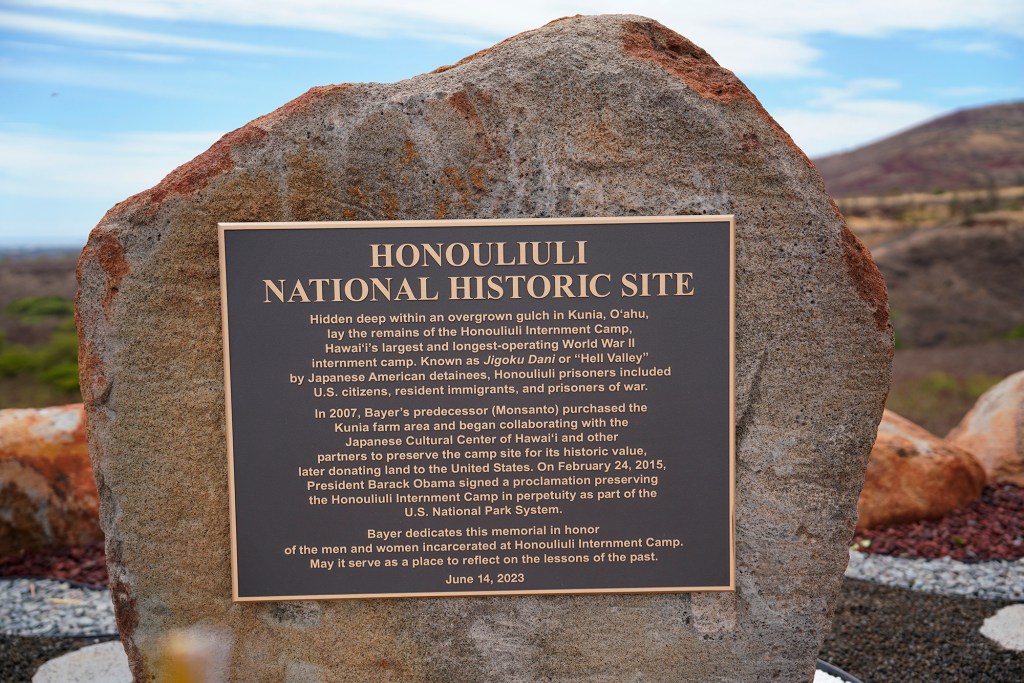
The internment camp was named a national monument 10 years ago and is currently managed from headquarters at the Pearl Harbor National Memorial, which is a fully funded national park. The monument, which became part of the National Park Service through presidential declaration but without sufficient dedicated funding, is still in the planning phase. There is no road network to get there, so there is no regular public access to the internment camp itself, which is located in Kunia, in a narrow valley north of H-1. The camp was shuttered soon after the war and the site fell into ruins.
Honouliuli’s NPS superintendent, Christine Ogura, is working to boost public awareness of the new park and build community involvement in its programs.
This year park officials are commemorating the 10-year anniversary of the national monument’s creation by hosting a series of talks and exhibits that highlight different aspects of the complex and the nuanced story that the internment camp represents.
Many of the NPS’s public events have focused on the experience of the Japanese Americans held there, accused of sabotage or espionage against the United States in the wake of the successful Japanese attack on Pearl Harbor. None of them were ever found guilty of treasonous activity but their lives and incomes were disrupted and their families were ripped apart by the incarceration and hostile public opinion.
In last month’s presentations, however, the focus was on the Korean experience at the internment camp. At least one additional event, a talk by Murabayashi and Mary Kunmi Yu Danico, is planned but has not yet been scheduled.
‘A Complete Shock’
The fact that so many Koreans were present in the camp during World War II has come as a surprise even to the Korean community.
“Until a few months ago, I certainly did not know about Koreans who, during World War II, ended up as prisoners of war right here in Hawaiʻi at Honouliuli Internment Camp,” said David Suh, president of the United Korean Association of Hawaiʻi, at a recent talk hosted by the park.
“It came to me as a complete shock,” said Edward Shultz, former director of the Center for Korean Studies at the University of Hawaiʻi and the immediate past president of the Korean American Foundation.
Few people know about it today because very few people knew about it then, either. Amid wartime security, information about who was residing at the internment camp was limited, and American officials enforced confidentiality.
“The military didn’t publicize that they had POWs here,” Murabayashi said in an interview. “It wasn’t a secret but it wasn’t published.”
But some of the story is now coming to light, surprisingly, from church records.
When the first Koreans migrated to Hawaiʻi as plantation workers from 1903 to 1905, many of them were members of the Methodist Church in Korea, which had successfully evangelized there.
Of the first 102 Koreans who arrived on the first boat, according to Murabayashi, 58 were Christians, and one of their first acts upon their arrival was to hold a prayer meeting and begin thinking about how to build a church. That led to the construction of the historic Christ United Methodist Church on Keʻeaumoku Street in Honolulu, which became a center for Korean activity in the islands.
Some 7,400 Koreans immigrated to Hawaiʻi. Originally hired as laborers at sugar plantations in Waialua and Kahuku, many began to settle and make lives in Hawaiʻi but others planned to stay only temporarily and then return home. So it came as a terrible shock when they found out in 1910 that the Japanese empire had forcibly annexed Korea, with reports of many acts of cruelty.
An eyewitness, a child living on Kauaʻi, later recalled the grief and anger the Koreans felt when they received the “tragic news of the demise of their homeland,” wrote Ch’oe, describing plantation workers who were openly sobbing and who then began gathering up all the Japanese-made objects they owned to toss them into a bonfire.
Korean-Japanese Tensions In Hawaiʻi
Consequently, there were tensions between the Korean Americans and Japanese Americans in Hawaiʻi even before the outbreak of World War II.
As the war progressed and American forces began advancing on Japanese-controlled strongholds, they took a number of Koreans into custody as prisoners of war, bringing them to the internment camp at Honouliuli. According to the National Park Service, hundreds arrived after each battle in the Pacific, including from Guam, Peleliu, Tinian and Palau, sometimes intermingled with Japanese prisoners.
Following the 1944 battle in Saipan, the NPS reported, about 350 Koreans arrived, all noncombatants, many with bullet and slash wounds. The bullet wounds came from the American troops, but the Koreans also appeared to have been victims of sword attacks by Japanese, suggesting they suffered systematic abuse.
Relations between the Koreans and the Japanese Americans at the camp became at times so strained that they had to be kept separate from each other, said Professor Alan Rosenfeld, the associate vice president of academic programs and policy at the University of Hawaiʻi, who has spent years studying Honouliuli.
“There are archival incidents of Koreans and Japanese fighting,” said Mary Kunmi Yu Danico, director of the University of Hawaiʻi’s Center for Oral History, who is leading the project to gather oral histories of the descendants of people who lived or worked at the camp.
The Korean nationals were given transportation home at the end of the war. They had experienced quite an ordeal over the years.
Word began to seep out in Hawaiʻi that Koreans were there, probably because the American military hired some local Korean Americans to serve as translators and guards at the camp.
The first published report that Koreans were living at Honouliuli came in the pages of the Methodist Church bulletin in 1944, according to Murayabashi. Church leaders had apparently been told that many Korean men in their 20s and 30s were being held there, and that they were bored and lonely. The first notice about their existence came when the church asked if anyone had spare musical instruments they would be willing to donate so the men could entertain themselves.
Later, church leaders began organizing an outreach to them, delivering Christmas gifts and arranging to loan them books.
That means there may be people living in Hawaiʻi today who recall those years and those interactions. Murayabashi, Danico and Ogura are asking people to come forward to share those memories.
The Korean nationals were given transportation home at the end of the war, Murayabashi said. They had experienced quite an ordeal over the years.
“One woman in her 80s said she saw her father for the first time when he returned” from the internment camp, she said. The child was about 5 years old. Her father had been gone for nearly half a decade, sent from his home to a land across the sea, one of many millions of people whose lives were damaged by the terrible conflagration that erupted when world powers clashed so ruthlessly.
 Sign up for our FREE morning newsletter and face each day more informed.
Read this next:
Local reporting when you need it most
Support timely, accurate, independent journalism.
Honolulu Civil Beat is a nonprofit organization, and your donation helps us produce local reporting that serves all of Hawaii.
ContributeAbout the Author