Kirstin Downey: City Neglects Sugarcane Plantation's Historic 'Showplace'
Strafed in the 1941 Pearl Harbor attack, the mansion was home to the manager of what was once Hawaiʻi’s biggest sugar plantation.
September 12, 2025 · 9 min read

About the Author
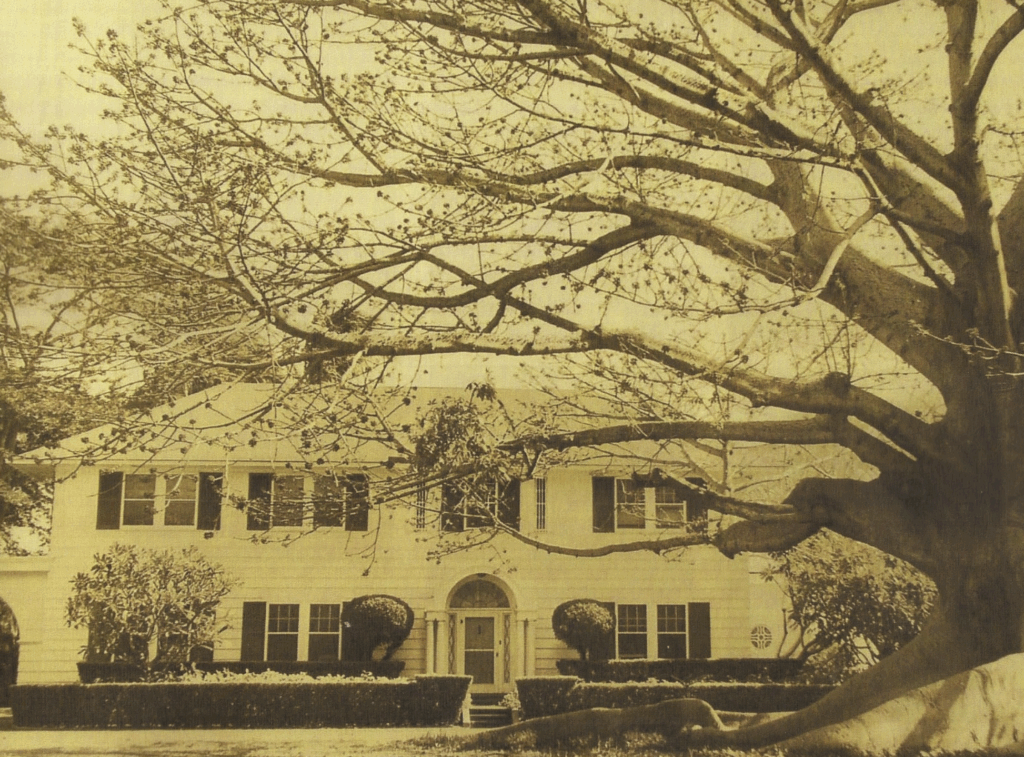
Can something be done to save this once-beautiful historic house before it burns down?
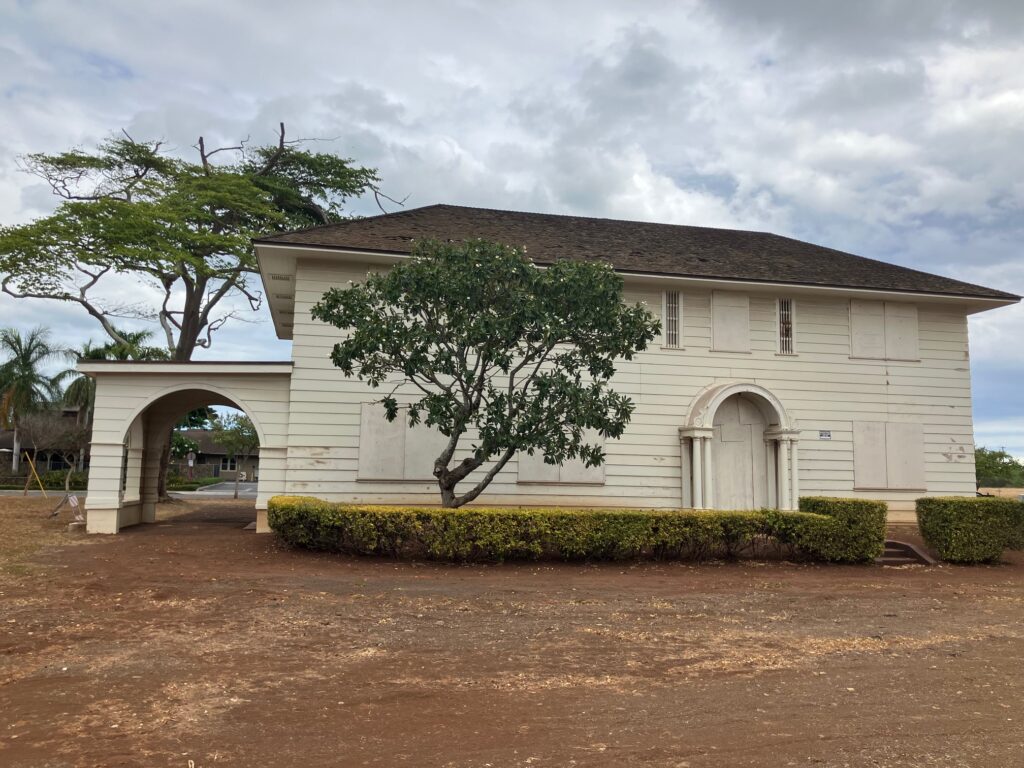
The plantation manager’s home at the heart of historic ʻEwa Villages, a graceful colonial revival home built in 1926, was once ʻEwa Plantation’s community centerpiece, surrounded by well-tended gardens. It served as a gathering place for a multitude of special events.
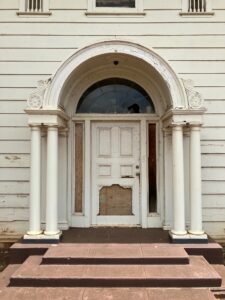
Now owned by the City and County of Honolulu, the building has fallen into disrepair. Its paint is peeling, its broken windows are boarded up to fend off intruders and the yard is a pockmarked desert of dry thatch.
“All it would take is one match and it would all go up in flames,” said Agnes Malate, who serves on the board of the ʻEwa Villages Historical Society, and who grew up in the villages. “All the history would be gone. It’s such neglect. All the history is being lost, being forgotten.”

Ideas showcases stories, opinion and analysis about Hawaiʻi, from the state’s sharpest thinkers, to stretch our collective thinking about a problem or an issue. Email news@civilbeat.org to submit an idea or an essay.
Maui-based Architect Brandis Sarich calls what is happening “demolition by neglect.”
“That’s a term we use for governments or individuals who have a property they don’t want to deal with, so they let it sit empty,” she said, explaining how buildings are allowed to gradually deteriorate, with untended problems mounting year by year. “They aren’t maintained, and then they get an engineer to say it should be condemned so they can tear down the historic property.”
For years, neighbors and the society have pleaded with the city to repair and renovate the house. They’d like to see it converted into a museum or restaurant, or leased to a user who will maintain the historic feel of the house, or really anything at all that will help to preserve it.
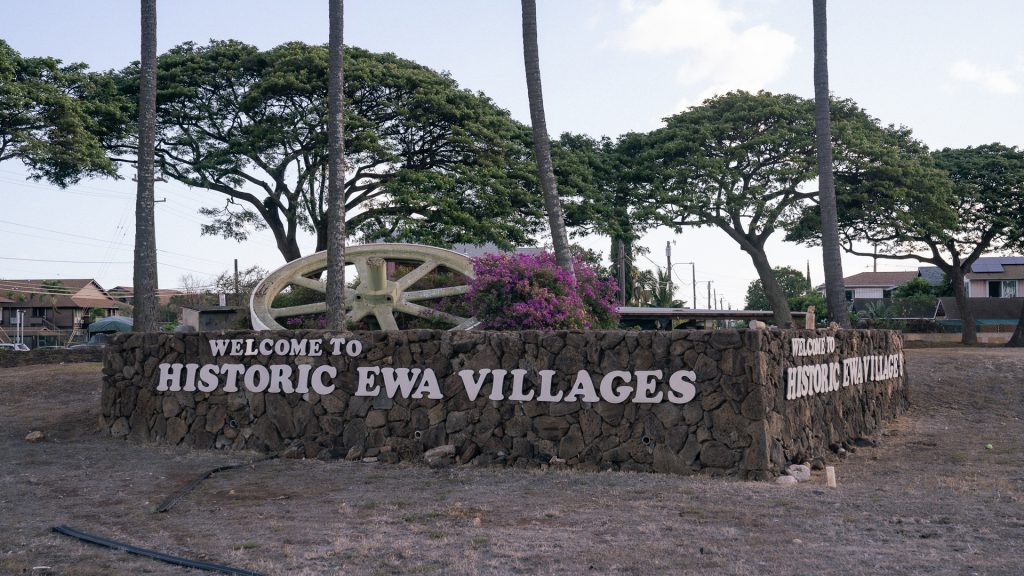
To people who remember and love ʻEwa Villages, a surviving cluster of historic plantation-style buildings on a tree-lined street anchored by its heritage sugar-train railway line, it’s more than just a place. It represents a disappearing way of life. They are trying to recapture its magic before it slips away.
A Sugarcane Community
ʻEwa Plantation, founded in 1890, was once the largest such operation in the state. It eventually encompassed some 11,000 acres of sugarcane fields and 1,200 residences for workers. It was divided into eight ethnic compounds or camps, but people there came together for the shared amenities, including a hospital, recreation center, grocery store and churches.
The plantation fielded popular softball and volleyball teams, and the annual Halloween and Christmas parades drew crowds each year, as did ethnic celebrations where people shared food, helping establish Hawaiʻi’s unique culinary traditions.
The plantation was shut down in 1971, having fallen victim to changing American trade policies and the high cost of operations in the United States compared to low-wage sugar producers in other countries.
The plantation managers didn’t even own the land. It operated on leased land owned by Campbell Estate, and the lease was scheduled to end in 1978. The plantation was a subsidiary of Castle & Cooke’s ʻEwa Sugar Co. and was acquired by Oʻahu Sugar Co., a subsidiary of Amfac Inc., a company created by the American government through the World War I seizure of German assets. The homes, which housed hundreds of families, fell into the hands of Oʻahu Sugar Co., which rented them out to plantation workers and retirees.
ʻEwa Plantation workers and their families were said to be “shattered” when the mill closed, according to newspaper reports at the time. In the 1990s, under Mayor Frank Fasi, the city stepped in, promising to renovate the houses and preserve the historic structures.
Many homes have been since been renovated and sold, and several of the plantation structures have been converted to adaptive reuse.
But as the years go by, the opportunity is passing for the manager’s house. The Historic Hawaiʻi Foundation placed the building on its list of endangered properties back in 2006, almost 20 years ago.
The city has “no active redevelopment plans or dedicated budget” for maintaining the manager’s house, Justin Limasa, public information officer for the Department of Housing and Land Management, said in an email. He said “extensive work” would be needed to bring it up to current design and disability-access building codes, at an estimated cost of $5 million to $6 million.
The building is kept secure from unauthorized access and to minimize potential hazards such as fire, Limasa said.
Takenaka Landscaping has the contract for grounds care.
‘It Was The Showplace’
The community is now a rare bit of historic landscape, a sliver of Hawaiiana that has survived amid the burgeoning sprawl of suburban housing tracts. The complex still displays old-school ideas of land management, with broad lawns and more space between the buildings than we see today. It is a landscape that breathes open air in an increasingly crowded world.
The house, known then as the mansion, featuring a unique arched canopy supported by Doric columns, stood at the center of the plantation complex.
The house was placed on the national register of historic places in 1995 as part of the ʻEwa Sugar Plantation Villages district. The district itself was described in the nomination form as an “oasis of rural charm,” with the surrounding plantation community crowned by a stand of “majestic banyan trees” running along Renton Road.
“When I was a growing up, it was the showplace plantation because it was kept up so well,” said Kaui Lucas, who lived in the house as a child from 1963 to 1969, when her father, Ed Bryan, managed the plantation. She remembers a lawn so lush it was almost a botanic garden, carefully groomed by her mother, Shada.
The couple had married at ʻEwa Community Church, across the street from the plantation house, in 1960.
The house’s “claim to fame,” Lucas said, is the visible bullet holes left in the dining room walls, above the windows, that were shot into the property by Japanese Zeros on Dec. 7, 1941, when the plantation was strafed during the attack on Pearl Harbor. More than 50 civilians at the plantation were injured that day, and one child was killed.
Hawaiʻi’s plantation legacy is mixed, with some remembering the period fondly and others viewing it as reflecting a toxic past. That holds true for ʻEwa Plantation as well.
Malate acknowledges that while part of the plantation’s legacy is the memory of back-breaking work, it was also a place that nurtured a strong sense of community and a wellspring of neighborly good feeling. She said those bonds remain strong even today.
But she and others don’t think the city is doing all it can to preserve that history.
“I’ve been asking since 2014: Who is in charge of this house?” said neighbor Debby Dew as she walked her dog near the plantation house recently.
Historic preservation advocates agree that it appears the city is doing little to maintain the property.
“It’s essentially vacant and they cut the grass,” said Jeff Livingston, historian for the Hawaiian Railway Society, which operates a railroad and museum nearby. “The city is just not interested; they ignore it,” he said.
‘Nobody Wants To Take Responsibility’
The historic railway, which once ran from ʻEwa all the way downtown and still makes a regular trek three days a week out to Electric Beach, is also at financial risk. The railway was once part of the vast operation at ʻEwa Sugar Plantation and served as the economic lifeline for the rural community when there were no cars and no highways. Now traffic congestion and the poor road network in the area are making the railway more difficult to operate.
Community advocates say they have tried hard to get the city’s attention for ʻEwa Villages’ problems but have never gotten the support they need. They call and send emails to city officials but seldom get answers to their questions about the mansion, they said.
“Nobody wants to take responsibility for it,” said Lori Arizumi, who has served on the board of directors of the ʻEwa Villages Historical Society since 2016. She said that engineering studies have found that the building is structurally sound and could be safely renovated, but that the city lacks the will to do it.
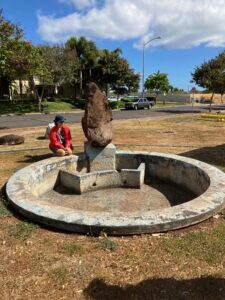
Homes that have suffered similar neglect have sometimes come to harm. The house in Maunawili that inspired Queen Liliʻuokalani to pen the song “Aloha Oe” burned down in 2022 after years of neglect.
City officials said they were not responsible for what happened to that property, once known as the Queen’s Retreat, because it was privately owned.
Limasa indicated the city might be open to future proposals for what could be done with the site.
“Although the city is not in a position to pursue a major renovation now, we remain committed to keeping the site safe and maintained, and to exploring opportunities that honor the historic and cultural significance of the Manager’s House as circumstances allow,” Limasa said.
Proposed legislation before the City Council — Bill 35 — would make it easier to lease properties like this to other interested parties, Limasa said.
Or perhaps someone could buy it, with a pledge to preserve it. The house is assessed at about $3.2 million. Historic preservation tax credits could subsidize some of the renovation costs.
It could become a restaurant, perhaps modeled on the popular plantation-style eatery Leoda’s Kitchen and Pie Shop in Olowalu on Maui, recently a recipient of a national historic preservation grant. Or perhaps it could become an art gallery like the Hui Noʻeau Visual Arts Center in a former Baldwin family home in Makawao.
Clearly the city needs some fresh new ideas and imagination. Ideally it would be someone with a willingness to advance money to make something good happen in a place that deserves it.
This house needs a champion.
 Sign up for our FREE morning newsletter and face each day more informed.
Read this next:

Local reporting when you need it most
Support timely, accurate, independent journalism.
Honolulu Civil Beat is a nonprofit organization, and your donation helps us produce local reporting that serves all of Hawaii.
ContributeAbout the Author