Beth Fukumoto: Let Hawaiʻi Voters Pick Who They Want In A Truly Open Primary
By not forcing voters to choose a single party in August, we can enhance the November general election.
November 9, 2025 · 5 min read


About the Author

Even experienced voters find Hawaiʻi’s primary rules confusing.
We don’t register by party, so we’re defined as “open” in national comparisons. But when you get your ballot with all the candidates, you still have to pick the same party for every race. If you choose a Democrat for Senate and a Green Party candidate for House, your ballot won’t count.
This is one reason it often feels like the real decisions happen before November, and why third parties struggle to gain support.

This year, reformers across the country are calling for more open primaries or all-party first rounds, so it’s a good time to clarify what these terms mean. While Hawaiʻi’s primary is called “open,” other states are talking about a different kind of openness.
Closed party primaries are the most restrictive. Only registered party members take part in that party’s primary unless the party itself decides otherwise.
Supporters argue parties should be free to choose their own candidates. Critics note that independents who help fund elections through taxpayer dollars are shut out of the round that often decides safe-seat winners.
Both points are valid. One solution employed elsewhere is for parties to operate and pay for their own selection processes, using rules established and enforced by their own members. The candidates selected for each party would then go to a publicly funded general election open to all voters. Sixteen states use this system.
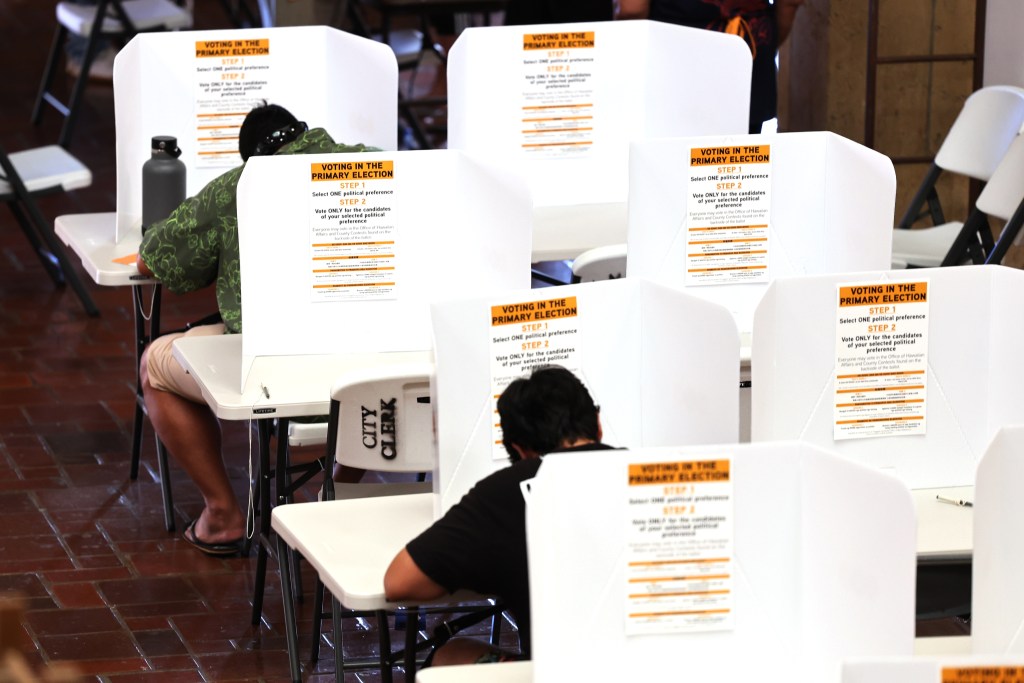
Hawaiʻi’s parties use a system like this to pick presidential nominees, but in our state-funded elections, we use an open party primary system. The keyword here is “party.” Everyone can vote, but you have to choose one party’s primary and stick with it for your whole ballot. This is more flexible than a closed primary, but it still restricts voters to one party’s lane.
A Single Primary Ballot For All Candidates
In states like ours where one party is much stronger, people often pick the primary that matters most, even if they plan to vote differently in November. So, even though the system is called “open,” most of the real competition still happens within one party’s primary. Thirty-one states use some version of the open party primary model.
All-candidate primaries change the field entirely.
Every candidate for an office appears on a single, nonpartisan primary ballot, and every voter gets the same choices. You can vote for a Republican in one race and a Democrat or independent in another without messing up your ballot. The top two, four, or five finishers move on to November, no matter their party.
The main draw is simple: one ballot, one group of voters, and strong reasons for candidates to reach out to more people, especially independents who are included from the start. There are trade-offs: smaller parties might have trouble making the cut, and in states with one dominant party, both finalists could be from that party. In Hawaiʻi, though, this could actually make the general election more competitive and get more people involved in the final round, rather than leaving the main action in August.
As national efforts to implement open all-candidate primaries pick up, we may benefit from starting our own discussion.
California, Washington and Alaska are the only three states using open, all-candidate primaries today. Reform campaigns in Oklahoma, Massachusetts, and Oregon are seeking to put similar systems on the ballot for 2026.
When you put all this together, our situation becomes clearer. We’re often called “open” because we don’t register by party and get a single ballot, but in reality, we have an open party primary. And, as national efforts to implement open all-candidate primaries pick up, we may benefit from starting our own discussion.
While I think the discussion should also include ranked-choice voting, in which voters indicate more than just their top choice in case someone doesn’t win a majority of the votes, it’s important not to confuse the debates.
A System That Reflects Who We Are
These reform discussions are often part of the conversation about ranked-choice voting. You can change one without the other, or you can combine them. They live in the same reform space but do different jobs. A primary system decides who may participate and how candidates advance. A voting method such as ranked-choice decides how ballots are counted once they’re cast.
If ranked choice isn’t in reach right now, we can still open the door to more competition by tackling the primary system itself. My preference is to move Hawaiʻi to an open, all-candidate primary.
It is familiar enough for local voters because our Honolulu City Council races already work similarly when no one receives a majority in the primary. The difference between those council races and this proposal is that an all-candidate primary doesn’t eliminate parties and wouldn’t require a nonpartisan Legislature.
But we do need a primary system that reflects who we are. If the vast majority of a district votes Democratic, it is more representative to have two Democrats with different views and experiences competing for general election voters.
Or maybe the district has a supermajority of progressives who would advance the Democratic and Green Party candidates to the general election.
Regardless of who the top two candidates are, this system would better mirror voters’ opinions.
 Sign up for our FREE morning newsletter and face each day more informed.

Local reporting when you need it most
Support timely, accurate, independent journalism.
Honolulu Civil Beat is a nonprofit organization, and your donation helps us produce local reporting that serves all of Hawaii.
ContributeAbout the Author