Turnout Is Up. People Like It. But Voting By Mail Is Under Attack In Hawaiʻi
The state Elections Commission has asked the Legislature to revert to in-person, same-day voting. But experts say voting by mail is safe and popular.
November 2, 2025 · 13 min read


About the Author

Brodie Lockard may be a wheelchair-bound voter, as he described himself, but he cast ballots by mail for 25 years straight and never missed an election because he was stuck in bed, or it was raining hard, or his adaptive van would not start.
“Hawaiʻi voters have enough hurdles without losing this tool that was so effective during Covid and has continued to let many thousands vote more conveniently,” he told the Hawaiʻi Elections Commission Wednesday via Zoom. “I don’t know why anyone will want to drive for miles and stand in line for hours when they can vote securely from their living room at their convenience.”
Lockard testified in support of voting by mail because, less than a month ago, the Elections Commission asked the Hawaiʻi Legislature to consider returning Hawaiʻi to one-day, in-person voting. Though the system has been in place only since 2020, enough opponents on Oct. 1 persuaded a narrow majority of the nine-member board that voting by mail can’t be trusted.
To Lockard, a board member of Common Cause Hawaiʻi, that notion was absurd. He said voting by mail was under attack by supporters of Donald Trump’s Make American Great Again coalition, which he said has claimed with no evidence that voting by mail is unsafe.
“This is part of their nationwide effort to reduce voter turnout, which includes requiring expensive and excessive personal identification like passports and rolling back the Voting Rights Act in southern states.”

Lockard and dozens of other testifiers sharing his views did not persuade Elections Commission members to change their mind. They even doubled down, voting to deliver a second request to the Legislature asking to not only rescind statewide mail-in voting but to also conduct an audit of the 2024 general election. Some commissioners have argued for months that it was marred by voting discrepancies in two of Hawaiʻi’s four counties.
As of Friday, Senate leadership had not responded to an inquiry on the Elections Commission’s requests. A spokesperson for House Speaker Nadine Nakamura said the request was being reviewed.
But the fact that only two of 76 legislators, both Republicans, voted against the 2019 legislation that enacted voting by mail across all counties in 2020 suggests there may be little appetite to reverse course in a body controlled by Democrats.
What the Wednesday meeting — another marathon session, six and a half hours in length, marked by impassioned testimony and numerous accusations — did reveal for the first time was a growing, coordinated opposition to the Elections Commission’s work. Commission meetings have thus far been dominated by testifiers and commissioners who think Hawaiʻi’s voting system is corrupt.
The push to junk Hawaiʻi’s statewide mail-in voting system also comes as data, studies and experts consistently show voting by mail is both rising in popularity and is safe and secure.
In Hawaiʻi, which has struggled with low turnout numbers, the total turnout of registered voters is actually increasing slightly. And in the November 2024 general election, just 4.5% of voters chose to vote in person.
Instead of junking voting by mail, there are ways to improve the system, experts say, such as conducting voter education campaigns to raise awareness of how it works and providing greater support to help voters deliver and process their ballots.
That said, opposition to the 2020 law is not ebbing, and it is often political in nature. The screen names of the more than 200 people who tuned into Wednesday’s online meeting included “MAGA Mom” and “Charlie Kirk,” and at least one testifier proudly and publicly admitted his support for the MAGA movement.
Jamie Detwiler, an unsuccessful Republican candidate for the state House who has also served as an election observer and filed complaints with the Office of Elections, said absentee voting should remain an option for those who depend on it such as military personnel. But she says there are too many problems with the current system.
“Let’s return to what works,” Detwiler testified, “and what works is in-person voting.”
An Evolving Yet Secure System
Voting by mail is a form of voting absentee, which dates to the War of 1812 to allow citizens to vote when they cannot physically do so in person. The practice gained urgency during the Civil War, when a majority of Union and Confederate states developed provisions for soldiers to vote. States began passing absentee ballot laws for civilians in the late-1800s to accommodate voters who were away from home or seriously ill on election day.
While Americans have traditionally voted in neighborhood polling places, beginning in the 1980s many states eased rules on issuing absentee ballots by allowing voters to cast ballots in person before election day or to begin mailing ballots to voters, according to a report from the U.S. Congress.
California became the first state to allow eligible voters to request an absentee ballot for any reason, including convenience. Today, 28 states allow all voters to use mail ballots and every state allows at least some voters to do so. Hawaiʻi is one of nine states and the District of Columbia that send mail ballots to every eligible voter each election.

There are multiple safeguards in place.
“Every state has a well-tested and multilayered system of checks to ensure the security of mail voting, though practices vary,” according to a study by the independent, nonpartisan Brennan Center for Justice.
That system includes having officials contact voters when a signature on their ballot is missing or is inconsistent, something Hawaiʻi requires. Like nearly all states, Hawaiʻi offers ballot tracking for election officials and voters. Penalties for attempting to evade security measures could include up to five years in prison and fines of $10,000.
“Mail voting malfeasance is exceptionally rare,” the Brennan Center said in the 2024 study. “If it does occur, these security checks enable election officials to prevent ineligible ballots from being counted and enable law enforcement to hold bad actors accountable.”
The study also found that the increased use of voting by mail has led to false allegations that the practice is vulnerable to widespread fraud and tampering. “Rumors circulated online include allegations that bad actors can submit fraudulent ballots in the names of other voters without being caught,” the study found.
The National Conference of State Legislatures, in a 2023 report, said that the 2020 presidential election was a watershed year for elections and conspiracy theories similar to the contested Bush v. Gore race of 2000. That was due in no small part to the Covid-19 pandemic and the negative reaction to it that began in March of that year, but it was also fueled by the behavior of one of the candidates.
“For the first time, a major party presidential candidate, former President Donald Trump, personally weighed in on the method voters used to cast their ballots, expressing distrust of absentee/mail voting,” NCSL reported, noting that Trump never conceded defeat.
The nonpartisan, nonprofit factcheck.org, in a report this past April, tied current objections to mail-in ballots to electronic voting machines and Trump’s second term “assault” involving “firing off a series of unfounded claims while announcing an effort to do away with both.”
“He continued to baselessly claim ‘MASSIVE VOTER FRAUD’ associated with mail-in voting,” the report states. “Experts say that while fraud is slightly more prevalent with mail-in voting than in-person voting, it is still relatively rare, and there is no evidence to support claims of widespread fraud.”
As for whether absentee or voting by mail favors one party over the other, NCSL said the answer is “mostly no” and pointed to a 2020 study by Stanford University.
Regarding turnout, the Washington State Standard reported in 2023 that most changes to voting laws “do little to affect overall turnout, much less election results.”
“But one fast-growing reform appears to stand out as an exception,” the report concluded. “When every registered voter gets sent a ballot in the mail — a system known as universal vote-by-mail — voting rates tend to rise, numerous studies have found.”
A University of Chicago study last year called the impact of vote-by-mail on turnout “modest” — a 2 to 4 percentage point increase.
It is states that set voting policy, and not the federal government. Since 2020, some states have sought to restrict voting by mail. Ohio shortened the time to apply for mail ballots and imposed new signature requirements and Arizona removes people from its list to receive a mail ballot if they go for more than two years without voting, according to the Standard.

But a large majority of Americans (58%) support the right to vote by mail, according to a Pew Research Center report in August, though support remains much lower among Republicans than Democrats. And roughly 30% of voters voted by mail last year.
“And as for Trump’s claims of fraud? Even the Heritage Foundation can’t find any,” according to the nonprofit, nonpartisan National Vote At Home Institute in a September report. “It’s ‘database’ of election fraud lists just 138 total cases nationwide, virtually none of them involving mail-in ballots.”
Barbara Smith Warner, the executive director of the institute, says that the persistent complaint from conservatives that voting by mail is ripe for fraud “is the big lie. And people can keep saying it as many times as they want, but it doesn’t actually make it true.”
The main reason for opposing voting by mail, she said, is to limit the number of people who vote “because they think that they can kind of control what happens better when fewer people vote.”
Warner said voting should not be a privilege left only to people who can take time off, or have transportation to a polling site, or have somebody to watch their kids.
“Voting is a right, not a privilege, and if it is a right you should make it as easy as possible,” she said.
The National Vote At Home Institute is based in Oregon, the first state to allow federal all-mail elections (in 1996) and the first state (approved in 1998 though ballot initiative) to require every registered voter be automatically mailed a ballot every election.
What Hawaiʻi’s 2020 Law Called For
Expanding voting by mail from a planned pilot project in Kauaʻi County to implementation of a statewide system was based on recognition that the 2014 primary was the first election in which more ballots (56%) were submitted before election day than on election day itself. Of those, 83% were mail-in absentee ballots.
Two years later, the number of votes cast before election day exceeded the number of votes cast at polling places on election day except in one county.
Legislators asserted at the time that expanding the program would “significantly reduce the logistical issues” that come with conducting elections at polling places. The resulting savings in state funds could then be deposited into the chronically underfunded Hawaiʻi Election Campaign Fund to support public financing of elections.
Chief Election Officer Scott Nago says that the state typically had to hire over 5,000 workers to be at dozens of polling precincts, usually at public schools, for a stipend of $85 each — something he described as a logistical nightmare that consumed the two years’ time between elections.
The counties, meantime, paid for absentee voting and voter registration. But after voting by mail was implemented, the state and counties entered into a 50-50 cost sharing of election expenses. Nago said cost savings did not materialize, however, and the state Campaign Spending Commission has unsuccessfully sought to increase legislative support for the Hawaiʻi Election Campaign Fund.
A November 2024 report from the Hawaiʻi Office of Elections to the Legislature on implementing elections by mail, something required by the 2020 law, said that the total cost for the 2018 elections was $6.4 million, $8.4 million for 2020 and $7.9 million for 2022.
“As a note, the cost of facilities fluctuated with Covid-19 as we needed to lease the Hawaii State Convention Center in 2020 to serve as a counting center for social distancing reasons,” the report explained. “Additionally, the cost of the voting system contract went up in 2022 as the voting system was upgraded and mailing house services were incorporated into the contract. Further, beginning in 2022, we included travel and voter education categories into the table as those categories were not directly accounted for in prior tables.”
The cost of the 2024 election will be determined by the state and counties by the end of this year. But the Elections Office expects the cost to be similar to that of the 2022 election “except for the new expense of the digital voter information guide.”
The 2020 law also called for a limited number of voter service centers that would remain open from the 10th business day preceding an election through election day to receive personal delivery of mail-in ballots, accommodate voters with special needs and offer same-day registration and voting. The law also allowed for “additional places of deposit” for delivery of mail-in ballots, namely, drop boxes.
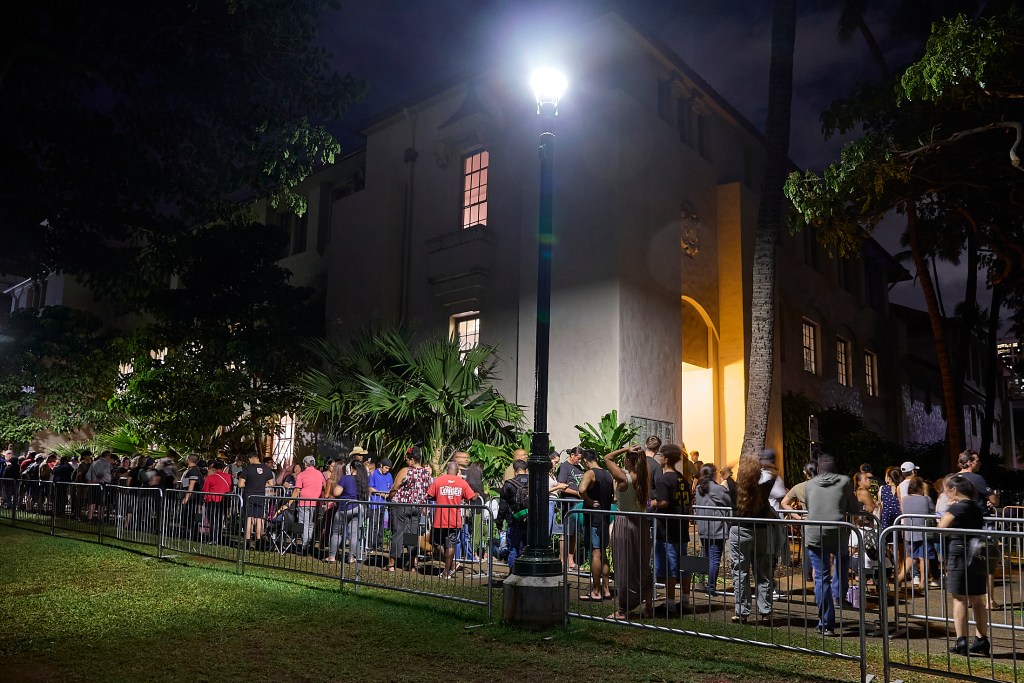
What few foresaw was that many voters, especially on Oʻahu and Maui, would choose to vote in person on election day, most notably on Nov. 5, 2024, which led to very long lines. That delayed the releasing of election results until well after midnight.
Still, Judith Mills Wong of the League of Women Voters of Hawaiʻi feels voting by mail “is working very well.” She said the league participated in a hand count of one district’s election last year to certify that the machine count was accurate. She said the result was “absolutely accurate.”
The league has, however, pushed for more voter service centers, including on the Big Island, where there are many voters living in rural areas. Keeping polling places open longer might also be an idea to consider, she said.
“And we do need to do more voter education, more encouraging people to vote,” she said. “All of that needs to be done to increase the participation. But I don’t think that has anything to do with the mail-in ballots diminishing the participation.”
Karl Rhoads chairs the Senate Judiciary Committee, one of the key committees any change to voting laws would have to go before. He does not appear open to hearing legislation that would eliminate vote by mail.
“MAGA guys are under this delusion that all of the vote-by-mail elections are illegitimate, and there isn’t any evidence to support that,” he said. “So this whole notion that somehow vote-by-mail is harming the Republican Party is just nonsense. They’re doing better than they did when we were voting at the polling places, when half of us were still voting at schools.”
 Sign up for our FREE morning newsletter and face each day more informed.

Local reporting when you need it most
Support timely, accurate, independent journalism.
Honolulu Civil Beat is a nonprofit organization, and your donation helps us produce local reporting that serves all of Hawaii.
ContributeAbout the Author