Eric Stinton: Be Tough On Public Education, But Also Be Thankful For It
When people care enough to criticize you thoughtfully, be grateful they don’t just dismiss you outright.
December 1, 2025 · 6 min read


About the Author

A while ago I was at an event for teachers and other education professionals. High school juniors and seniors were there, guiding discussions and providing input.
It was Saturday night, so you can probably guess the type of students who opted to spend their evening talking about school with a bunch of teachers: thoughtful, interested, involved. Kids who genuinely enjoy learning and being at school.
So it struck me when one student said she always wanted to be a teacher, but the older she got the more she thought better of it. Not that she didn’t want to be a teacher anymore, but that she shouldn’t — that it was unwise. To her, the profession is plagued by low pay, high pressure and the political whims of the moment.

Ideas showcases stories, opinion and analysis about Hawaiʻi, from the state’s sharpest thinkers, to stretch our collective thinking about a problem or an issue. Email news@civilbeat.org to submit an idea or an essay.
Her diagnosis of the profession is unfortunately accurate in my view, but hearing a young person vocalize those points gave me an amorphous yet crushing sense of guilt.
The pay, pressure and politics of teaching are all topics I’ve written about extensively in this column over the years. I have depicted teaching as exactly the things she doesn’t want to have to deal with. Am I responsible in some way for shooing away potential talent from what I consider one of the most important roles in society?
To be sure, I don’t think she was familiar with me or my work; this is less about me specifically than a general commentary ecosystem that I’ve contributed to. Even though I have little real influence, I couldn’t shake the feeling that perhaps someone out there who was on the fence about becoming a teacher may have been dissuaded after reading something I wrote.
The Views From Within And Without
It’s been a few years since I’ve written about or worked in the public school system. When I was teaching in the DOE, I felt justified being critical of it. I was immediately affected by its systems and decisions, and there was a genuine value in being able to publicly criticize it while being a part of it.
At times the teachers I worked with went out of their way to stop by my classroom and tell me how much they appreciated me using this platform to voice the kinds of issues that are usually vented over pau hana beers.
Other times, the speed and silence with which they walked past me said everything they needed to say, the kind of frustration that is more commonly and clearly communicated online: not only was I wrong, I was so wrong that I betrayed the very principle of public education by criticizing it.
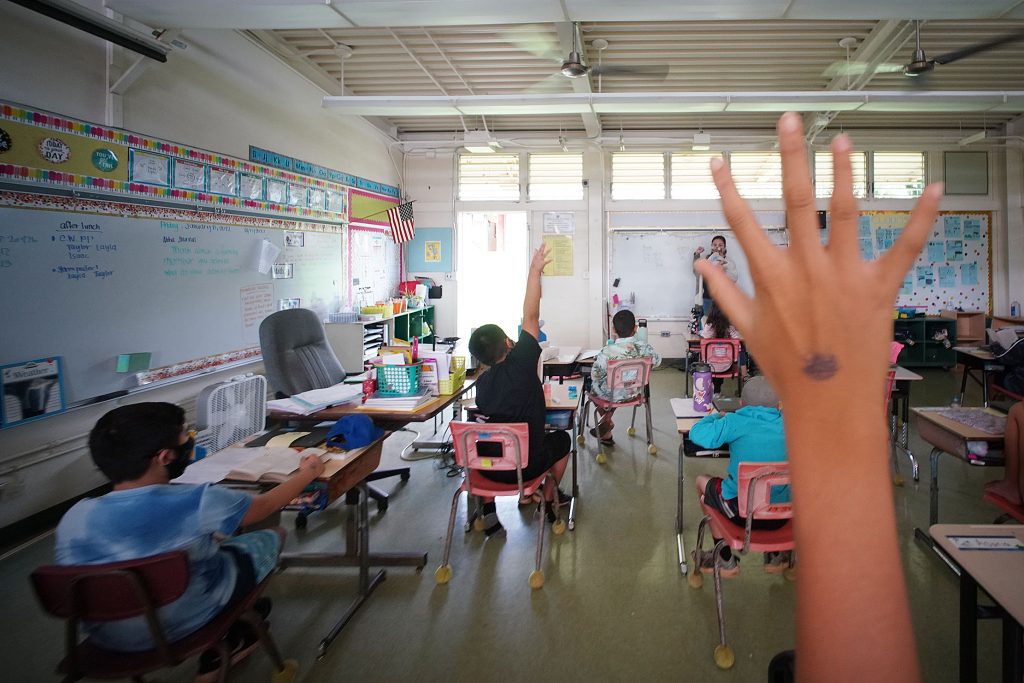
Now that I teach in a private school, I’m less inclined to criticize the DOE. If anything, I feel like I’m part of the problem by leaving the public school system instead of continuing to try to improve it from within.
Can you be thankful and critical at the same time? To be thankful for something means you want it to be there, but to be critical of it means you want it to be different. Can you really want something while at the same time not wanting it to be how it actually is?
I’ve seen similar thoughts emerge around the lawsuit against Kamehameha Schools. People who have been critical of how Kamehameha Schools reaches out to poorer Hawaiian communities — or doesn’t —were immediately ardent defenders of the institution. This is not a contradiction; they maintain their criticism, but recognize the solution is to fix what’s broken, not fundamentally reconstitute the whole thing.
This is also reflected in the broader culture wars of this country: the “let’s be honest about our country so we can make it better” crowd vs. the “if you don’t like it, leave” crowd. We saw this play out recently with the No Kings protests, which House Speaker Mike Johnson referred to as “hate America rallies.” Some see exercising the rights enshrined in the American Constitution as a way to say they love this country but want it to be better; others see it as a form of anti-American hate.
These are not equally valid interpretations.
Criticism As A Love Letter
Although it’s never a comfortable experience to get criticized, I’ve learned over the years to be grateful for thoughtful criticism of my work. I reserve the right to be wrong and change my mind, and I’ve long said my goal as a columnist is conversation, not consensus.
But more than that, I try to see critique as a way of saying that my ideas are worth taking seriously. Passionate disagreement shows care and attention; the real insult is dismissal.
This also applies to how I feel about the DOE. Anyone who has worked in it has reasonable criticisms of it, and it’s important to address them. My criticism of the DOE over the years is a kind of love letter, a belief in the potential of public education to be better than it is, even as it’s already better than we tend to think it is.
There’s value in taking a few minutes to stop and consider what makes your life better, more meaningful.
It’s no different than a teacher being tough on a student whose habits are causing them to perform beneath what they’re capable of. If you didn’t care, you wouldn’t bother.
At the end of every class, I ask my students for appreciations. They don’t have to be related to class or school at all, just anything they appreciate in their life. There’s value in taking a few minutes to stop and consider what makes your life better, more meaningful. I’ll do the same to end this column.
I appreciate being able to speak out with my full chest against the dysfunction in our politics and culture.
I appreciate Kamehameha Schools for helping to perpetuate a culture that has given me more than I can possibly reciprocate.
I appreciate all the teachers, school staff and volunteers who provide the best possible care and education for our collective communities.
And I appreciate the readers and commenters who use their ever-diminishing time in this life to engage with my work, even when — especially when — they are critical of it.
 Sign up for our FREE morning newsletter and face each day more informed.
Read this next:

Local reporting when you need it most
Support timely, accurate, independent journalism.
Honolulu Civil Beat is a nonprofit organization, and your donation helps us produce local reporting that serves all of Hawaii.
ContributeAbout the Author