Is Hawaiʻi Doing Enough To Rein In Artificial Intelligence?
States are leading the way to regulate AI, but a national report finds the Aloha State comes up short.
December 21, 2025 · 11 min read


About the Author

The Texas Legislature created policies for transparent artificial intelligence use by state agencies. Georgia ordered a Senate study of AI and digital currency. And California set up risk management and whistleblower protections for developers of advanced AI models.
These are recent examples of state-level AI activity cited in a nonpartisan report published by the Council of State Governments. “Great Expectations: How U.S. States are Engaging with the Fast-Moving AI Sector” analyzed all 50 states’ responses to the rapid rise of AI.
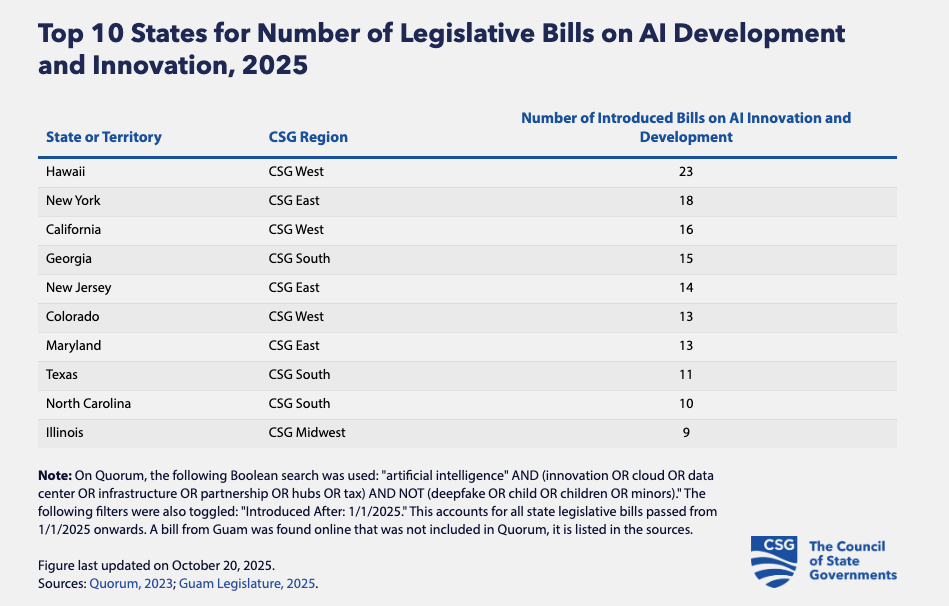
California, Texas and New York (which in October prohibited rental algorithms that utilize competitor data) are excelling but so are smaller, less tech-focused states. Hawaiʻi is barely mentioned. The only area where it led in 2025 was in introducing the most bills about AI innovation and development.
And that’s not much to hang our hat on because all the Hawaiʻi bills that the council tracked died, including ones to set up a statewide data and artificial intelligence governance center.

The focus on state governments gained fresh urgency when President Donald Trump issued an executive order Dec. 11 imposing a national AI standard, possibly limiting the efforts of states to enact their own laws. Already, California is threatening legal action “and other states and groups are likely to sue as well,” the news organization Stateline reported.
Since the emergence of ChatGPT in 2022, states have proposed thousands of laws aimed at regulating and guiding AI’s use in areas such as data sharing, cybersecurity, privacy, employment, criminal and civil law, health care, higher education, consumer protection, housing and manufacturing.
“In 2025 alone, states and U.S. territories proposed 252 AI-related measures, supporting its status as a top legislative priority,” according to the Council of State Governments report released Nov. 20.
With Congress “apparently unwilling or unable to enact legislation regarding AI,” the report continues, “the states, as laboratories of democracy, are leading the way on this issue.”
Will Hawaiʻi be part of that?

“Right now, Hawaiʻi does not have a cohesive strategy for how we approach artificial intelligence, and that’s something we need to be honest about,” said state Rep. Andrew Takuya Garrett. “AI is already being used across government, education and the private sector, but our policy response has been fragmented.”
Garrett said that’s a big reason he introduced two AI bills last session, including one that would have established a Hawaiʻi Artificial Intelligence Advisory Council to advise the governor and Legislature. He said the state needs to move toward “a more intentional framework instead of reacting bill by bill.”
“The fact that many AI-related bills did not pass reflects that lack of coordination, not a lack of urgency,” he said in a recent email.
Telling Consumers When They’re Dealing With AI
The Council of State Governments has reported on AI before. What’s new this year is a comparison of states’ AI involvement. That’s where Hawaiʻi was pegged ahead of all states in terms of the number of bills introduced in 2025.
California and New York and Texas have the most Forbes Top 50 AI firms headquartered there and the most venture capital investments in startups, as well as the most data centers and the highest percentages of jobs requiring AI skills.
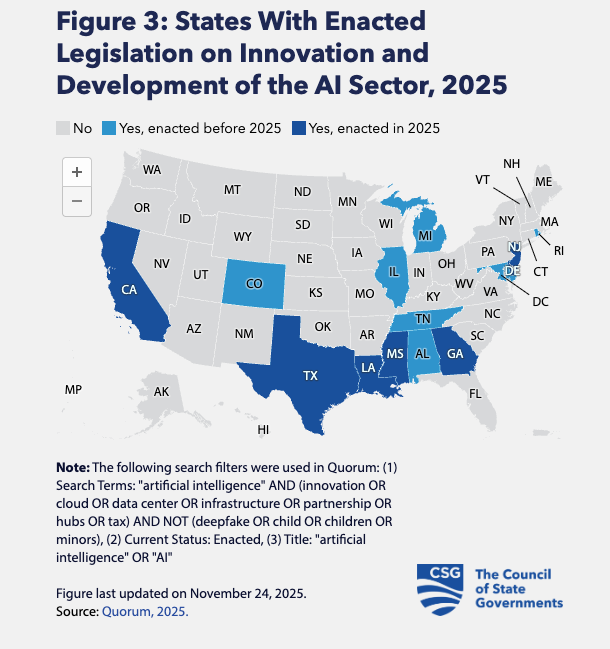
Hawaiʻi may never be able to compete in those categories, but other states have nonetheless been able to generate laws governing AI. Here’s a few examples in 2025, according to the council:
- North Carolina created the North Carolina AI Leadership Council to advise state agencies on AI strategy;
- Wisconsin prohibited the distribution of AI representation of an individual with the intent to coerce;
- Illinois required clear disclosure to consumers when they interact with AI systems in commercial transactions to prevent deception; and
- Colorado, which in 2024 enacted an AI and algorithmic discrimination law, tweaked it to retain transparency aspects but eliminate risk assessments.
The Council of State Governments advised states to foster public-private partnerships to examine how AI solutions might be utilized in government operations such as chatbots, stress the public’s right to know when and how AI is used in consequential decisions, establish clear guidelines for ethical use of AI, enforce rules that discourage harmful practices, and mandate audits and third-party testing to identify biases or malfunctions.
One other piece of advice from the council: “Consensus emerged that AI should augment, not replace human judgment.”
What Hawaiʻi Didn’t Do
The council estimated there were 23 AI-related bills in Hawaiʻi last session. But, unlike several other states, Hawaiʻi’s bills did not pass and were instead carried over to the new session that beings Jan. 21.
The failed bills included measures to set up a statewide data and artificial intelligence governance center, require notifying consumers when chatbots and not humans are interacting with them, ask the Legislative Reference Bureau to procure software and analytic services to streamline state laws and regulations, and prohibit users of algorithmic decision-making from determining eligibility in a discriminatory fashion.
Also dying were bills calling for an Aloha Intelligence Institute within the University of Hawaiʻi to advance artificial intelligence initiatives statewide. But Garrett said the institute ended up being funded through $2 million in the state budget for workforce development in order to stem outmigration of young adults. That was the work of Donovan Dela Cruz, chair of the Senate Ways and Means Committee.
One bill relating to AI that did pass the 2025 session, although it wasn’t mentioned in the council report, creates a data sharing and governance working group within the state’s Office of Enterprise Technology Services. A primary focus is to share data to help young adults find educational and work opportunities in Hawaiʻi in order to stem outmigration.
The bill barely mentions artificial intelligence, however, and primarily looks to allow greater access to data currently siloed in about a half-dozen state agencies. The legislation (which also came from Dela Cruz, who has long championed workforce development) says that the Hawaiʻi Data eXchange Partnership has not been doing enough to facilitate the school-to-work pipeline.
A report from the working group is not due to the Legislature until just before its 2027 session.
No bills addressing AI were enacted in 2023 but two became law in 2024. One set up a two-year program at the UH to develop a wildfire forecast system using AI, while the other prohibits a person from “recklessly” distributing “materially deceptive media” known as deepfakes in state elections.
(The deepfakes law is being challenged by the right-wing satirical The Babylon Bee and a local conservative activist, Dawn O’Brien.)

State Sen. Karl Rhoads authored the deepfakes bill in 2024 as well as a 2021 law that makes it a violation of privacy to post or threaten to post AI-generated images or videos on social media. The latter bill was primarily aimed at sexual exploitation such as revenge porn.
He also authored the failed 2025 bill to ban the use of algorithms in decision-making that might discriminate on the basis of race, sex and gender against humans. Rhoads said he thought such a law might be useful in administering government programs in areas like housing and education.
“Part of the problem with AI is that it’s so complicated that it’s hard to know whether you’re even asking the right questions,” he said. “It’s not just complicated technically, it’s complicated about how you deal with it. And I think that’s one reason there hasn’t been a ton of movement. It’s just hard to get your head around.”
Rhoads was uncertain if Trump’s executive order would spur his colleagues to do more on AI next session. He said he has not seen much demand from the public about AI legislation.
Rep. Trish La Chica said she was lobbied to oppose the deepfakes bill by Meta, which owns Facebook and Instagram. La Chica authored a House version of the Senate bill that eventually became law.
On her bill this year requiring consumers to be notified when chatbots are being used, she said she was lobbied again by Meta but also Google and Amazon.
“They argued that my bill went too far,” she said. “It should be narrowed, like, ‘Just focus on the apps that provide some type of high risk, like healthcare services, like mental-health care.'”
But La Chica told the Big Tech reps that wasn’t the point of her bill. As a mother of two, she wants children to know that AI-generated programs like Alexa from Apple and Siri from Amazon are not human, and for parents to be assured their kids are not being targeted or manipulated.
La Chica plans to bring the chatbot bill up again next session along with an algorithmic decision-making measure similar to Rhoads’ bill to prevent discrimination in the healthcare industry.
“AI is moving fast, and government is playing catch-up,” she said. “But I feel that we are at a turning point. So whether it’s a kid interacting or chatting with a tech bot, or somebody being denied care by a computer, at the end of the day, how are we responding to putting people first?”
AI Use In County Governments, UH
The sluggishness to move at the state level comes as AI is already established in some county governments.
In the City and County of Honolulu, for example, there is automatic paying of electric bills and the use of chatbots to answer customer questions in some departments. The Department of Planning and Permitting last week unveiled a program called CivCheck that uses an AI software tool to enhance the permitting process. And the Honolulu Police Department is looking to use AI to transcribe audio from body cameras.
But even as departments seek to streamline services and make them more efficient, the Honolulu Charter Commission is considering asking voters next November to consider amending the charter to limit the use of AI to ensure transparency.
At the state level, there has been a rise in complaints against attorneys alleged to have used AI to produce fictional court documents. Last week, the Hawaiʻi Supreme Court said it is considering adopting stronger safeguards to ward off AI abuse in state court filings.
“A one-size-fits-all federal approach risks missing local needs, and Hawaiʻi shouldn’t wait on Washington to decide how AI is used here.”
State Rep. Andrew Garrett
Garrett, who chairs the House Higher Education Committee, also credited UH President Wendy Hensel for making AI “a top priority.”
In August, Hensel presented a plan she said would advance initiatives at the system level and across the 10 UH campuses. And in November UH launched an AI Curriculum and Pedagogy Task Force to craft recommendations and outline a practical integration plan to a recently formed AI Planning Group.
“Most experts believe the scale of change we are seeing today will be more impactful than the industrial revolution,” Hensel told UH regents in August. “The university should be a leader in moving Hawaiʻi through this moment.”
Garrett said he expects renewed efforts focused on AI governance, transparency and responsible use next session, particularly within state government, along with continued work on building long-term capacity through UH.
“Even as there’s discussion at the federal level about centralized AI regulation, states still have an important role to play,” Garrett said. “A one-size-fits-all federal approach risks missing local needs, and Hawaiʻi shouldn’t wait on Washington to decide how AI is used here.”
Hawaii Legislators
Explore detailed legislator profiles, voting records and what happens in hearings on Digital Democracy. Visit Digital Democracy
Congress is also likely to remain involved, even though it ultimately decided not to place a 10-year moratorium on state AI action this summer. Drafts of Trump’s One Big Beautiful Bill Act that became law in July included the moratorium. While that was removed from the final language, it “sparked debates” over the ability of states to regulate and legislate AI, the Council of State Government concluded last month.
In a statement issued after Trump’s order, U.S. Sen. Brian Schatz of Hawaiʻi said Congress “has a responsibility to get this technology right — and quickly — but states must be allowed to act in the public interest in the meantime.”
Schatz said he would working with colleagues to introduce a full repeal of the order.
“Preventing states from enacting common-sense regulation that protects people from the very real harms of AI is absurd and dangerous,” he said in his Dec. 11 statement, which also recognized that AI offers “amazing possibilities.”
 Sign up for our FREE morning newsletter and face each day more informed.

Local reporting when you need it most
Support timely, accurate, independent journalism.
Honolulu Civil Beat is a nonprofit organization, and your donation helps us produce local reporting that serves all of Hawaii.
ContributeAbout the Author